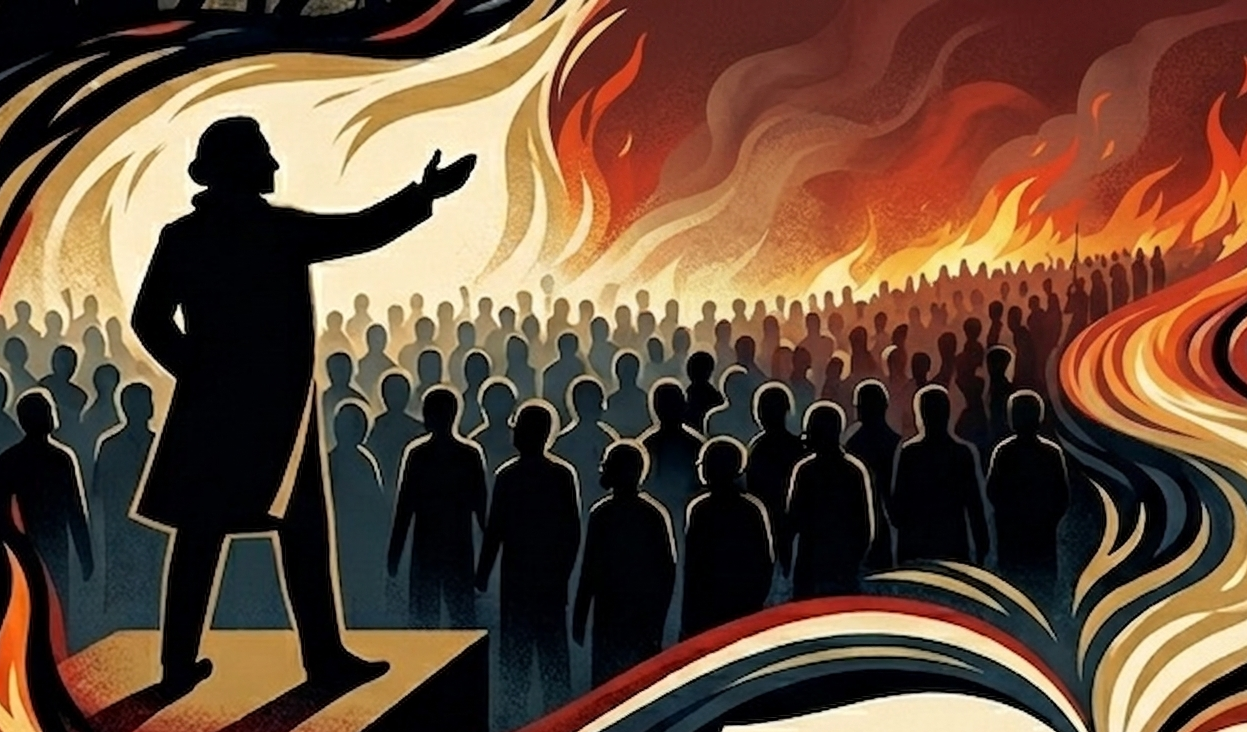











Over the course of history, some frequently used concepts held a special weight in political science and are used with a strong conviction without questioning their origin and conceptual coverage. These concepts constitute the fundamental elements for describing, analyzing, and interpreting political systems. It also needs to be underlined that these concepts could be controversial, evolving, and may serve as effective means in populist political struggles. It is also observed that some political concepts are twisted and manipulated by politicians to govern the masses, especially in countries where democratic culture is not well-developed.
In today’s political discourse, the theory of "general will" developed by Rousseau is used as "national will" with the purpose of using it as a political instrument for legitimizing power and maintaining authoritarian regimes, especially in countries where a pluralistic democratic culture is weak. In other words, it may not be wrong to underline that the general will is interpreted for the justification of totalitarian democracy, where the state has the power to keep the society under strict control.
The theory known as the "social contract," developed by leading thinkers of the Enlightenment, was essentially developed with the aim of transforming the source of legitimate political power from “divine/godly will” to the society’s ordinary people. Discussions on Rousseau's general will have been continuing at political forums, and a twisted form of it has been called “national will”.
According to the theory, all political power and authority are transferred from God to an abstract sovereign power, claimed to represent "the entire population," called the "general will". This assertion attributes to the general will an absolute political power justified by claiming it represents "the entire population."
The concept of the general will is based on the assumption that different social groups existing in a society will have a "common good/will." In other words, it is supposed that all different ethnic and religious groups, social classes conflicting with each other with different economic interests, different gender groups, and civil society groups all have a common good and will.
Rousseau described the concept of the general will as indivisible, infallible, essential, and inalienable; it is adopted as a concept encompassing and representing all differences and conflicting interests, especially in underdeveloped societies where a democratic culture has not developed, even if it does not reflect the majority of the electorate. In other words, the concept of the general will is understood as the supreme will of the entire nation/society, assuming it is above all the individual interests and wills of citizens. Also, this concept is glorified and used as a political discourse that legitimizes populist, authoritarian, and antidemocratic practices by those who use this concept in the name of the political majority, especially in the absence of constitutional oversight mechanisms. On the other hand, by upholding the "unity of powers" rather than a "separation of powers," Rousseau's theory of "general will" leads to legitimizing authoritarian regimes. In this respect, the unity of powers defends an understanding of absolute sovereignty and provides a philosophical base for authoritarian regimes.
Since Rousseau’s “general will” is accepted as "always right and infallible” and represents the common good of a society, it implies a monistic view where any conflicting opinion with the general will is considered wrong. This argument allows the majority leader, or any leader claiming to represent the genuine interest of the people, to reject all opposing views, as Rousseau argues that the general will represents the good of all society and individuals. Rousseau also says that individuals must alienate all their rights to the community in a total surrender in order to ensure equality, and claimed that obedience to this general will won’t be harmful to the individual’s freedom.
General Will & Jacobins
The theory of the "general will," under the influence of Maximilien Robespierre, was recognized and adopted by the Jacobins, who carried out the French Revolution; this concept was used to justify all policies applied to transforming the society into a nation-state based on a unitary system under the French entity. Briefly, the theory of the general will was used as an effective political instrument, interpreted by the Jacobins as "national will," and constituted the intellectual and conceptual basis of all policies and legislation. Thus, it is observed that this concept was used by the Jacobins in radical changes aimed at liquidating the old regime institutions, the monarchy, and the church, and eliminating their influence on society.
The Jacobins, who seized power in France after the revolution, imposed their goals on society regardless of the social cost, and justified using any means, including violence, to achieve their aims. The Jacobins, having secured a majority in the Constituent Assembly, asserted that popular sovereignty was represented by the assembly, and it meant the Assembly represented the “general will” that everyone must obey. This way of thinking leads to the justification and legitimizing of “majority despotism.” They declared supporters of the old regime and those opposed to the revolution as enemies of the people and applied terror under the guise of "the despotism of freedom." Furthermore, to justify their violent policies, they employed the rhetoric of "internal enemies," repeatedly claiming that "they were more dangerous than external enemies," thereby continuing their search for legitimacy and sending approximately 40,000 people to the guillotine. The Jacobins used accusations such as "corrupt person" and "enemy of the people" against all their political rivals, portraying the elimination of these "immoral people" by the guillotine as an unavoidable necessity for the protection of the common good.
As briefly outlined, a close relationship between Rousseau’s general will and direct democracy has been endorsed, and the general will constituted the philosophical basis that legitimized authoritarian regimes.
On the other hand, the Jacobins, interpreting Rousseau's views—which rejected the separation of powers and granted absolute and unlimited authority to sovereignty—in a way that suited their own purposes, implemented a system in which the powers of the three branches of government were united in the assembly. Taking this understanding even further, the Jacobins argued that the decisions made by the majority in the Assembly represent the concrete expression of the will of the people. So, they claimed the legitimacy to govern the citizens under the absolute power of the Jacobins.
Conclusion
The theory put forward by Rousseau, through its implementation within the representative system, ultimately leads to the conclusion that the political group(s) in power is always right and that everything it does is correct, legitimizing authoritarian rule and disregarding the rights and interests of other political groups.
Therefore, while attributing great power to the will of the majority, individual freedoms are ignored. Rousseau's doctrine has always been criticized, particularly by libertarian thinkers and commentators, for attributing absolute power to the general will and sovereignty, leading to interpretations that grant unlimited authority to political power over the individual and its availability to be used as a tool of political oppression.
The glorification of the concept of national will—according to the Jacobin theory of national sovereignty which replaced the general will—asserts that the "nation," a spiritual entity separate from the individuals of a country's inhabitants, is the sole and legitimate source of sovereignty, and that it is exercised through its elected representatives.
Today, the national will, by being accepted as if it were a "sacred" concept that legitimately ignores the conflict of different interests, encompasses and represents the entire society with its differences and has gained a kind of popular recognition. Particularly, populist parties adopting it and employing populist rhetoric legitimize authoritarian regimes to govern all voters, including those who voted for them and those who did not, even in cases of representing only a certain percentage of voters with conflicting interests—sometimes 25-35 percent. As a result, all voters become dependent on the preferences of those in power.
As is seen, the theory of the general will is based on the assumption that voters express their free will through their votes and a common will emerges, even though all voters cast their votes for different preferences. However, this assumption has not been confirmed by social and political realities. On this issue, social scientists and jurists think in the same way, stating that elections do not reflect a common will and that in a democratic society, it is not possible to obtain a result where all voters made the same choice.
Historical observation shows us that, although elections are regarded as a primary condition of democracy, they are not sufficient for the establishment of a well-functioning democratic system. It is also observed that the holding of elections, in many cases, does not even reflect the will of the majority of the people. On the other hand, considering that elections are conducted under the influence of effective, economically powerful groups that dominate the communication means capable of shaping society, we are reminded to discuss to what extent the outcomes of elections reflect the will of the people. (NT/VK)