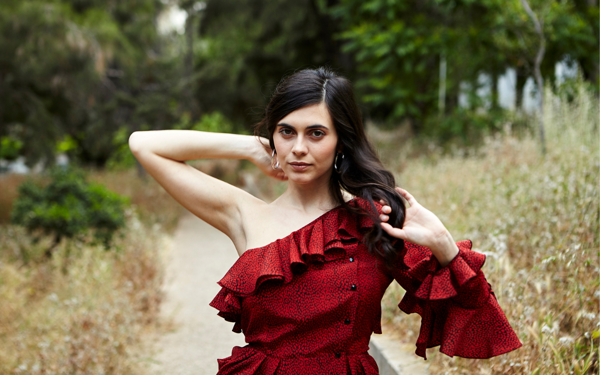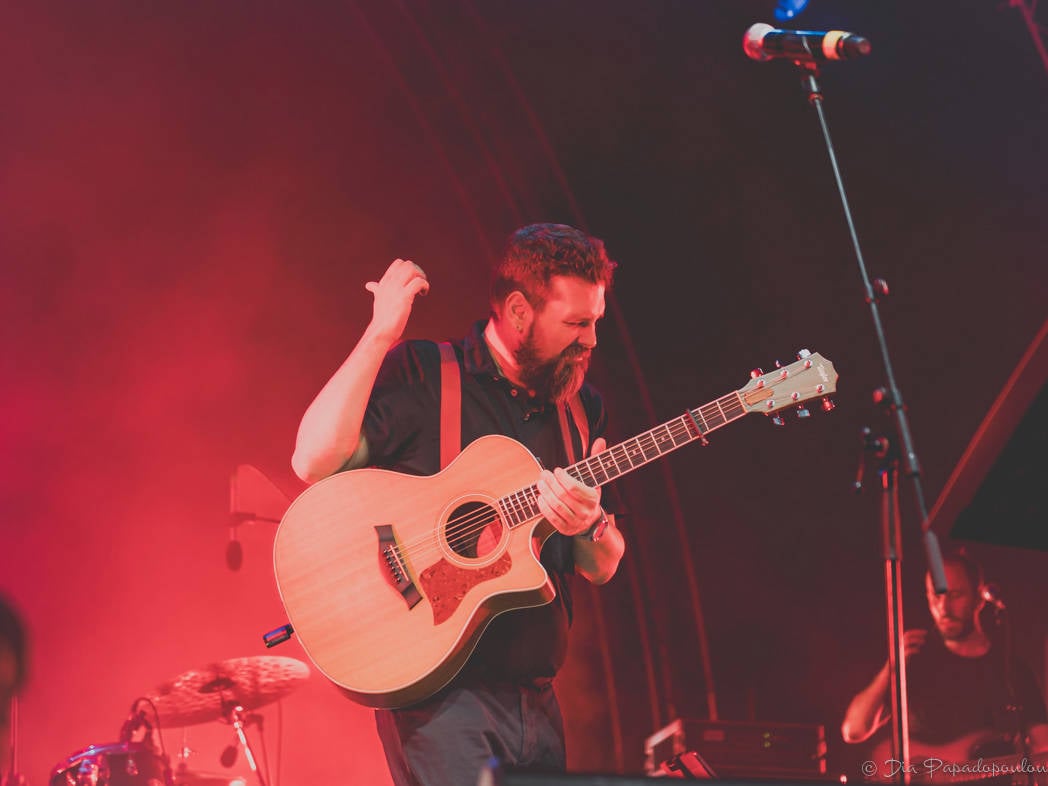








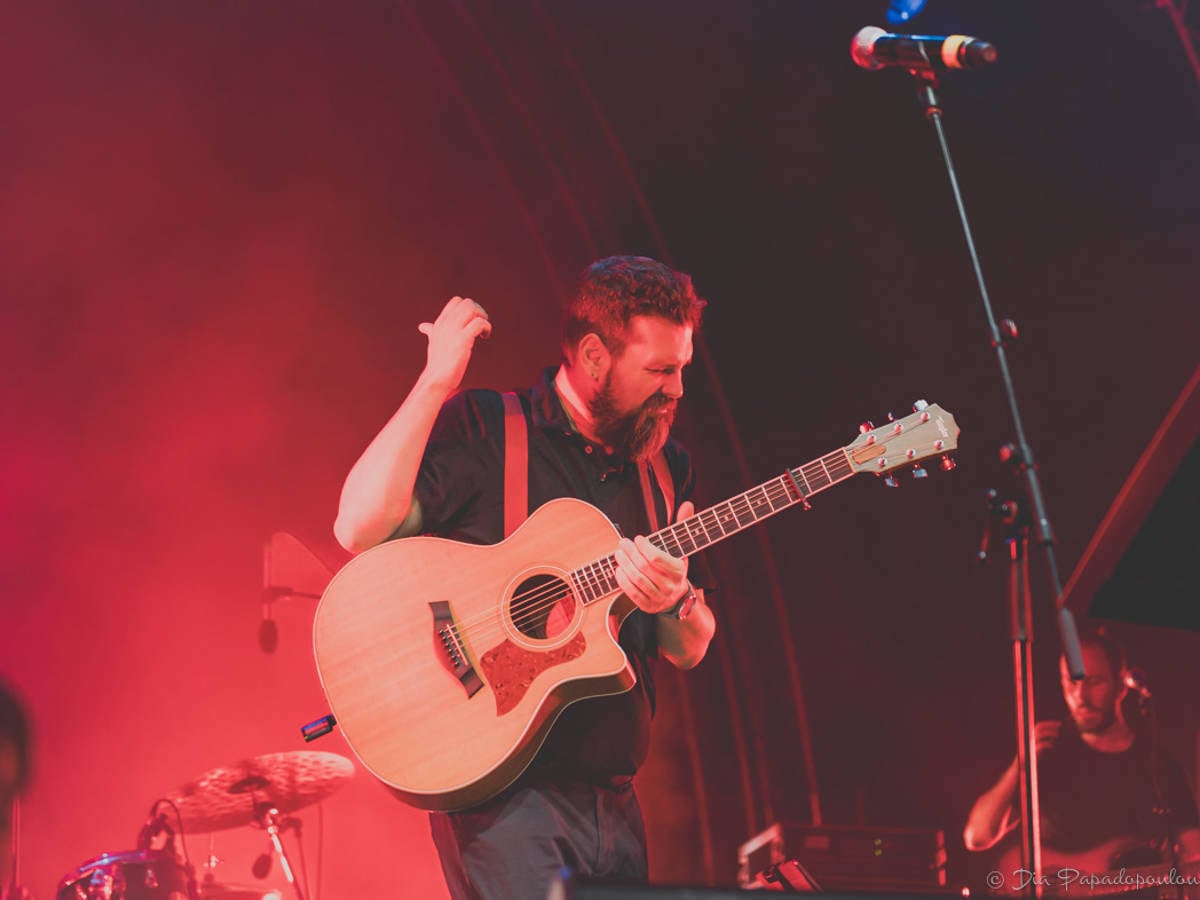



Spiros Grammenos is a musician in Greece who combines the entehno tradition with the energy of punk and ska.
He places satire, irony, and social criticism at the center of his music. As a storyteller who stands with those who do not accept injustice, he deals with heavy themes in his songs such as the absurdity of everyday life, state repression, patriarchal violence, social memory, and solidarity. Sometimes he expresses these themes in a sharp way, sometimes as a deep lament, and often with a sarcastic tone.
With Grammenos, who builds a line of solidarity stretching from the streets of Athens to Palestine, we talked about how music can work as an act of resistance and memory, the absurd panic that censorship creates on the side of those in power, and the voice of the street.
A body and a story
Dark humor and irony occupy a very strong place in your songs; how would you describe the role this language plays in conveying your political critique to listeners?
Dark humor and irony are ways to tell harsh truths without becoming a preacher. They create a distance that at the same time illuminates, letting the listener laugh and reflect together. With irony you expose hypocrisies, with black humor you make the poison more drinkable so it can enter the bloodstream of the conversation. They also protect the creator: a form of resistance and survival against the weight of reality. They don't aim to teach, but to wake people up, move them, and bring them toward a shared awareness — with a laugh that burns.
You are often described as a musician who stands against the system, and your songs frequently deal with the state, the media, repression, and the violence and inequalities produced by the system. How would you define your own musical and political position most accurately?
I consider myself part of the side that won’t compromise with injustice — not as a professional rhetorician but as someone who speaks through his music and lyrics. My music is critical, solidaristic and human-centered: it targets power structures, exposes violence and the media’s rhetoric, and defends those who suffer. I’m not an ideologue preaching solutions, I’m an observer and storyteller who calls for collective awareness and action through imagery, irony and feeling.
With songs like “Ψυχή” (Psihi) and “Το όνομά μου είναι το δικό σου” (To Onoma Mou Einai To Diko Sou), you also keep alive the memory of people like Zak Kostopoulos and Vassilis Maggos; what makes these kinds of songs important to you?
I sing so memory won’t fade. These songs are testimony — humanizing people the system tried to erase as numbers or headlines. They give name, body and story to those who fell victim to state or police violence and injustice, demand accountability, and keep the public conversation alive. They are an act of solidarity with the families and a warning that silence and forgetting favor impunity. Art here functions as memory, voice and motivation so these lives won't become mere statistics.
Sharing the burden
You mentioned that art functions as memory. “Καμία Μόνη” (Kamia Moni), a song you wrote against femicides, also emerged in the shadow of consecutive murders. You previously stated that you wanted to “share the weight” of performing this song with Nefeli Fasouli. How exactly do you establish your own place in such a song of rebellion?
My stance in a song like this is simple and clear: I stand as an ally and a besieger of oblivion. I don’t try to represent others’ experiences. I hold them with respect. The “shared weight” means sharing the responsibility of the voice: it should not be just a man speaking about women, but a common voice with women artists, allowing authenticity and intensity. With Nefeli Fasouli we sought to combine immediacy and sensitivity, to give space to rage and to preserve the dignity of the victims. I favor collaboration and collective authorship, so the performance becomes a shared act rather than a personal display.
When you performed “Κουκουλοφόρος” (Koukouloforos) on the state broadcaster ERT, the crew's panic and the incident being taken to parliament revealed the absurd panic of the authorities towards a song. What does that moment on stage tell you about the current climate of art and freedom of expression in Greece?
This moment made clear how fragile and uneasy power becomes when art holds up a mirror to it, and how afraid the government is of losing its far-right constituency. The panic wasn’t so much about the song itself as about the fear of being seen and challenged. It shows that freedom of expression still provokes defensive reactions, theatrical excesses and parliamentary posturing that reveal insecurity, not strength. At the same time, the incident proves the power of art: a simple performance can unsettle complacency and force a conversation. So the climate is tense—prone to moral panic—but also fertile: when the authorities try to silence or dramatize, art gains visibility and the public debate widens. What made me laugh was that the song’s lyrics will remain forever written in the parliament’s records.
Greece’s well known humor and political satire channel Luben TV summarized what happened that day on ERT, the attempts by ruling party MPs from New Democracy to impose a blockade on the channel, and the absurd panic in parliament through this montage.
With your song “Το Καραβάνι Για Τη Γάζα” (To karavani gia ti Gaza), you move beyond Greece’s internal political climate and express open solidarity with Palestine. What does it mean to write a song in Greece that stands with Palestine and the Palestinian struggle? For instance, have you faced any pressure because of it?
Writing a song that supports Palestine in Greece means refusing the comfort of silence. It’s an act of solidarity that links local injustices to global ones, a reminder that violence, occupation and displacement are not distant abstractions but human realities that demand a response. For me it’s about naming, listening and aligning with people under siege, using music to build empathy and keep the issue in the public sphere.
Yes, adopting that stance provokes reactions. Criticism from nationalist or pro-establishment corners, occasional attempts to delegitimize the message, and awkwardness in some media or institutional spaces. But direct pressure has been limited compared with the symbolic cost of being accused of taking sides. Still, if the outcome is debate and visibility for suffering, I consider it part of everyone’s responsibility to risk discomfort rather than contribute to erasure.
Are artists like you, who take a clear political stance and risk marginalization, alone in the Greek music scene today? In the face of state pressure and the general political atmosphere, how is the relationship among independent musicians? Can we speak of a concrete solidarity, of musicians standing shoulder to shoulder, similar to the old rebetiko or entehno eras?
Between us, we are not alone. When needed, part of the community will certainly unite. In many cases of censorship or injustice, there will be widespread reactions from the broader artistic world. Often we will respond en masse even when the injustice is directed at someone who has not expressed a political stance or taken a position. Injustice carries no political sign.
On stage, you create a space that is distinctly your own, not only through your songs but also through the direct, almost conversational relationship you build with the audience. What is it that truly makes a concert feel alive for you?
The living element for me is reciprocity: when the stage and the audience speak on the same frequency. When the lyrics and the music meet the attention, the breath and the reactions of the people, the applause, the singing together, the silence that fills with meaning. Authenticity matters, not playing a role but being present. Also the unpredictable moment, a look, a remark, a performance that changes and turns the show into a shared experience rather than a lecture. All the beauty lies in becoming one. Breaking the distance between us.
Between the uncompromising anger of “Η λίστα” (I lista) and the deep sorrow of “Με Λόγια Ξένα” (Me logia xena), which feeling accompanies you most strongly in the streets of Athens today?
Walking in Athens, I carry many feelings. Above all I look for joy among people and for love. I also carry sorrow, because sorrow keeps memory alive. I carry the gaze of young people who come ready to build a better world, even if they’re often portrayed as little people glued to their screens on social media. Anger is necessary; it is the fuel that keeps the struggle for justice going.
I am also curious about what you have been listening to lately. Would you share with us a short list of 8 to 10 songs that have been making you feel good or helping you listen to the world again these days?
Each week I share a short playlist of songs that keep me company via thepressproject.gr. Here’s the latest. Τake a little walk through sound with me:
(DS/VC/VK)