



The film “Sarı Zarflar” (Yellow Letters), directed by İlker Çatak, was released on Mar 27.
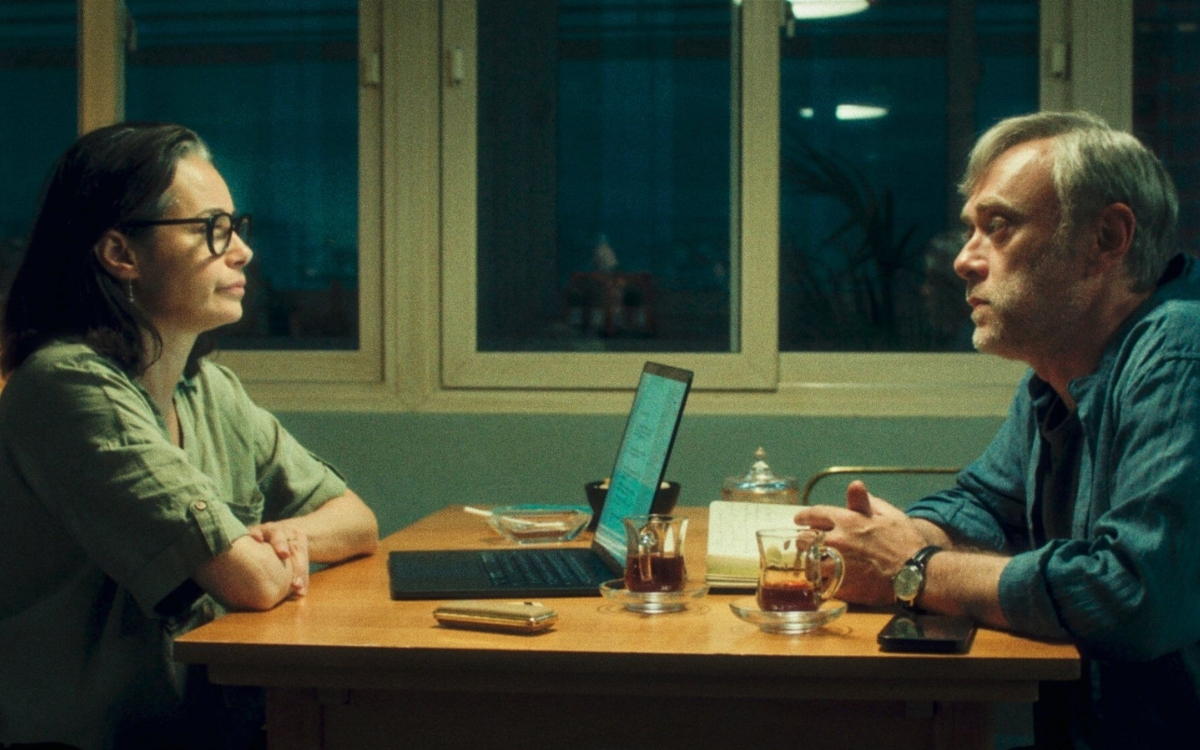
The film, which returned with the Golden Bear award from the 76th Berlin International Film Festival (Berlinale), tells the story of theater artist Derya (Özgü Namal) and academic Aziz (Tansu Biçer), who lost their jobs as a result of their struggle against political pressure in Turkey.
Although the story takes place in Ankara and İstanbul, the production was entirely shot in Germany. In the film, Berlin stands in for Ankara, while Hamburg plays the role of İstanbul.
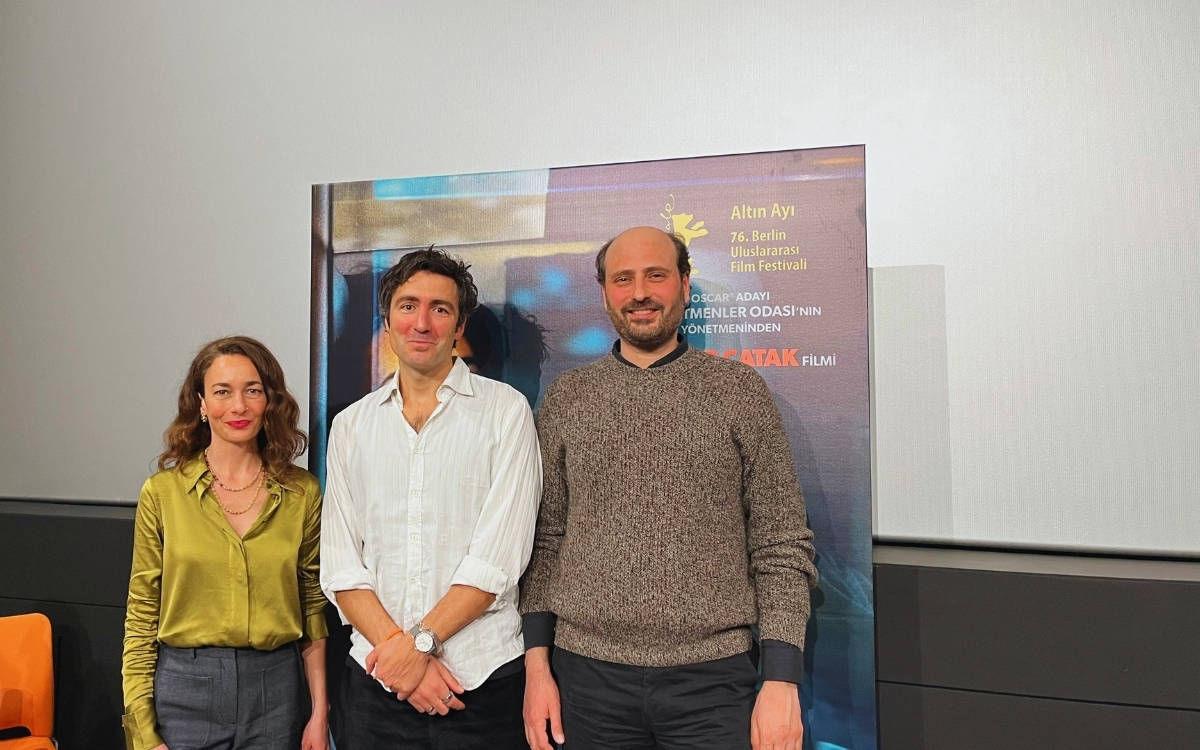
The film’s screenwriters İlker Çatak, Ayda Meryem Çatak, and Enis Köstepen answered questions from journalists and film critics at a press meeting held on MAr 28 at İstanbul Modern.
'We spent about six months only on research'
İlker Çatak first spoke about the sources he used during the film’s preparation process and described how they focused on the story:
“The research process plays a very large role in all my films. It was the same in The Teachers’ Lounge and in Fidelity. For this film in particular, we spoke with many people from the worlds of art and academia, especially figures such as Süreyya Karacabey in Ankara and Fırat Erdoğmuş in Berlin, and we consulted various sources.
"Nilgün Toker’s article Beklerken* was particularly influential during our preparation process. Barış Ünlü’s book The Turkishness Contract likewise. We spent about six months only on research. We then had the script read by the Academics for Peace. However, by making time and place ambiguous, we aimed to make the story more universal and not offer the audience a comfortable distance. Turkey was a reference, but not the only context.
"Layers were added with Germany and a broader historical background in mind. It was important for the German audience to confront 1933, and the film’s evocation of processes experienced in East Germany also made it meaningful for us.”
Ayda Meryem Çatak, for her part, spoke about the film's political stance: “Even the absence of a political stance is, in fact, a political stance. All of us, inevitably, in our lives in general and in the work we do, in some way display a political stance. In the film as well, the entire story actually begins from a political stance.
"This stance, for example, causes the characters to lose their jobs. However, our aim was not to provide the audience with ready-made answers, but to prompt ethical and moral questions. Because that is not a place that can be answered easily.”
bianet’s questions
There are many different groups in Turkey that are exposed to violations of freedom of expression or legal pressure. I wonder why you chose specifically to tell the story of the Academics for Peace. Despite the current resolution process, the situation of academics still does not receive enough attention. The DEM Party is criticized on this issue, while the state takes no steps at all.
Enis Köstepen: In fact, the starting point of the film was different. When we asked İlker in 2021 for an idea he wanted to shoot in Turkey, he suggested the story of a couple of theater artists. Over time, the idea emerged that one of the characters should be an academic in order to deepen this story. At that time, the trials of the Academics for Peace were still very recent, so drawing inspiration from this story felt meaningful to us. But we did not want to make a direct “Academics for Peace film.” By leaving time and the political process ambiguous and by playing with cities, we tried to construct a narrative. Still, traces of that period are present in the film: details such as the markings placed on doors and the inability to access a computer are directly drawn from that process.
İlker Çatak: Our main preference was actually to abstract the issue to some extent. We wanted to break the reflex, especially common in the West, of elevating oneself by looking at other countries. I thought that abstraction would break this “finger-pointing” reflex. In this context, for example, we discussed whether there should be a signature campaign in the film. We did not want to give that comfort to the audience, and rather than allowing the viewer to distance themselves by saying “this happened in Turkey, it does not concern us,” we aimed for them to confront their own historical and social context. For this reason, the story gained a layer that could also touch Germany and other geographies.
Enis Köstepen: The “loss of center” of the characters was important. As they step out of their own comfort zones and encounter other experiences and characters such as Rojda and Baran, their perceptions are transformed. One of the reasons we turned to texts such as The Turkishness Contract was this: what happens when the place where a person positions themselves at the center is shaken? Who questions them, and how? We tried to preserve this conflict in the construction of the characters as well. Thinking of Aziz as a more flawed, more distant character, and showing his tension with collective struggle, was important for us in this respect. Because our concern was not to create ideal heroes, but to create people who exist with their contradictions.
The film is a German production, it takes place in Germany, and the German President congratulated you for the Golden Bear; but at the same time, you are from Turkey. I realize that, given the subject, it may be difficult, but did no official from Turkey congratulate you?
İlker Çatak: I have not received such a congratulatory message from anyone yet. Maybe we will from now on (laughs).
I do not think all three of you had such a motivation, but in the film the political driving force progresses through the male character, while the female character is mostly in a position of being carried along behind him. You deconstruct this in the car scene. I am curious about your motivation when writing the female character.
Ayda Meryem Çatak: We are both fortunate to be people who can live beyond genders in our lives, regardless of being women or men. It was very important for us to convey this in the film.
Society does not differ much, whether Turkish society or German society… Wherever you go in the world, even if a woman does the same job, she can earn less than a man and may have to demonstrate greater performance. Even when she becomes a mother, the leave policies are different… Here, I also have to give İlker his due. İlker really paid attention to the female role, to the extent that it required Enis to step in at times. In some criticisms, it is said that the character of Derya has a submissive side and that we therefore define the woman from a more conciliatory or weaker perspective. But I also see a form of resistance here. We may even have made the female character too strong. Because Derya displays a stance against patriarchy and receives support for this from her mother-in-law. Likewise, the couple’s daughter Ezgi also has the right to assert her own stance. So it was not only Derya, all of our female roles had a voice throughout the film. Our main issue here was rather that Aziz’s understanding of gender stands in an anachronistic place.
On waiting with Nilgün Toker
Nilgün Toker is one of Turkey’s most prominent professors of philosophy. As a political philosopher, she has written and taught on authoritarian regimes, and on the conditions, necessity, and responsibility of producing anti-violence politics.
She has carried her relationship with political theory into the field of human rights as an activist. For signing the petition “We Will Not Be a Party to This Crime,” she was dismissed from her position in the Philosophy Department at Ege University on Jan 6, 2016, by Statutory Decree No. 679.
We present here a section from Toker’s contribution to the compilation “Beklerken - Zamanın Bilgisi ve Öznenin Dönüşümü” (İletişim Publishing), prepared by Zerrin Özlem Biner and Özge Biner.
"One day we will return to the university, but it is not clear when. Will we return? That is also not clear. It seems that our situation is more like uncertainty than waiting. Waiting and uncertainty, there is a difference between these two concepts. I am of the opinion that the way power in Turkey controls time creates uncertainty rather than waiting. That is why I object to the thesis that it is authoritarian. I accept that authoritarian regimes make people wait, but I argue that totalitarian regimes create uncertainty. The difference between the two is this: in uncertainty, it is not clear what you are waiting for. What will happen, what will come, why it happens is not clear. There is nothing related to time. What is at stake is a situation beyond losing control of time. A state of not knowing exists. It is a condition of not knowing what you can expect, not knowing what will cause what, and having no knowledge regarding these questions. I think the situation we are in is exactly such a situation.
"Today, we are like Kafkaesque people who “do not know why they are being punished” — I say this in quotation marks because we actually do know — who cannot foresee whether this is temporary or structural, who cannot find a legal counterpart to it, and who are, in a sense, passed from one place to another. We are subjects who experience the question of what has happened to us and what will happen in a state of absolute uncertainty, who do not know whether this situation has an end, and who have no knowledge about it. We are in a position of having no knowledge about what our relationship with power will be. In that sense, we are in a full regime of uncertainty. Everything is possible. You may be reinstated tomorrow, or you may never be reinstated. You may be imprisoned tomorrow, or you may not be… Everything is uncertain. There is a difference between this situation and waiting. Waiting is actually something calmer, something softer. Uncertainty is something harsher, something more violent. In fact, uncertainty itself is violence, and I think this is a characteristic of totalitarianism."
(TY/VK)