







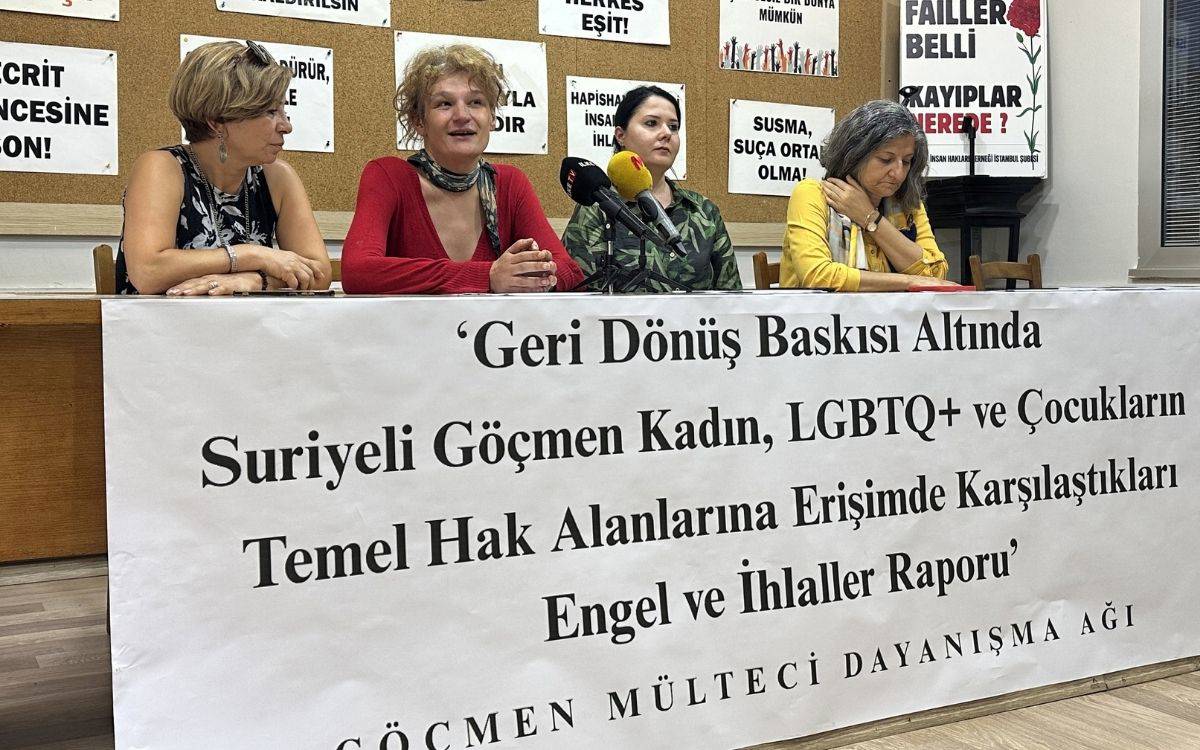



The Immigrant and Refugee Solidarity Network has released a qualitative field report detailing the structural barriers and rights violations faced by Syrian migrant women, LGBTI+s, and children in İstanbul.
The study, presented at a press conference at the Human Rights Association (İHD) İstanbul office today, examines how administrative regulations and shifting migration policies implemented since late 2024 affect access to healthcare, justice, and education.
The report is based on nearly 50 in-depth interviews conducted across different districts of İstanbul, and researchers noted that the study is ongoing. Representatives from the network and İHD attended the press conference.
According to official figures cited in the report, the number of Syrian migrants under temporary protection in Turkey decreased from 3.7 million to 2.9 million since the fall of the Baath regime in Dec 2024, with more than 400,000 of them residing in İstanbul.
While authorities present the repatriation of more than 700,000 individuals as voluntary, field data indicates that spatial restrictions, bureaucratic obstacles in updating address registrations, and legal ambiguities leave asylum seekers in a state of insecurity, hindering long-term social integration.
A homecoming: Yaman’s journey of belonging between İstanbul and Aleppo
Focus on vulnerable groups
Speaking on the findings, Özgün Özata from the network said that the research focuses specifically on the loss of rights experienced by vulnerable groups such as women, children, and LGBTI+s.
"These groups face greater difficulties in social life and become easy targets for racist rhetoric," Özata said, adding that while men were also interviewed, the study concentrated heavily on the specific problems of these groups.
"We wanted to see how the loss of rights we read about on paper affects people's daily lives. We observed that these actually lead to quite dramatic consequences, and we want to share them," she added.
Syrian refugee regains temporary protection status after HIV-related suspension
Access to healthcare
The report highlights severe limitations in the healthcare sector, noting that migrants are increasingly reassigned from Family Health Centers to Migrant Health Centers. Because there are only 33 migrant health centers across İstanbul, families must pay a monthly contribution fee of 3,000 liras (~64.8 US dollars) when visiting local clinics.
High co-payments and service fees severely restrict low-income families from accessing preventative care, prenatal monitoring, vaccinations, and regular medications, sometimes driving individuals toward unregistered medical alternatives.
In the field of education, the report documents that school-aged migrant children frequently experience peer bullying and social exclusion. Network representatives warned that without stronger interventions from school administrations and counseling services, children who drop out face a heightened risk of social isolation and informal labor.
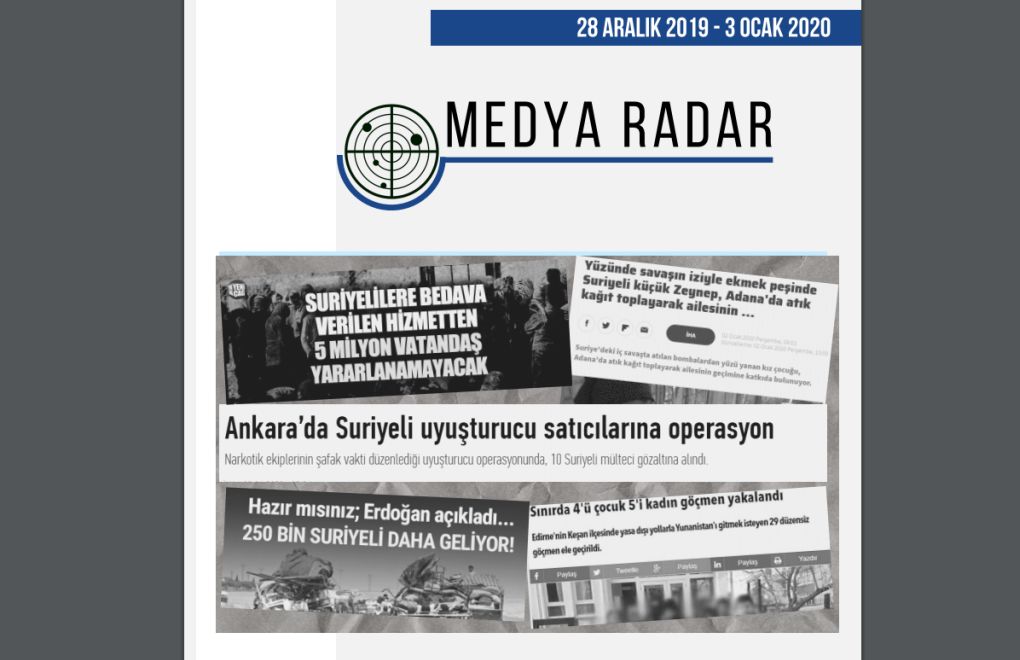
Report: Media Blames Syrian Refugees for Citizens Who Cannot Receive Healthcare
Women avoid reporting domestic violence
Regarding access to justice, the study reveals that migrant women who experience domestic violence are often afraid to approach the police or judicial mechanisms due to a fear of deportation, a vulnerability exacerbated by Turkey's decision to leave the İstanbul Convention, a Council of Europe treat for combating violence against women.
The report cites an instance where a migrant woman applied to a migrant health center for an abortion and was accused of "unchastity" because her residence records did not show her living with her husband.
The report also addresses conditions at removal centers, stressing that individuals under administrative detention must have continuous access to legal counsel, qualified interpretation, and basic humanitarian amenities to uphold international law.
.jpg)
BEING A REFUGEE WOMAN IN TURKEY
Refugee woman from Iran: Why is the man who raped me not arrested?
Recommendations
The Immigrant and Refugee Solidarity Network called on legislators, local authorities, and civil society to shift migration policies away from security restrictions toward humanitarian assurance and mutual social cohesion.
The network urged officials to alleviate financial and bureaucratic obstacles to health and education, strengthen legal aid for vulnerable women and children, and ensure transparency in administrative detention procedures. (EMK/VK)