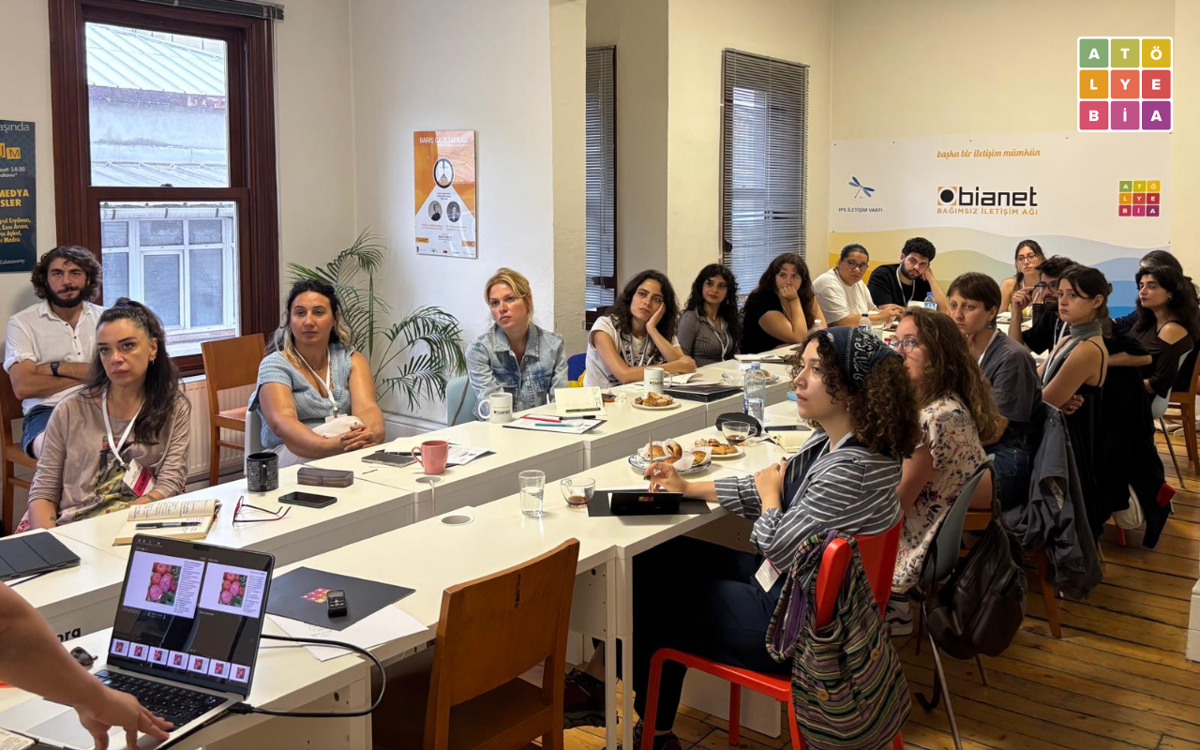






Atölye BİA holds Spatial Literacy Workshop

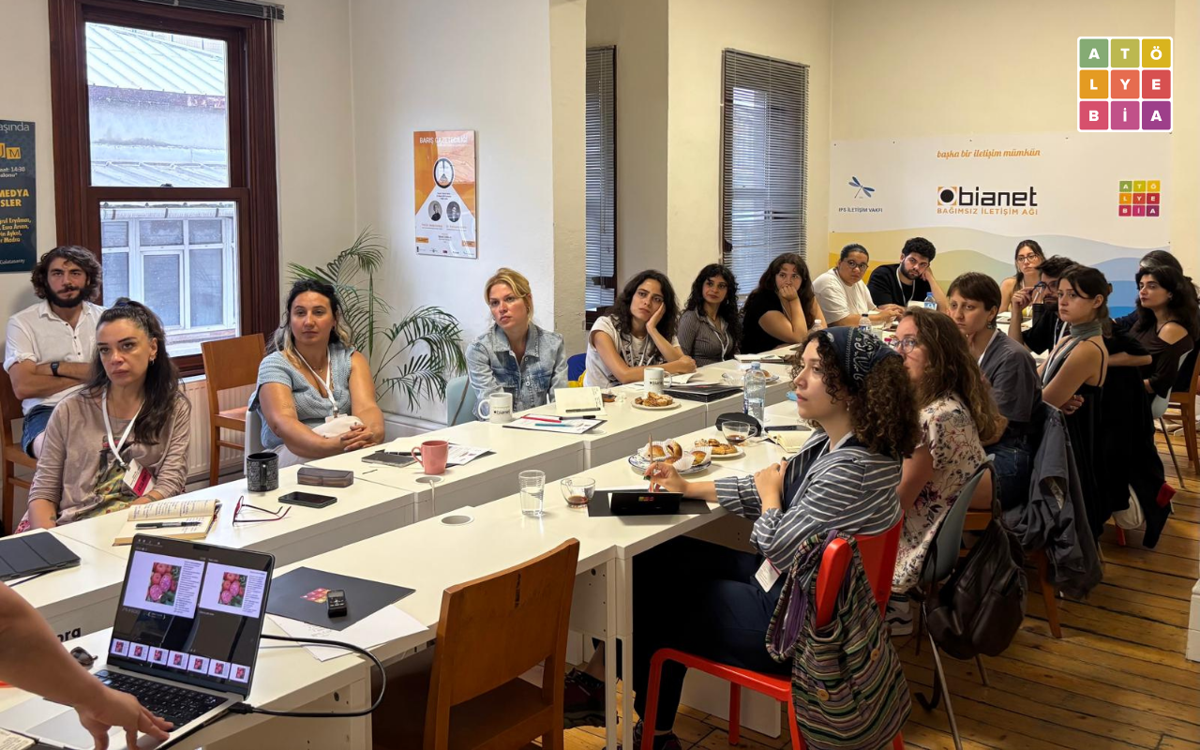



The Spatial Literacy Workshop was held at Atölye BİA in Beyoğlu, İstanbul, on Jul 25-26.
On the first day of the workshop, participants addressed various topics, ranging from how space is produced through social relations to the relationship an investigator builds with space, and from accessing spatial information via open sources to writing practices prior to fieldwork.
The workshop began with opening and framing remarks by Atölye BİA Coordinator Ceyda Sungur, followed by an introduction session among participants.
The first day's program
- Introduction to Spatial Literacy (Ceyda Sungur)
- Production of Social Space (Ceyda Sungur)
- Getting Closer to Space (Gülşah Aykaç)
- Accessing Spatial Information from Open Sources (Nuray Çolak Tatlı)
From knowing space to transforming it: Spatial literacy
The workshop opened with the session titled "Introduction to Spatial Literacy," led by Dr. Ceyda Sungur. Sungur discussed what spatial literacy means with the participants. She addressed space through social memory, daily life, class relations, and urban transformations.
Participants discussed the relationship between space and memory using various examples. Among these examples were the architects of buildings, doorbells, houses shrinking due to urban transformation, and changing commercial structures in neighborhoods. Sungur described spatial literacy as a process of "knowing, getting acquainted with, and transforming."
Sungur drew attention to the importance of going beyond merely knowing a space and becoming involved in the social relations there:
When we encounter the set of social relations carried by the space, we begin to experience an acquaintance with that space. In this way, we become part of the space and the social relations there, meaning we begin to be involved. Here, I would like to emphasize the difference between inclusion and involvement. Inclusion means being part of something, whereas involvement also contains the capacity to change and transform it. We can think of this process as a process of gaining awareness.
In this framework, Sungur addressed spatial literacy as a process that develops through critical thinking and turns into a practice of citizenship over time.
How is space produced through social relations?
In the second session of the day, Ceyda Sungur met with participants under the title "Production of Social Space." The session began with the question, "Why do we call it social space rather than just space?" Participants discussed this question through memory, socialization, equality, safe spaces, and the relations that different social groups establish with space.
Sungur emphasized that space is shaped alongside social relations. She explained that social relations are established within space, and these relations continuously change the space itself. She said socioeconomic conditions, culture, identity, gender, and power relations play a role in the production of space.
Sungur emphasized through daily practices that space is experienced differently based on gender:
You can only walk along certain routes. You prefer places only where there is light, perhaps extending your route to feel safer. But having light is not enough to feel safe either. We also think of homes as safe spaces. However, domestic violence is one of the most micro-level spaces where psychological and social violence also takes physical form.
She graduated from the Department of City and Regional Planning at METU. She completed her master's degree in urban design at İTÜ and her doctorate in geography at Université Paris-I-Panthéon-Sorbonne. Her work focuses on gender, daily mobility, labor geography, and feminist geography. She currently works as the Coordinator of Atölye BİA within the IPS Communication Foundation.
Getting closer to space: Where does the researcher stand?
In the third session of the day, Gülşah Aykaç met with participants under the title 'Getting Closer to Space.' Drawing from her own spatial research experiences, Aykaç addressed the intimacy established when researching a space and the researcher's position in knowledge production. She explained that as one gets closer to space, different layers are revealed and the researcher begins to question their own assumptions.
Aykaç focused on the concepts of positionality and self-reflexivity. She said the identity, background, and experiences of the researcher affect the relationship established with space. She stated that prioritizing 'getting acquainted' with a place is more important than merely knowing it. She described this acquaintance as a mutual process where the researcher tries to understand the space while the space also affects the researcher.
Aykaç pointed out that while producing knowledge about space, the researcher must also question their own position:
We have an experience in a space, but whose experiences exist there? Are there experiences of suppressed people or experiences that are never mentioned? If we are talking about embodied knowledge, we can ask 'Whose body?', and if we are talking about self-reflexivity, we can ask 'Whose space?'
The ethical dimension of producing knowledge was also discussed in the session. Aykaç conveyed being careful and thoughtful toward the researched place and its residents through the 'ethics of care.' She drew attention to the ethical dimension of choices in the research process, ranging from the decision to take photos to the language used.
About Gülşah Aykaç
She received her bachelor's degree from the Architecture Department at İTÜ in 2009 and her master's degree from the Architectural Design Master's Program at the same university in 2013. She conducted her doctoral studies at the Architecture Program of Middle East Technical University between 2015 and 2020. She conducted research at NTUA (National Technical University of Athens) in 2017 and at NCSU (North Carolina State University) as a Fulbright visiting researcher in 2018. Throughout her doctoral studies, she took part in independent urban initiatives composed of people coming together around the city, public space, and art, such as AsiKeçi (Ankara) and Victoria Square Project (Athens). Currently, she conducts individual and collective work on urbanization narratives in the context of Turkey, micro-urban histories, feminist theory and pedagogy in architectural education, and contemporary labor processes in architecture.
Accessing spatial information from open sources
In the fourth session of the day, Nuray Çolak Tatlı met with participants under the title 'Accessing Spatial Information from Open Sources.' Çolak Tatlı explained the open sources that can be used when researching a space and how the data obtained from these sources can be evaluated in journalism.
Addressing how maps represent space, Çolak Tatlı emphasized that what is left out on a map is as important as what is shown. She pointed out that the production purposes of maps and the techniques used can affect the information that emerges about space.
Maps from different periods of İstanbul, aerial photos, and digital databases were examined during the session. By comparing maps and aerial photos from different dates, participants saw through examples how changes in urban transformation and construction can be tracked over time.
Çolak Tatlı also drew attention to the possibilities that spatial data from open sources can provide in journalism. She shared that different information, from which institution is responsible for a road to cultural heritage structures, and from population and transportation data to urban development, can be researched through maps.
About Nuray Çolak Tatlı
She graduated from the Department of City and Regional Planning at Dokuz Eylül University in 2008. She received her master's and doctorate degrees in the same field. She continues her work on zoning legislation and real estate development processes.
How do you know Tarlabaşı?
The first day of the workshop concluded with a writing exercise titled "How Do You Know Tarlabaşı?" Participants were asked to write down what they knew, heard, and were curious about the area before going to Tarlabaşı.
In the exercise, participants noted their existing impressions of Tarlabaşı and the topics they wanted to see or question in the field. These initial texts aimed to make the participants' baseline assumptions about the space visible prior to the field study to be conducted the following day.
After the fieldwork, participants were asked to turn their "acquaintance story" with Tarlabaşı into a feature story.
What is a feature story?
A feature story is a genre of journalism that tells a topic or a space through observations, details, and experiences gathered from the field. It can establish a more narrative structure compared to news language; space, people, atmosphere, and details of daily life are important parts of the text. What the reporter sees, hears, and encounters in the field contribute to building the narrative.
Second day: Looking closely at Tarlabaşı
The second day of the workshop began with participants meeting at Taksim Square.
Discussions on space, social relations, and urban transformation addressed on the first day of the workshop continued on the second day with a field trip covering Taksim and Tarlabaşı, accompanied by Dr. Ceyda Sungur and Dr. Nuray Çolak Tatlı.
Starting around Taksim Square and Gezi Park, the trip addressed the relationship between space, memory, and publicness through the historical transformation of the area. The changing use of the square and the place of the Gezi Resistance in the recent history of the area were discussed.
Passing then to Tarlabaşı, participants reached Ağrılı Ahmet's Place coffeehouse by following the traces of the Taksim 360 Project and the surrounding urban transformation.
The second day's program
- Warming up to writing: Free writing
- First impressions of Tarlabaşı
- In pursuit of detail: Describing the space
- Approaching Tarlabaşı
- Joint reading: Tarlabaşı experience
- First encounter with Tarlabaşı: An acquaintance story (I)
- First encounter with Tarlabaşı: An acquaintance story (II)
- Looking closely at space
Continuing at Ağrılı Ahmet's Place in Tarlabaşı, participants did a free writing exercise before the field study.
Sungur and Çolak Tatlı asked participants to transfer what was on their minds to paper continuously, without being tied to a specific topic.
Explaining that the exercise was intended to overcome the hesitation that arises when starting to write and to strengthen the connection between the mind and the hand, Ceyda Sungur said it was not always necessary to find the "right sentence." She stated that wrong sentences or sentences whose purpose is not yet known can also be part of the writing process.
Following the free writing, participants went out to the field again to make observations in the streets of Tarlabaşı. Participants were asked to observe the surrounding people, structures, sounds, smells, and traces of daily life for 45 minutes and to note down what they saw.
The study focused on describing unique details encountered. Sungur also drew attention to the position established by the observer with the neighborhood:
This place is the living space of these people, and we come here as strangers. Therefore, being in a position observing the people who live here can create an unequal and patronizing relationship. By accepting our status as strangers, we need to observe and write without disturbing the people across from us as much as possible.
In pursuit of detail
Returning to the coffeehouse after the field study, participants shared their observations and encounters from the streets of Tarlabaşı. Their presentations focused on daily life in Tarlabaşı and the transformation of the neighborhood.
Participants also discussed how their predefined notions about the space could change through field observations. One participant pointed out that Tarlabaşı is frequently criminalized or romanticized. They explained that observing daily life in the street market led them to question their own expectations about the neighborhood.
Sungur and Çolak Tatlı asked participants to select a specific detail that caught their attention during the first walk and deepen their observations on it. Participants then took to the streets of Tarlabaşı once again to pursue their questions and speak with people in the neighborhood.
From observation to a feature story
Participants returned to Atölye BİA after the fieldwork in Tarlabaşı. In this session, they explained the topics that caught their attention in the field and how they wanted to turn them into feature stories.
Participant topics included abandoned and transforming structures in Tarlabaşı, people they encountered in the neighborhood, and prejudices about the area. One participant explained how their initial prejudices shifted following observations and interviews conducted in the neighborhood.
Based on the observations of the participants, Sungur and Çolak Tatlı offered suggestions on how they could structure their stories. (EG/VK)


bianet Sivil Toplum Paydaşları Muhabiri ve Atölye BİA Asistanı (Ocak 2026). bianet Sosyal Medya Editörü (Nisan 2025-Ocak 2026).
Disability-Focused Journalism Workshop ends: 'We must kill the ableist in our heads'
First day of Disability-Focused Journalism Workshop: 'We must question the language we construct'
DISABILITY-FOCUSED JOURNALISM WORKSHOP
'The history of disability is also the history of normality'
'Seafarers in danger, the US and Israel are bombing Yemen'