










As soon as the "Framework Bill" was shared with the public on Aug 5, before the "ink had even dried," "regular guests" on television programs unleashed all the malice in their vocabulary without the slightest concern for polarizing, dividing, othering, or demonizing society. Some fundamentally oppose it, saying, “terrorists cannot be treated as counterparts,” while others offer assessments that could be summed up as “all authority rests with the president, parliament has been rendered dysfunctional, it is not democratic, it contains nothing about democratization,” or described as “not enough, but yes.” Yet the vast majority display this attitude without feeling any need to base their “valuable opinions” on objective data.
The regime in Turkey
They neither hesitate nor feel embarrassed to portray the “party-affiliated presidential system of government,” which has been in place for more than eight years, as though it were a new regime in terms of its structure and operation. They act as if this regime’s methods and instruments of governance had not been in use for years and they were encountering them for the first time. The authorization provided for in the bill is, of course, a negative development for democracy. But it is not a new practice unique to this text. Is it possible to deny that for eight years the country has been governed through presidential decrees that take effect with the signature of a single person, on whatever date that person chooses, and can be repealed whenever that person wishes, while the Turkish Grand National Assembly (TBMM) has been left with less initiative on many issues than under the previous regime? Do they not know that even in areas where the TBMM retains its initiative, all that happens is that hands go up and down because of the structural characteristics of the ruling party? I don’t think so! Then why do they take this position? It is quite difficult to give a single answer...
The agreement was also approved by parliament
The “Framework Bill,” adopted by the TBMM General Assembly on Aug 10, 2026, is essentially an agreement between the parties to an armed conflict, similar to examples seen in conflict resolution processes around the world. As previously discussed in this column, steps related to “democratization” are not, and should not be sought, primarily within an agreement of this kind, which is designed to ensure that the guns fall silent/the right to life/the right not to be killed. Their absence should not be regarded as a specific, deliberate omission. Still less can such a step be expected from a government that has become dependent on two instruments for generating social consent that are also consuming the government itself. “Democratization” is not something a government with the characteristics of the current one would or could implement, nor is it a step it could take. When everyone knows that it has no instrument for securing consent left other than different forms of “violence,” which it has to intensify with each passing day, and the instrumentalization of the law, it is unrealistic to expect it to take steps toward democratization. Let us not deceive ourselves.
What created and made today possible
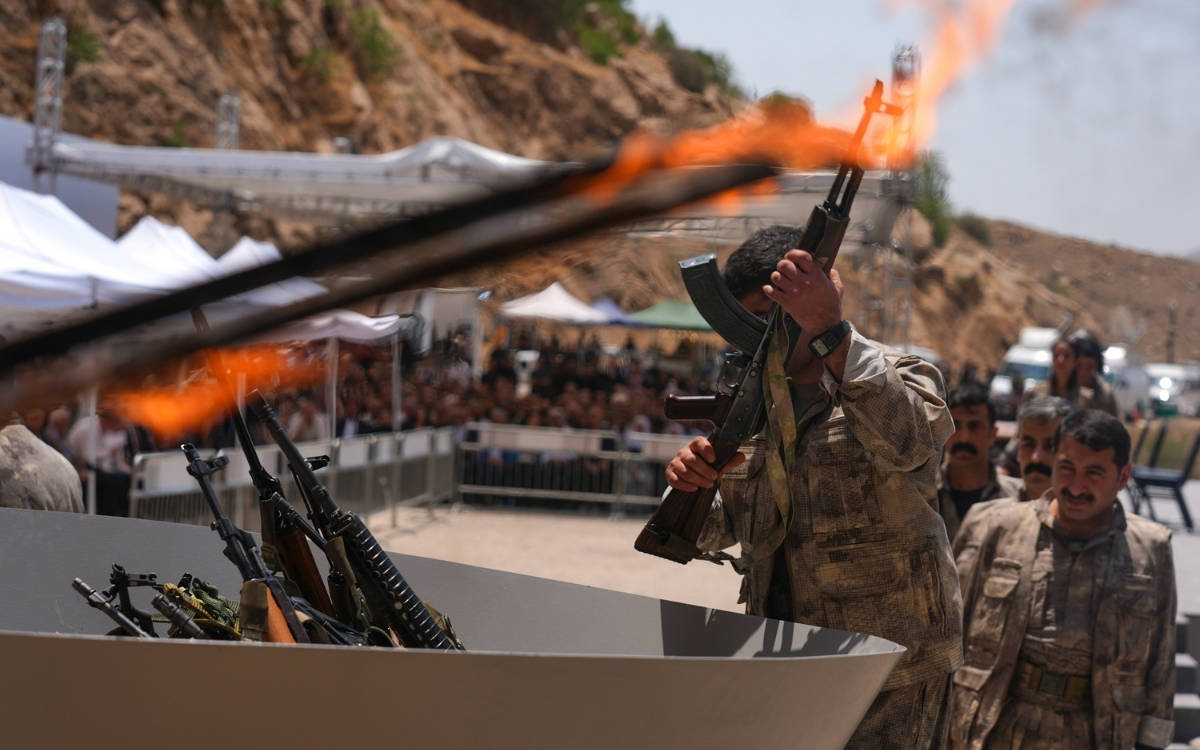
So who is the law/agreement currently on the agenda primarily for? It is worth stating this in all sincerity, without hesitation or apprehension. This law is for the “Peace and Democratic Society Group,” which destroyed its weapons at a ceremony on Jul 11, 2025, in the Casane Cave area of Dukan, a town in Sulaymaniyah province in the Kurdistan Regional Government of Iraq, and announced the reasons for doing so to the world in a written statement, as well as for those who share and support the views expressed in that statement but were unable to be there. Of course, it is also for the thousands of prisoners currently held in prisons in Turkey who embrace this text and “could put their signatures to it,” as well as the tens of thousands of political exiles forced to live abroad. To briefly recall the text: “Freedom fighters who joined the PKK at different times in order to fight against attacks aimed at denying and destroying the Kurdish existence, took up arms and struggled in different regions (...) We are voluntarily destroying our weapons before you in order to pursue our struggle for freedom, democracy and socialism through democratic politics and the law, and on the basis of the enactment of democratic integration laws.”
In the narrow sense, the law in question consists simply of an agreement based on such a demand. At this stage, although this is not sufficient, what matters should be whether the “right not to be killed” demanded by the parties to the conflict can be secured through an agreement/law as a result of the negotiations. The parties say they have reached an agreement! They say, “It has shortcomings, but it can be considered sufficient for a start.” We hope the implementation phase of the law will be completed in full and as quickly as possible without any major problems.
As stated in the text, ending “attacks aimed at denying and destroying the Kurdish existence,” regarded as an outcome achieved under present-day conditions, is the result of a long-running struggle for which a heavy price has been paid. The political and social accumulation generated by that struggle first enabled the Kurdish people to embrace and defend their national existence. It was further strengthened by the relationships it developed and the alliances it forged across Turkey and around the world. The historical accumulation and richness behind being at the negotiating table today stands as an undeniable source of strength and confidence. By its very nature, this also requires a similar degree of responsibility regarding the decisions to be made and agreed upon at the table.
For a political solution to the Kurdish issue
Besides being an agreement, this law will also serve as the first step in the legal sphere during this period toward a “political solution to the Kurdish issue.” The Kurdish question and its resolution had already been brought under the roof of the TBMM through the commission’s work. With this stage, it will also constitute a “first” in terms of the legislature’s function. However, neither the content of this law nor the current structure of the TBMM is sufficient for a political solution to the Kurdish question or for “normalization,” known as the final stage of conflict resolution processes. For this reason, a joint struggle is also needed to remove, one by one, the obstacles to the democratization of the republic and to establish a “new” life and order based on equal citizenship.
Like all left-wing, socialist and democratic parties and organizations, the Peoples’ Equality and Democracy (DEM) Party, pro-Kurdish, is in favor of peace. At the same time, unlike the others, it is a party that, despite the process’s shortcomings, by its very nature has a place and role in advancing it, and indeed must play that role. Nevertheless, despite some periods of stagnation, it has managed to remain an integral component of the social opposition in the struggle for social equality, freedoms, rights and the rule of law. It has also played important roles in the opposition’s concrete historical gains. Regardless of the stage that has been reached, even the slightest hesitation in this regard would increase both the risk of the process being derailed, as in previous years, and the risk of the DEM Party becoming isolated, shrinked and diminished. The other components of the opposition have important roles to play in this regard, just as the DEM Party does.
Joint struggle for a solution
To achieve a joint struggle, there is a need for an inclusive, constructive, persistent and always “realistic” approach within a framework that takes the existing situation into account. At every stage, there must be an ability to empathize and, without becoming confined to personal or institutional calculations, efforts must be made above all to create the conditions for always taking steps together that will also enable a political solution to the Kurdish issue, and those conditions must actually be created. Let us not forget that once equal citizenship is secured, there is the possibility that a major wall dividing the class, including through ethnic identities and other sub-identities, and standing “in the way of becoming a class for itself,” will come down. If this happens, it has the potential to create opportunities that could also pave the way for class struggle.
Those in Turkey who are wholly and/or on certain issues dissatisfied with the existing situation and do not consent to it should, without any ifs or buts, be able to decide first and foremost on unity in action, all together, side by side, with concrete demands and an objective plan and program. This unity in action must also be embraced by broad sections of society so that the demands are taken into consideration. Alternatively, the government can be defeated at the ballot box through an alliance similar to the “urban consensus,” which was implemented in the 2024 local elections following the DEM Party’s proposal to the Republican People’s Party (CHP), main opposition, and dealt the Justice and Development Party (AKP), ruling party, and Nationalist Movement Party (MHP), government ally, their biggest defeat of the past decade. Yet experience shows us that even this is not enough today. Preparations must also be made for how the gains achieved will and should be defended.
Here, let us leave the final word to our pioneers of the 1970s: “There is no liberation alone, either all of us together or none of us.” (OH/VC/VK)