












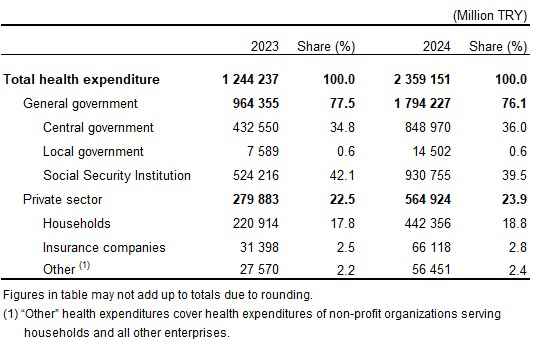
On Dec 4, the Turkish Statistical Institute (TurkStat) published a press bulletin titled “Health Expenditure Statistics-2024.” According to the data in the bulletin, a total of 2 trillion 359 billion 151 million liras was spent on health services in Turkey in 2024, marking a 90 percent increase compared with the previous year. Of the total expenditure, 76 percent belonged to the “general government” and 24 percent to the “private sector.” The bulletin also states that in 2024, compared with 2023, total health expenditure by the general government increased by 86 percent, while private sector spending rose by 102 percent. On that day and in the following few days, we observed that health expenditures were covered in the written and visual media, with this figure in particular being highlighted and shared by commentators. However, the real situation regarding health expenditures can be understood by analyzing the data disclosed to the public by TurkStat within the framework of both their sources and knowledge of the function and operation of the health financing model currently in practice in Turkey.
The annex to the press bulletin also includes, as in previous years, explanations regarding the methodology used (calculation and data sources), as well as tables showing the sources of health expenditures and spending areas. In these tables, the sources of expenditure are grouped as a) General Government and b) Private Sector, while spending areas are grouped as a) Current and b) Investment expenditures. “General Government” consists of the central government, local government (local administrations), and social security (Social Security Institution), while the “Private Sector” consists of households, insurance companies, and others (non-profit institutions serving households).
A very brief history
In Turkey, the regular sharing of data and information on the health expenditures of individuals and institutions by a public body has been carried out by TurkStat since 2010. At the outset, TurkStat shared data calculated retrospectively for previous years using a similar calculation method, publishing press bulletins titled “Health Expenditure Statistics” for the years 1999-2007 in 2010, for 2008 in 2011, and for 2009-2012 in 2013. In November 2014, it stated that a new calculation method, different from previous years, had been used in calculating health expenditure data for 2012 and 2013. Since then, health expenditure statistics for the previous year have been published every year in November or December in the form of a press bulletin and its annexes.
Health expenditures are not increasing in Turkey
According to the data published by TurkStat, total health expenditure in Turkey amounted to 4 billion 985 million liras in 1999, 18 billion 774 million liras in 2002, 24 billion 279 million liras in 2003, 57 billion 740 million liras in 2008, 57 billion 911 million liras in 2009, 606 billion 835 million liras in 2022, 1 trillion 244 billion 237 million liras in 2023, and 2 trillion 359 billion 151 million liras in 2024. Based on these figures, health expenditures in Turkey increased every year compared with the previous year. A similar trend is also observed in calculations that take annual inflation rates into account. However, these figures do not reflect the real situation. The reality behind this visible face of health expenditures can only be made apparent through a comparable parameter. One of these is the share (ratio) of health expenditures within gross domestic product (GDP).
Accordingly, while the share of total (current and investment) health expenditures in GDP in Turkey was 4.8 percent in 1999 and 5.4 percent in 2002, it stood at 5.3 percent in 2003, the first year of the Justice and Development Party (AKP). It later reached the highest level of this period at 6.1 percent in 2008 and 2009. Thereafter, although increases and decreases were observed over the years, the share of total health expenditures in GDP generally showed a downward trend and fell to as low as 4 percent in 2022. In the first year following the point at which it reached its lowest level, the ratio of total health expenditures to GDP was 4.6 percent in 2023 and 4.9 percent in 2024. In other words, it is observed that the share of expenditures made for health services has decreased to a notable extent compared with 2008 and 2009. By contrast, in the vast majority of countries of the Organisation for Economic Co-operation and Development (OECD), of which Turkey is also a member, the opposite trend, namely an increase, is observed. While the OECD average was 7.2 percent in 1999, 7.7 percent in 2002, and 7.9 percent in 2003, it was 8.2 percent in 2008 and 8.9 percent in 2009. A similar trend has continued in recent years as well. The share of health expenditures in GDP was 9.2 percent in 2023 and 9.3 percent in 2024. Taking these data into account, the share of health expenditures in GDP has increased steadily over the years in OECD member countries. For Turkey to reach a similar share, it would need to increase its health expenditures by almost 100 percent.
The real face of general government health expenditures: The SSI’s share has always been the largest
In the data published by TurkStat, it was explained above that one of the two sources of health expenditures is the “general government” and the other is the “private sector,” and that the content of the general government consists of expenditures made by the “central government; general and special budget institutions,” the “local government; municipalities, provincial special administrations, etc.,” and “social security; the Social Security Institution.”
In Turkey, since social security institutions were merged in 2006 with Law No. 5502 on the Social Security Institution, the share of current health expenditure made by the Social Security Institution (SSI) within general government current health expenditure has increased rapidly with the Justice and Development Party (AKP) governments, whereas it was 55 percent in 1999 and 53 percent in 2002. The SSI’s share within general government current health expenditures rose to 62 percent in 2003 and to 63 percent in 2004. While this increase reached 66 percent in 2010 and 2011, it peaked at 74 percent in 2013. This ratio did not fall below 70 percent until 2020. It was 69 percent in 2020, 64 percent in 2021 and 2022, 61 percent in 2023, and 57 percent in 2024. These data show that the vast majority of general government current health expenditures are made by the SSI. Between 2003 and 2024, it never fell below 60 percent except in the final year. For this reason, this preference needs to be evaluated specifically. It is worth sharing once again that we can reach the real source of health expenditures in Turkey by examining this situation. Then let us ask our question: What does the rapid increase in the SSI’s share within general government current health expenditures that we have observed during the AKP years, and the preservation of this share over the years, indicate?
The neoliberal public health insurance model
The SSI is an institution affiliated with the Labor and Social Security Ministry and, together with the premiums of other public insurance branches (retirement, maternity, disability, etc.), collects health insurance premiums as well (from registered employees and employers). For those covered by insurance and, with certain limitations, the people they are obliged to care for, it purchases curative health services from Health Ministry, private (including foundation university hospitals), and state university hospitals, medicines from pharmacies, eyeglasses from opticians, and orthoses, prostheses, and medical supplies for the insured from medical companies. The health insurance premium collected from employees is neither proportional to income (a lower amount is not taken from those with low salaries and a higher amount from those with higher salaries), nor is regularly paying this premium and being covered by public health insurance sufficient to be able to use health services within the scope of health insurance. In order to use the service, in addition to the premium, it is mandatory to make additional payments each time under more than 10 headings, such as “prescription co-payment,” “examination co-payment,” “medicine co-payment,” and “medicine price difference.” If services are received from a private hospital, individuals also have to pay an “additional fee,” which can amount to up to 200 percent of the service fee.
For this reason, the current financing model of health services in Turkey, which, as in dozens of countries, was planned and implemented by the World Bank and the (AKP) Governments in order to ensure that health expenditures are made indirectly or directly by those who use health services and to transform health service provision from an area where social distribution is reorganized into an area of capital accumulation for employers, can be called the “neoliberal public health insurance model.” In this financing model, SSI expenditures within central government health expenditures are not, in a real sense, health expenditures made by the state or the public. Their public character lies only in the fact that health insurance premiums are collected by the state from employees and employers. For this reason, health expenditures carried out by the SSI (for treatment and rehabilitation services, as well as medicines, medical supplies, etc.) are, in essence, exactly the same as health expenditures made by individuals (households out of pocket). Therefore, the correct approach is to consider health expenditures made by the SSI not as state expenditures but within the scope of private health expenditures.
The largest share in health expenditures
According to this assumption, if a reassessment is made, approximately 29 percent of total current health expenditures in 2021, 27 percent in 2022, 30 percent in 2023, and 32 percent in 2024 were carried out by the “general (central and local) government.” In addition, the share of health expenditures made by the “private sector” (households/direct out-of-pocket, health insurance premiums and co-payments, insurance companies) within total current health expenditures was 71 percent in 2021, 73 percent in 2022, 70 percent in 2023, and 68 percent in 2024.
As can be seen, the issue with health expenditures in Turkey in 2024 is not the 102 percent increase in “private sector” expenditures compared with 2023. The issue lies in the fact that although SSI expenditures are now entirely financed through health insurance premiums and co-payments collected from individuals, they are included within “general government” health expenditures and shared with the public as “state health expenditures.” Indeed, once SSI expenditures are excluded from this group, it will also become apparent that the share of “general government” health expenditures has been very low in all years. In that case, there will be no doubt regarding the demand to increase health expenditures and to achieve this by increasing the share of “general government” expenditures.
In closing, in order not to give rise to any speculation, I need to state that TurkStat’s reliability and the question of which sector is preferred in carrying out “general government” and SSI health expenditures are also important, but they are subjects of a different discussion and a separate article.
References
TÜİK Haber Bülteni (2025). Sağlık Harcamaları İstatistikleri, 2024. Sayı: 54188, 04 Aralık 2025.
https://data.tuik.gov.tr/Bulten/Index?p=Saglik-Harcamalari-Istatistikleri-2024-54188
Hamzaoğlu, O. (2023). AKP’li Yıllarda Sağlık Hizmetlerinin Finansmanı: Neoliberal Kamu Sağlık Sigortası Modeli. Toplum ve Hekim, 38(3):174-184.
https://www.belgelik.dr.tr/ToplumHekim/kayit_goster.php?Id=3137
(OH/TY/VK)