











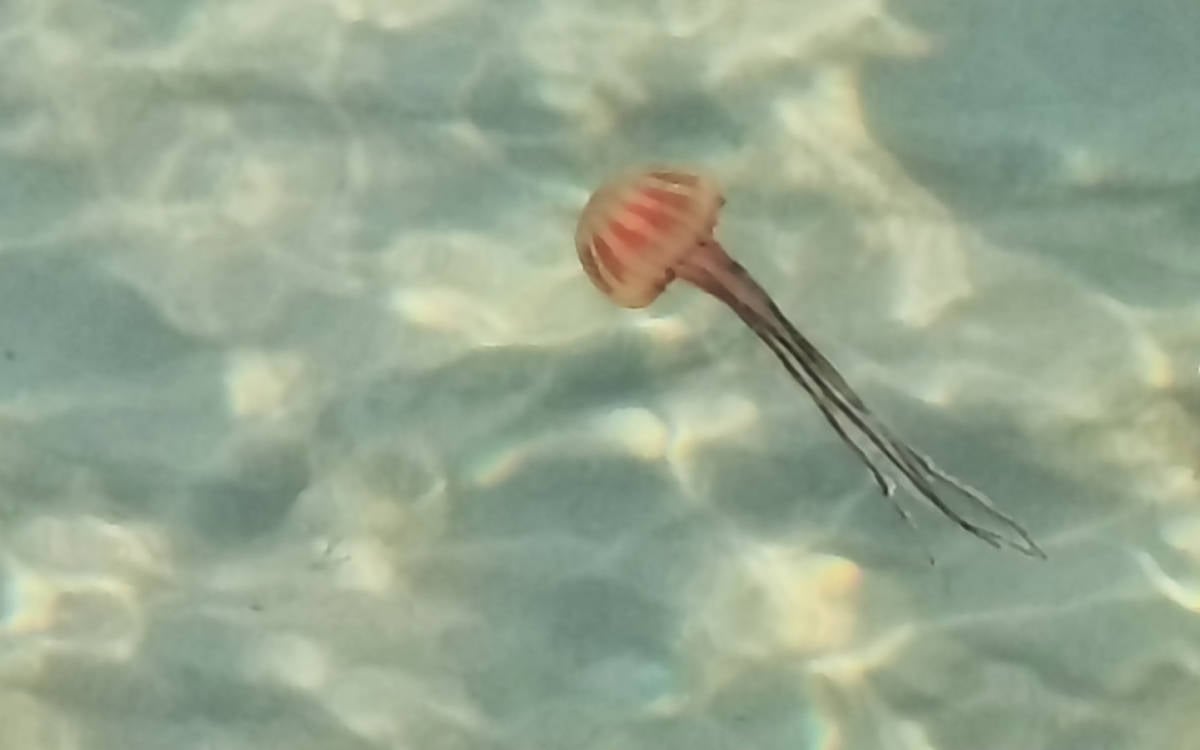



The venomous compass jellyfish (Chrysaora hysoscella) was recently spotted off the coasts of the Şarköy district in Tekirdağ, northwestern Turkey.
Hydrobiologist Levent Artüz said the organism seen on the coast is the compass jellyfish, a species that can be observed along the coasts of Turkey. He added that the species can cause skin irritation due to the stinging cells on its tentacles.
Artüz stated that the compass jellyfish is distributed across the Atlantic Ocean, the Mediterranean Sea, the North Sea, the Aegean Sea, and the Sea of Marmara, noting that its presence in the Sea of Marmara is not new.
"Biogeographically, the compass jellyfish is a native species of the Northeast Atlantic Ocean and the Mediterranean basin," Artüz said. He added that claims suggesting the species was carried to the Marmara region via ballast water from ships do not align with scientific facts.
According to Artüz, the entry of the species into the Sea of Marmara occurred naturally through the two-way current system of the Dardanelles Strait.
'Not an invasion'
Artüz said the first comprehensive hydrobiological studies on gelatinous organisms in the Sea of Marmara were conducted in the 1890s by Russian zoologist Aleksey Alekseyevich Ostroumoff.
Stating that the record of the compass jellyfish in modern literature dates back to 2000 based on sampling from the Erdek Gulf, Artüz said this should not be seen as a new invasion of the species, but rather as the first official academic cataloging date in the modern era.
Artüz listed the primary causes for the species becoming permanent and proliferating periodically in the Sea of Marmara and the İzmit Gulf as human-induced pollution, rising sea water temperatures, overfishing, and eutrophication.
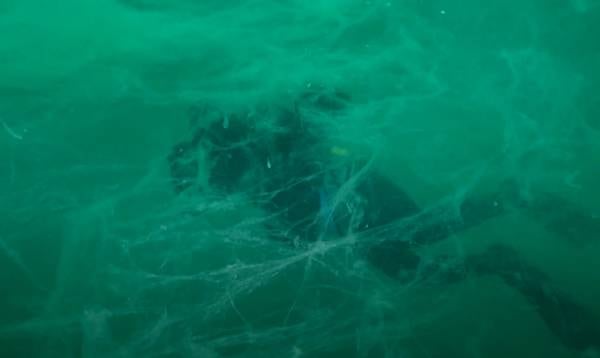
Underwater video reveals return of 'sea snot' in Marmara Sea
Stating that the discharge of domestic, industrial, and agricultural waste into the sea increases the organic load in the upper water body, Artüz said turbidity reduces light transmittance and increases heating in the upper layer. He noted that these conditions support the reproduction and growth processes of the compass jellyfish.
Artüz also said the decline in pelagic fish stocks that feed on plankton, such as anchovies and sardines, due to pollution and overfishing has weakened the natural pressure on jellyfish.
"These are all developments in the form of a decrease in species diversity and a change in competition conditions depending on the increase in the number of individuals of existing species, which is a typical feature of the second stage of pollution," Artüz said, adding that this is called the Rule of Pessimum Conditions in ecology.
What to do in case of contact
The compass jellyfish has stinging cells specialized for hunting and defense on its tentacles. When it comes into contact with human skin, symptoms such as burning, pain, itching, redness, blistering, and whip-like marks can be seen.
Dr. Özgür Deniz Tezcan, who works on venomous marine creatures and is the author of the book Practical Health Guide for Sailors, states that contact with a compass jellyfish can be compared to a bee sting, excluding allergic reactions.
According to Tezcan, there is a possibility of being affected even in case of contact with dead individuals of the compass jellyfish. For this reason, dead jellyfish seen on the shore should not be touched with bare hands.
'We do not know the sea we live by the coast of'
Artüz said that the compass jellyfish is in its own natural habitat, stating that the real problem is human-induced pressures on the marine ecosystem.
"This creature has neither a grudge against humans nor a planned attack," Artüz said, adding that the increase in jellyfish is a cycle that can be seen in the Sea of Marmara every year during the spring and summer months.
Artüz criticized the presentation of this situation in the media every year as a disaster encountered for the first time.
"We do not know the sea we live by the coast of," he said. According to Artüz, the increase in the visibility of compass jellyfish should be viewed alongside pollution, overfishing, and the disruption of ecological balance, rather than just the natural cycles of the marine ecosystem. (YÖ/HA/VK)





.jpg)

