
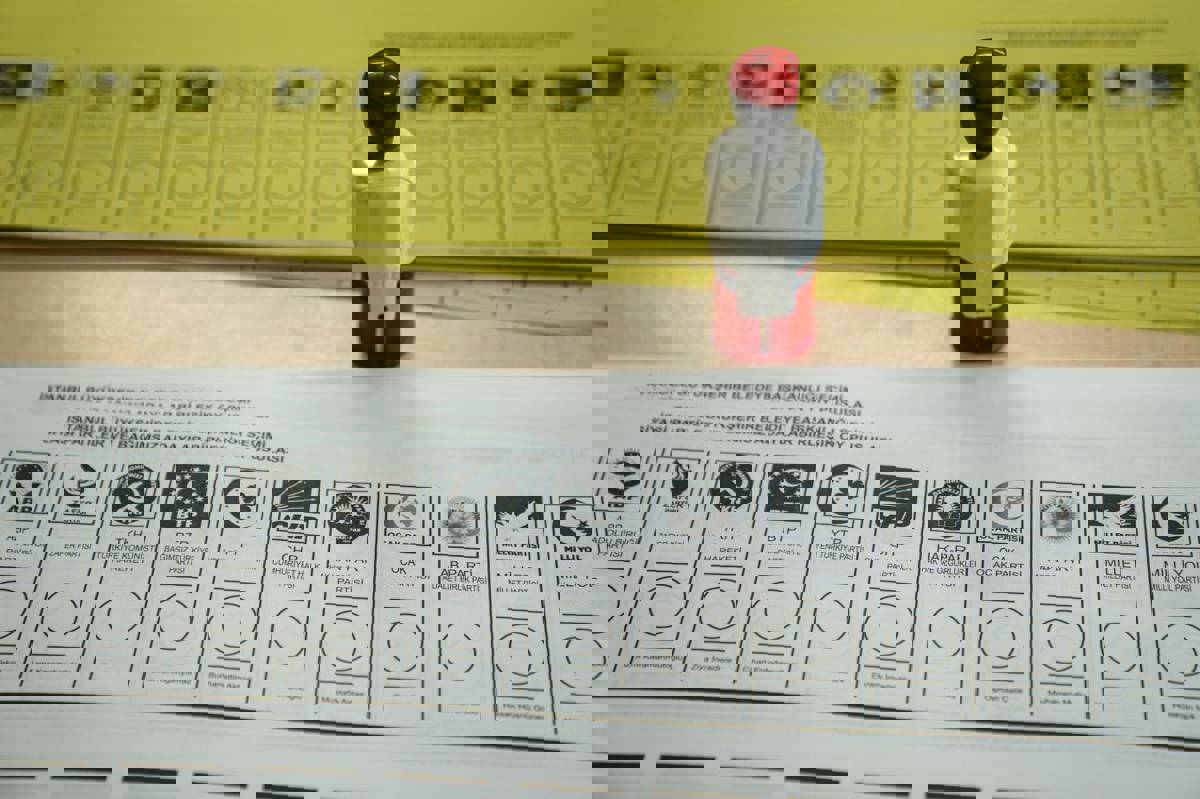



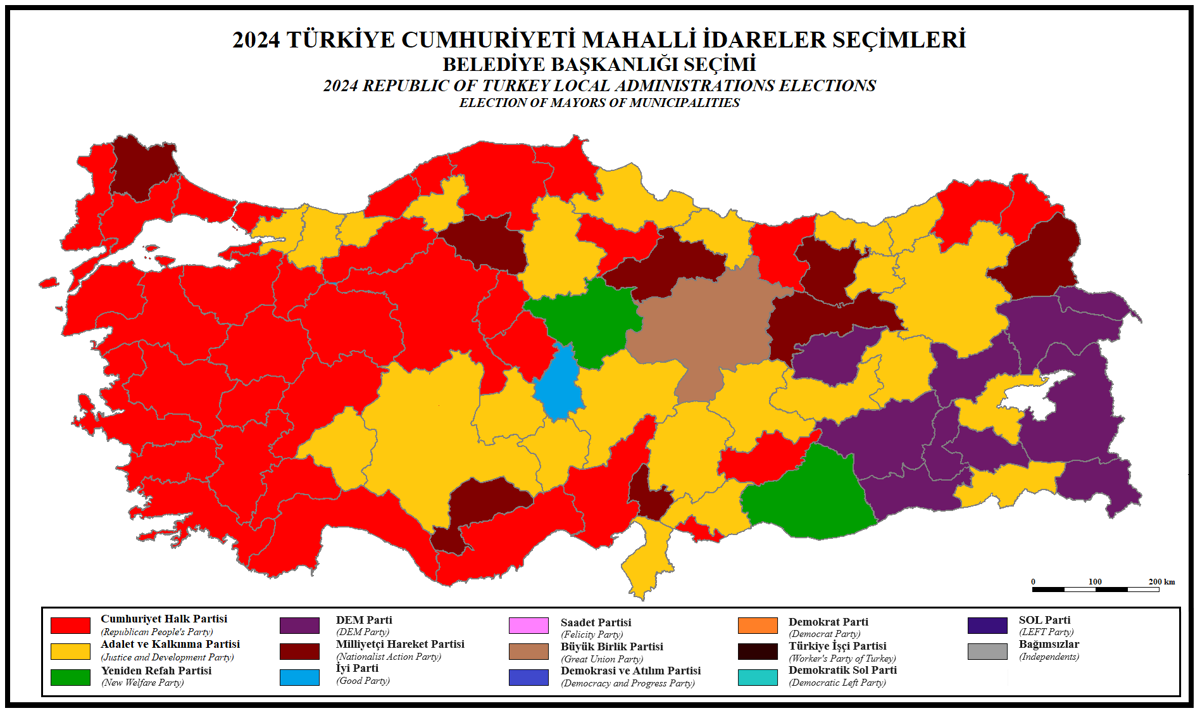
Turkey’s 2024 local elections pushed the ruling Justice and Development Party (AKP) into second place in the overall vote for the first time, while the main opposition Republican People’s Party (CHP) emerged as the leading party with 37.81%.
The result gave the CHP control of 14 metropolitan municipalities, including Ankara and İstanbul, consolidating gains it first made in those cities in 2019.
Suspended mayors
| Municipality | City | Type | 2024 Winning Party | New Administration |
|---|---|---|---|---|
| İstanbul BB | İstanbul | Metropolitan Municipality | CHP | CHP acting mayor |
| Antalya BB | Antalya | Metropolitan Municipality | CHP | CHP acting mayor |
| Adana BB | Adana | Metropolitan Municipality | CHP | CHP acting mayor |
| Beşiktaş | İstanbul | District | CHP | CHP acting mayor |
| Avcılar | İstanbul | District | CHP | CHP acting mayor |
| Beyoğlu | İstanbul | District | CHP | CHP acting mayor |
| Büyükçekmece | İstanbul | District | CHP | CHP acting mayor |
| Beylikdüzü | İstanbul | District | CHP | CHP acting mayor |
| Şile | İstanbul | District | CHP | CHP acting mayor |
| Ceyhan | Adana | District | CHP | CHP acting mayor |
| Seyhan | Adana | District | CHP | CHP acting mayor |
| Manavgat | Antalya | District | CHP | CHP acting mayor |
| Bolu Merkez | Bolu | City | CHP | CHP acting mayor |
| Kuşadası | Aydın | District | CHP | CHP acting mayor |
| Beykoz | İstanbul | District | CHP | AKP acting mayor |
| Bayrampaşa | İstanbul | District | CHP | AKP acting mayor |
| Gaziosmanpaşa | İstanbul | District | CHP | AKP acting mayor |
| Uşak Merkez | Uşak | City | CHP | No election yet |
Early signals
Those earlier losses had already unsettled the AKP. At the time, then-Interior Minister Süleyman Soylu signaled that the government could extend its practice of appointing trustees, previously used in pro-Kurdish municipalities, to CHP-run cities as well. Soylu said trustees had been appointed to municipalities of the Peoples’ Democratic Party (HDP) after President Recep Tayyip Erdoğan expressed discomfort, and similar concerns were later directed at CHP municipalities.
Following the 2019 elections, authorities alleged that members of terrorist organizations had been hired by the İstanbul Metropolitan Municipality and even claimed that utility bill collections could be handled by such individuals.
Post-2024 crackdown
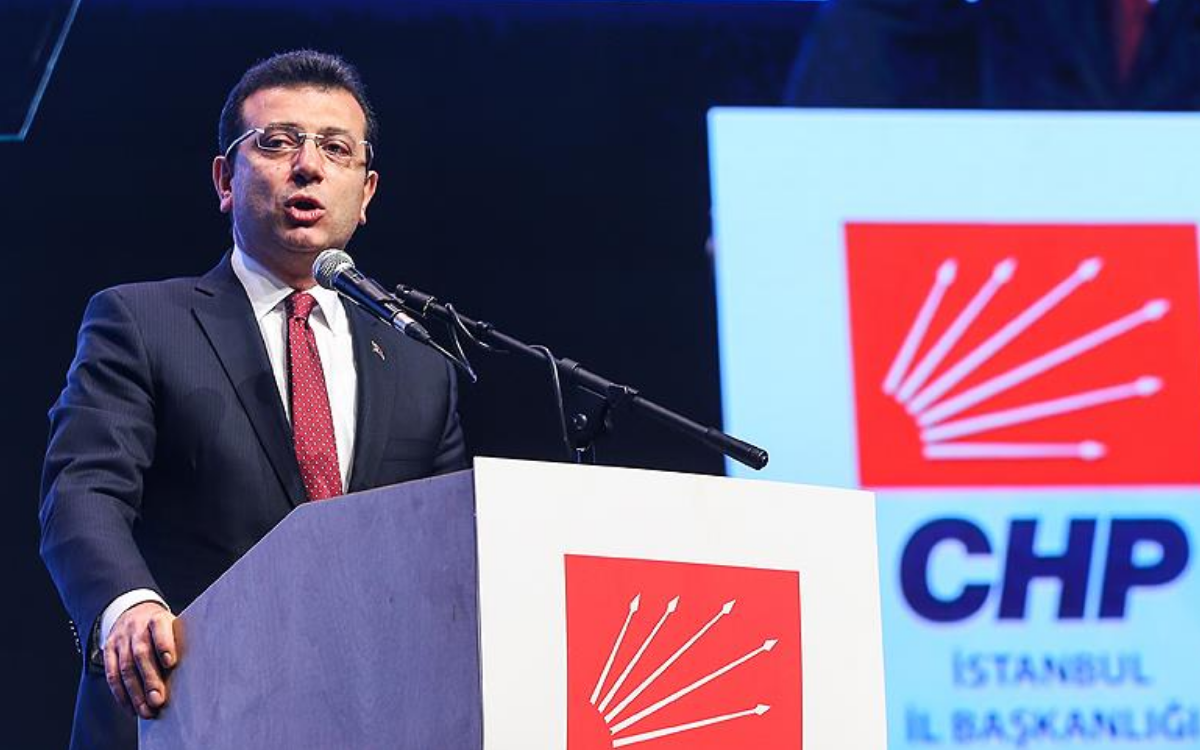
After the 2024 elections, discussions of appointing trustees intensified, particularly as İstanbul Mayor Ekrem İmamoğlu, who had defeated AKP candidates three times, gained prominence as a potential presidential contender. Starting with Esenyurt on Oct 30, 2024, a series of dismissals and trustee appointments targeting CHP municipalities followed.
Indictment seeks up to 2,352 years in prison for İmamoğlu
Changes in local administrations since the elections have significantly altered the political landscape. Due to trustee appointments in municipalities run by the pro-Kurdish Peoples’ Equality and Democracy (DEM) Party and the CHP, as well as party defections, the current balance of power no longer reflects the original voter mandate.
A total of 55 mayors switched to the AKP or its ally, the Nationalist Movement Party (MHP). Party changes among municipal council members also shifted control of three municipalities to the AKP, while trustees were appointed to 13 municipalities.
On Mar 27, Uşak Mayor Özkan Yalım was detained in Ankara as part of a corruption investigation, later arrested, and removed from office.
Most recently, Bursa Mayor Mustafa Bozbey was detained over allegations related to money laundering and forming or joining an organization, tied to his tenure as Nilüfer district mayor between 1999 and 2019.
Under Turkish law, the Interior Ministry can suspend local officials under criminal investigation. In practice, however, such suspensions have become permanent, with no mayor appointed as trustee returning to office in the past decade.
Typically, trustees are appointed in cases involving "terrorism-related" charges, while municipal councils select acting mayors in other cases. In 13 municipalities where mayors were removed on terrorism charges, the Interior Ministry appointed trustees directly.
In these municipalities, not only were elected mayors removed, but municipal councils also effectively lost their governing role. Trustees, along with appointed executive committees, assumed full control, sidelining elected representatives.
No reinstatement
The removal of Esenyurt Mayor Ahmet Özer and Şişli Mayor Resul Emrah Şahan was based on allegations that they cooperated with a terrorist organization under a so-called “urban consensus” during the Mar 2024 elections. Both were later granted release in decisions aimed at avoiding contradictions with the government’s reconciliation efforts. However, Şahan remained in prison due to a separate arrest order.
Court deems local election alliance between Turkey’s main opposition, pro-Kurdish parties a ‘terrorist act’
Nationalist Movement Party (MHP) leader Devlet Bahçeli’s remarks, summarized as “Ahmets to office,” referring to Özer and Mardin Mayor Ahmet Türk, did not lead to the reinstatement of dismissed mayors.
2. Mayors replaced with trustees
| Municipality | City | Type | 2024 Winning Party | Current Administration |
|---|---|---|---|---|
| Mardin | Mardin | Büyükşehir | DEM Parti | Governor |
| Van BB | Van | Büyükşehir | DEM Parti | Governor |
| Esenyurt | İstanbul | District | CHP | Deputy Governor |
| Şişli | İstanbul | District | CHP | District Governor |
| Batman Central District | Batman | City Center | DEM Party | Governor |
| Hakkâri Central District | Hakkâri | City Center | DEM Party | Governor |
| Siirt Central District | Siirt | City Center | DEM Party | Governor |
| Dersim Central District | Tunceli | City Center | DEM Party | Governor |
| Halfeti | Urfa | District | DEM Party | District Governor |
| Ovacık | Tunceli | District | CHP | District Governor |
| Bahçesaray | Van | District | DEM Party | District Governor |
| Akdeniz | Mersin | District | DEM Party | District Governor |
| Kağızman | Kars | District | DEM Party | District Governor |
3.Municipalities changing hands by politician transfers
| Belediye | İl | 2024 Winning Party | Current Administration |
|---|---|---|---|
| Aydın BB | Aydın | CHP | Transfer to AKP |
| Birecik | Urfa | DEM | Transfer to AKP |
| İkiköprü | Batman | DEM | Transfer to AKP |
| Söke | Aydın | CHP | Transfer to AKP |
| Vakfıkebir | Trabzon | Bağımsız | Transfer to AKP |
| Arsin | Trabzon | YRP | Transfer to AKP |
| Beşiri | Batman | YRP | Transfer to AKP |
| Dulkadiroğlu | Kahramanmaraş | YRP | Transfer to AKP |
| Yalvaç | Isparta | İYİ Parti | Transfer to AKP |
| Yenipazar | Aydın | CHP | Transfer to AKP |
| Sultanhisar | Aydın | CHP | Transfer to AKP |
| Şehitkamil | Gaziantep | CHP | Transfer to AKP |
| Altınova | Yalova | CHP | Transfer to AKP |
| Diğer 42 belde | Çeşitli | Karma | AKP / MHP |
Alongside dismissals driven by investigations and court cases, political defections have further reshaped local governance. One of the defecting mayors held a metropolitan post.
As a result, mayors who collectively received more than 8.8 million votes out of 17.2 million cast to win their positions have been replaced, or their municipalities are now governed by parties other than those originally chosen by voters.
In the 2024 elections, the CHP won 412 municipalities, the AKP 354, the MHP 220, and the DEM Party 78. Nearly two years later, the AKP-MHP alliance has gained control of 78 additional municipalities through defections and trustee appointments. (Mİ/VK)