












Today marks 128 years since Mikdat Midhat Bedirxan published the first Kurdish newspaper, Kurdistan, in Cairo, Egypt, on Apr 22, 1898.
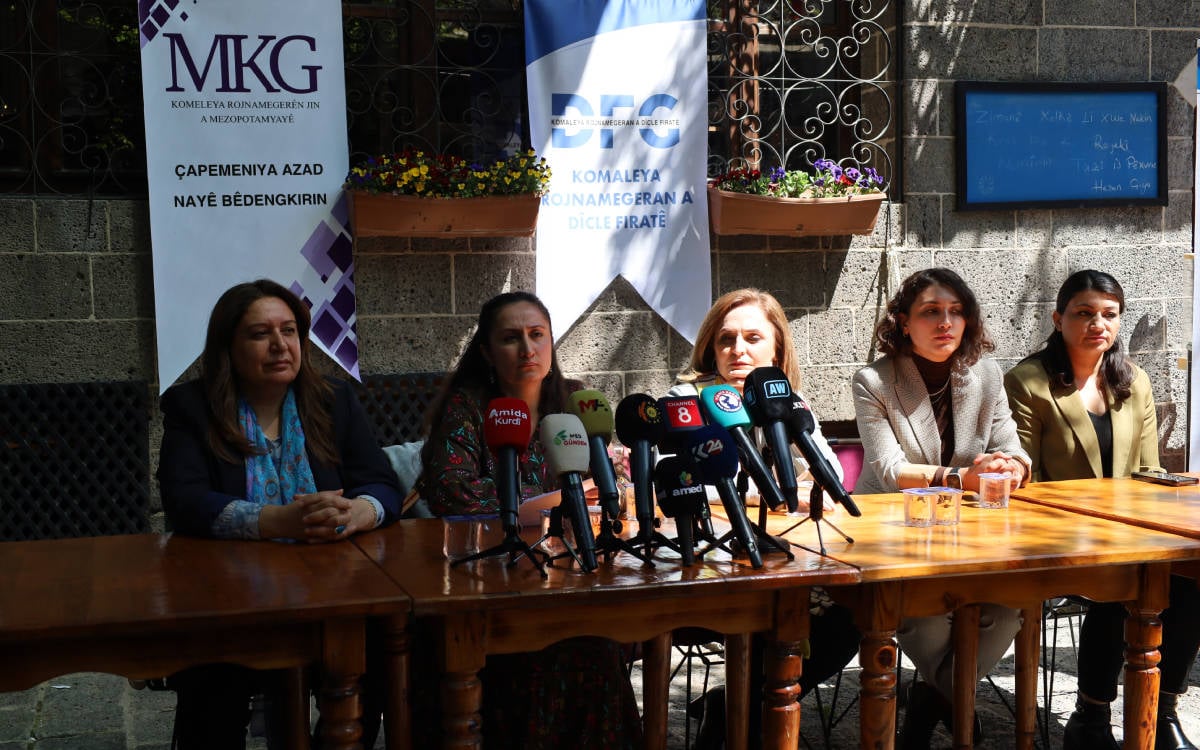
The Dicle Fırat Journalists Association (DFG) and Mesopotamia Women Journalists Association (MKG) gathered in Diyarbakır today to mark the Kurdish Journalism Day, celebrated since 1973.
Speaking on behalf of both associations at the event, MKG Chairperson Roza Metina said that Kurdish journalism today is under detention, arrest, judicial pressure, censorship, access bans, economic siege, and digital attacks.
"Targeting journalists during news coverage, attempting to make press institutions invisible, closing accounts on digital platforms, and blocking news content are open attacks on the public's right to reach the truth," she said.
"Reports from international and local press freedom organizations reflect deepening digital censorship against journalists and news outlets, practices harming the right to a fair trial in press cases, and systematic pressure on media outside the government line. This picture is not accidental. Pressures on Kurdish journalism are part of the policy to silence the truth and leave society in the dark."
Kurdish journalists targeted in new wave of online censorship
Metina commemorated all journalists who lost their lives for press freedom and noted their solidarity with colleagues held in prisons, facing trial, threatened, forced into exile, or prevented from working.
Calling on international press organizations and human rights institutions, she said, "Do not remain silent against the pressures on Kurdish journalism and free press workers. Take a clear stance against policies trying to show journalism as a crime. Writing the truth is not a crime. Defending the public's right to receive news is one of the most basic conditions of a democratic society. We will not take a step back in the face of pressure; we will continue to defend the word of women, the truth of peoples, and the Free Press tradition."
'Kurdish press is essential for Kurdish people'
Peoples' Equality and Democracy Party (DEM) Party Spokesperson Ayşegül Doğan also spoke at the event.
"There was exile 128 years ago, and today there is pressure and siege. There is pressure on the entire press, but this pressure is even greater on the Kurdish press," Doğan said.
Recounting her recent visit to imprisoned journalist Nedim Oruç, a reporter for Ajansa Welat, Doğan said, "Nedim was also arrested for political rather than legal reasons. He was practicing journalism during the attacks on Eşrefîyê and Şêxmeqsûd and was arrested. He was arrested unjustly, and his hearing is soon.
"I am making a call from here and asking for the release of all journalists arrested due to journalism. Nedim sent his greetings. He said he misses practicing his profession, his friends, and his daughter. We must grow this solidarity. I once again celebrate Kurdish Journalists Day. May this be an occasion for the alliance, peace, and freedom of the Kurdish press, the Kurdish people, and those living with Kurds."
Journalist Nedim Oruç detained while covering protest in Şırnak over Aleppo clashes
DEM Party Deputy Co-Chair Tayip Temel also called for the release of imprisoned journalists in a written statement to mark the day.
He mentioned that the Kurdistan Newspaper, which Mîqdat Mîdhed Bedirxan began publishing in Cairo, was the "first torch lit in exile, under impossible conditions and great pressure." He called it "the first institutional step in the search to make the voice of a people heard by the world."
"Kurdish journalism has maintained its existence against pressure, censorship, and bans throughout history, having to pay great prices," the statement read. "The Kurdish press, prevented from making its voice heard in its own lands, has struggled to exist all over the world from Cairo to Geneva, London to İstanbul. Kurdish Journalism Day, celebrated since 1973, has insisted on walking in the footsteps of truth and stubbornly continued the free press tradition on the path opened by Mîqdat Mîdhed Bedirxan despite continuous attacks, obstacles, destruction and assimilation policies, and massacres.
.jpg)
IMPRESSIONS FROM DİYARBAKIR
Kurdish journalists released after 400 days, but justice remains elusive
"Today, the journalism profession is still under heavy threats. The presence of our colleagues who are tried and arrested for their reports, and whose pens are sought to be broken, is the biggest obstacle before Peace and Democratic Society. On this occasion, we reiterate that journalism activities are not a crime and that journalists in prisons should be released immediately."
He commemorated Musa Anter, Gurbetelli Ersöz, Nagihan Akarsel, Cihan Bilgin, and Nazım Daştan, along with all killed Kurdish journalists. (HA/VK)

