
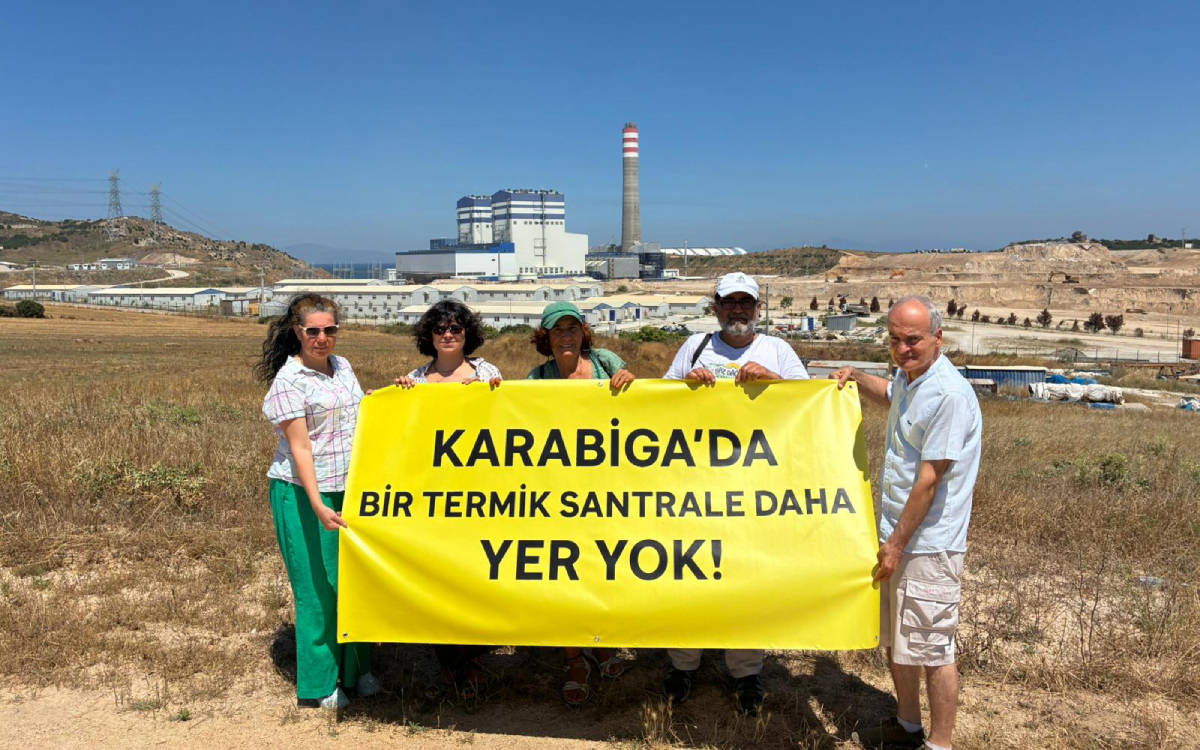



The official permitting process has begun to expand the capacity of the Cenal Coal Power Plant located in the Karabiga town of Biga, Çanakkale in northwestern Turkey.
The plant operated by Cenal Elektrik Üretim A.Ş., which uses imported coal, currently has an installed capacity of 1,320 MW. The company submitted an application to the Environment, Urbanization and Climate Change Ministry to add a new 1,050 MW unit, raising the total installed capacity to 2,370 MW.
Cenal Elektrik Üretim A.Ş. was established in 2011 as a joint venture between Cengiz Holding and Alarko Holding, two major conglomerates in the country. The first unit of the plant in Karabiga became commercially active in Nov 2017, followed by the second unit in Dec 2017. Following the separation of Alarko Holding and Cengiz Holding's energy partnerships, the plant remained with Cengiz Holding.
Environmental concerns and zero new employment
The company calculated the investment cost of the project at 18.7 billion liras in the project file submitted to the ministry. Financing will be provided by Denizbank, Halk Bank, Finansbank, Ziraat Bank, and AlstomEPC.
The project area falls within the boundaries of forest areas, agricultural land, urban development zones, and water surfaces according to the Balıkesir-Çanakkale Planning Region 1/100,000 scale environmental plan. The construction process also envisions building a concrete plant in the area.
While 130 personnel are expected to work during the 48-month construction phase, no new workers will be hired to operate the expanded plant. The company plans to run the new unit using the existing plant workforce.
İzmir coal-fired plant continues operations despite court ruling
The current plant generates approximately 9.9 billion kWh of electricity per year, meeting 3% of Turkey's electricity needs. The new unit is projected to add another 7.8 billion kWh to annual production.
According to open sources, the plant's current coal requirement is about 3.3 million tons per year. The amount of coal to be used after the capacity increase is not yet clear at this application stage. The project file states that coal can be supplied from Russia, Colombia, South Africa, or Indonesia.
In its current state, the plant causes 10 million tons of CO2 equivalent greenhouse gas emissions annually.
Imported but 'domestic and national'
Despite being using imported, the company emphasized a "domestic and national" focus in its project file:
"National Energy Source: It contributes to reducing foreign dependency in energy by ensuring that domestic coal reserves are converted into energy using human-oriented and environmentally friendly technologies."
During the operational phase, the plant plans to meet all its water needs, including cooling water, process water, and drinking water, from seawater. The facility is expected to use seawater at a capacity of 152,500 cubic meters per hour.
Maraş coal-fired plant expansion could lead to ‘1,900 premature deaths'
Effectively a new plant
A group of 15 non-governmental organizations working in the climate and environment fields protested the project in a joint statement.
The NGOs stated that the 1050 MW capacity increase effectively means a brand new imported coal power plant:
"Turkey's initiation of the permit process for a new imported coal-fired thermal power plant in Çanakkale, while preparing to chair the COP31 Climate Summit, contradicts its claim of climate leadership. In the details of the project, which is expressed as a 'capacity increase' in the EIA application file, we see that the construction of a separate boiler and a separate chimney is planned, which will almost double the coal consumption. This capacity increase of 1,050 MW means a new imported coal plant.
"There are already five other coal-fired power plants in Çanakkale. Estimates regarding the health effects of these plants indicate that they have caused at least 3,167 premature deaths since 2005. The economic cost of the cumulative health effects of the plants is calculated to be approximately 7 billion dollars.
"Scientific data shows that the main cause of the climate crisis is fossil fuels, namely coal, gas, and oil. Despite this, planning new imported coal plant investments contradicts Turkey's 2053 net-zero target and its strategy to reduce dependency on imported resources and foreign debt.
"While COP31 President and Environment, Urbanization and Climate Change Minister Murat Kurum talks about 'making clean electricity the backbone of economies and societies' and 'accelerating decarbonization,' the Energy Ministry granting a license for a new coal plant that will burn entirely imported fuel and emit high amounts of greenhouse gases shows that contradictory approaches are being adopted between the Environment, Urbanization and Climate Change Minister and the Energy and Natural Resources Minister. This contradiction is worrying for the fate of COP31."
Although the company included a section titled "Cumulative environmental impact assessment" in its capacity increase application file, it did not present a detailed account of the existing environmental burdens in the region or the total combined impact with other thermal power plants. It noted that these assessments were left for the EIA report to be prepared later.
Maraş thermal plant linked to thousands of deaths 'still running without filters'
Past court cases
The environmental impact assessment (EIA) processes of the Cenal Coal Power Plant have been the subject of lawsuits in the past.
The Karabiga Clean Nature Association, the Union of Municipalities of Mount Madra and Mount Kaz, the Biga Environment Association, professional chambers affiliated with TMMOB, and local residents of Karabiga took the deficiencies in the EIA report prepared during the establishment phase of the plant to court.
Although the Çanakkale Administrative Court rejected the case in May 2016, a reversal decision came from the Council of State in Nov 2018. The Council of State canceled the "EIA Positive" decision. However, the plant continued to burn coal, arguing that the Council of State did not issue a stay of execution. Subsequently, a new "EIA Positive" decision was granted for the plant in 2019.
The plant's current 1,320 MWe production license was obtained in 2013 and is valid until 2062. Upon the company's capacity increase application, the Energy Market Regulatory Authority (EPDK) accepted the request to increase the production license by 1,050 MWe and raise the number of units from two to three, on the condition that the project receives EIA approval.

TURKSTAT STATISTICS
Half of 18.2 billion cubic meters of water abstracted by thermal plants in 2020
Missing data
Serious problems have occurred in the past regarding sharing data on emissions, chimney performance, and waste management of existing thermal power plants in Çanakkale with the public. Courts have ruled in favor of the right to information. Despite this, deficiencies in disclosing environmental data to the public continue.
For instance, Çanakkale's Lapseki district is among the top 10 stations exceeding the World Health Organization's 24-hour average guideline value of 15 µg/m3 for more than 4 days throughout the year. Sufficient data for measurement could not be obtained from the Çanakkale Çan industrial air quality measurement station in 2022 and 2023.
HEAL: Coal pollution in Turkey caused nearly 200,000 premature deaths in 55 years
On a daily basis, Turkey produces approximately 1.14 million MW of electricity. Consumption stands at 1.133 million MW. Hydroelectric power plants with dams rank first in electricity generation with a 24% share. Imported coal plants rank second with a share of 17.7%, followed closely by solar power plants at 16.9%.
Turkey currently has 37 active coal-fired thermal power plants with an installed capacity of over 30 MW, totaling an installed capacity of 20.8 GW.
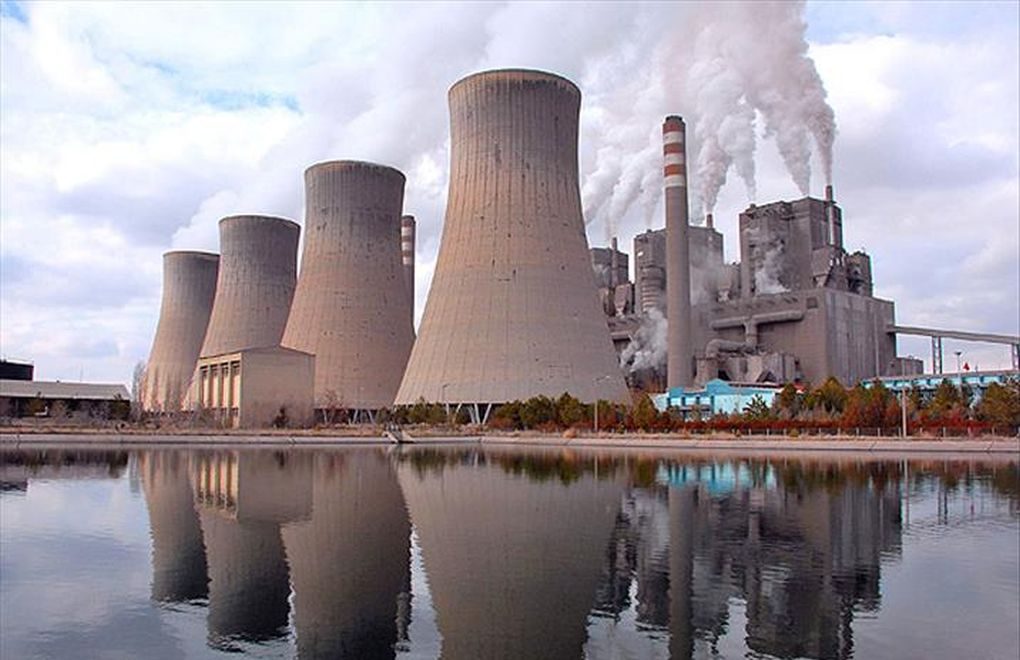
15 Thermal Plants to Operate Without Filters for Another 2.5 Years by AKP, MHP Votes
Net-zero target
The non-governmental organizations opposing the project noted that Turkey imports 78% of the fossil fuels it uses for energy production.
Stating that the insistence on fossil fuels results in "foreign dependency in energy, high bills, worsening air, water, and soil pollution, and increasing health problems," the NGOs called out Minister Murat Kurum:
"Turkey, which imports 78% of the fossil fuels (oil, gas, and coal) it uses for energy production, sees its insistence on fossil fuels return to us as foreign dependency in energy, high bills, worsening air, water, and soil pollution, and increasing health problems. Especially recent wars and geopolitical tensions have once again shown how vulnerable countries become due to dependency on fossil fuels.
"We demand that Environment, Urbanization and Climate Change Minister and COP31 President Murat Kurum terminate the EIA process of the new coal plant project, which is sought to be implemented under the name of capacity increase in Çanakkale-Biga, cancel both coal power plant projects along with the project in Afşin-Elbistan, and take concrete steps toward a fair and planned exit from fossil fuels."
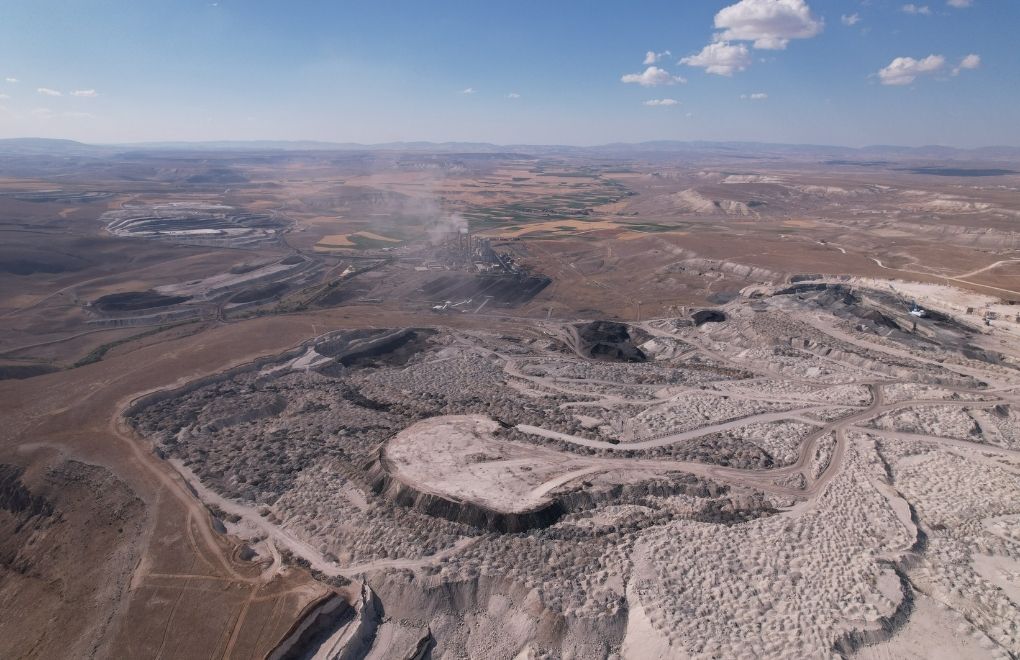
Zero coal target: 'Turkey can replace coal sites with solar energy fields'
The hidden cost of coal
According to a recent report by Greenpeace Turkey, the hidden cost of coal to the country is 592.1 billion liras annually. This figure corresponds to approximately 21,500 liras per household.
In other words, according to the report's methodology, the extra cost of coal per household every year is more than a single retirement pension. Additionally, state subsidies and support for coal reach a total of 133 billion 729 million liras per year. (HA/VK)