









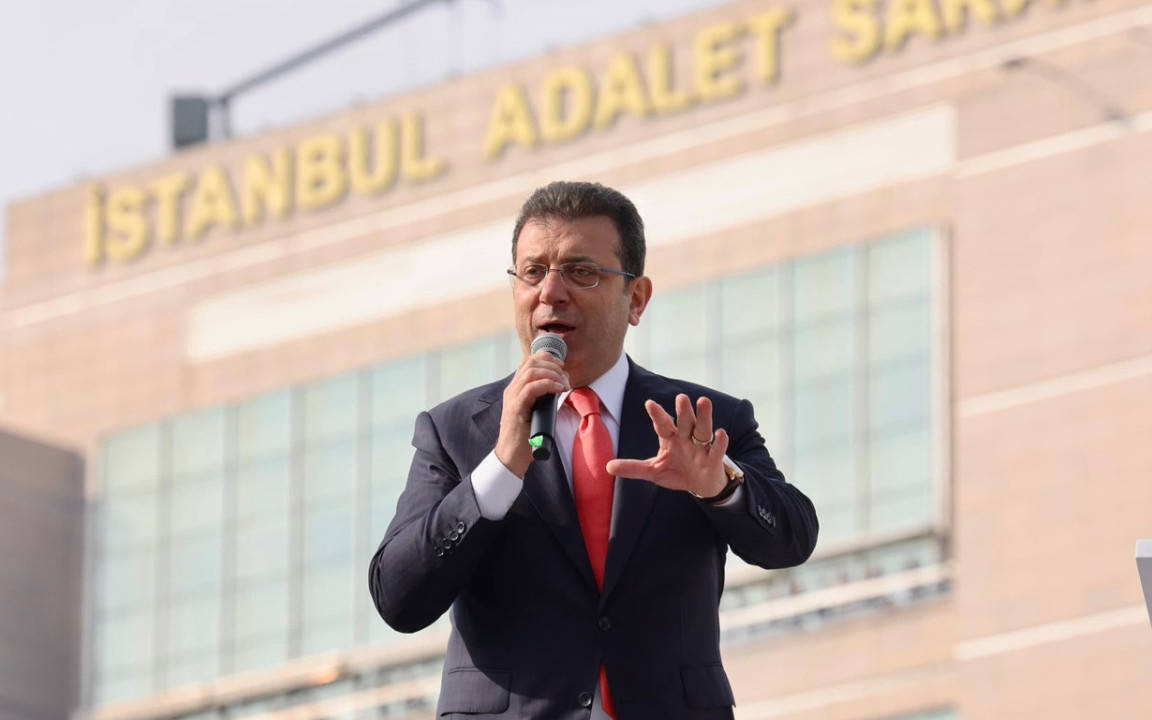



The European Court of Human Rights (ECtHR) has requested a defense from Turkey regarding the application of Ekrem İmamoğlu, the suspended mayor of İstanbul and presidential candidate for the main opposition Republican People’s Party (CHP).
The court also requested copies of relevant sections of the investigation file and all documents in the case file from the government.
İmamoğlu has been held at the Marmara penal court complex in Silivri, İstanbul since Mar 2025. He is being tried while in detention on charges of forming and leading a criminal organization, bribery, interfering with public tenders, and unlawfully obtaining personal data.
İmamoğlu appealed his detention to the Constitutional Court on May 13, 2025, but did not receive a result. While his file was pending, he applied to the ECtHR in Nov 2025.
The ECtHR placed the application on its agenda on Mar 23 and requested a defense from Turkey on Apr 13. The court directed six questions to the government.
Indictment seeks up to 2,352 years in prison for İmamoğlu
Questions by the court
The questions cover a broad framework, ranging from the legal basis for the arrest to potential political motivations and whether the right to be elected and democratic participation were restricted.
The high court first asked whether İmamoğlu had exhausted effective domestic remedies. It then questioned whether the arrest was based on reasonable suspicion of a crime and if available evidence was sufficient to convince an objective observer that a crime had been committed.
The court also asked whether the decisions to continue the detention included relevant and sufficient justifications, if the duration of the detention was reasonable, and whether restrictions on file access prevented an effective right to appeal.
Four of the questions are standard inquiries the ECtHR makes in all detention applications. However, the fifth and sixth questions were asked for the first time in the case of İmamoğlu. These two questions cover whether the arrest was made for political motives and whether this claim directly targets his candidacy in the presidential elections.
Questions 5 and 6
- Were the restrictions imposed by the State in the present case, purportedly pursuant to Article 5 of the Convention, applied for a purpose other than that envisaged by those provisions, contrary to Article 18 of the Convention (see Rasul Jafarov v. Azerbaijan, no. 69981/14, §§ 153-163, 17 March 2016, and Selahattin Demirtaş v. Turkey (no. 2) [GC], no. 14305/17, §§ 421-438, 22 December 2020)?
- Is Article 3 of Protocol No. 1 to the Convention applicable regarding the alleged restrictions on the applicant’s participation in the presidential elections (see, for the general principles, Brito da Silva Guerra and de Sousa Magno v. Portugal (dec.), nos. 26712/06 and 26720/06, 17 June 2008, with further references)? Did the institution of criminal proceedings against the applicant and the applicant’s pre-trial detention, allegedly imposed for political purposes, prevent him from exercising his right to stand for election and to participate effectively in the electoral process, in breach of Article 3 of Protocol No. 1 to the Convention (see, for the general principles, Selahattin Demirtaş, cited above, §§ 382-89)?
The request for a defense from Turkey does not mean the ECtHR has found the application admissible or ruled on a violation. This stage is a procedural interim step where the court seeks a defense and additional information from the state. A decision on the merits of the application will be made later.
This period usually takes several months. However, the ECtHR decision for a priority review in this file could reduce the timeframe to six weeks. (HA/VK)

