





In the recent past, Turkish rap has become one of the most profitable and largest genres in the Turkey's music industry. Spilling out of phones, cars, and venues, this music represents a glittering market that has reached billions of streams. However, behind this glittering facade lies a deep process of apoliticization and loss of identity—reminiscent of Turkey’s sociological erosion—as the genre turns its back on its roots and its very purpose.
To trace the origins of this transformation, we must look to Turkish rap’s past in Germany, where it emerged not merely as part of the entertainment industry but as a struggle for existence.
In Germany in the late 1980s, the children of the Gastarbeiter generation were living in a limbo, caught between two cultures. Street gangs like the 36 Boys, formed by these young people who faced racism and exclusion in Germany, went beyond simply erecting barricades against Neo-Nazi attacks; they were also drawing their own cultural boundaries in defiance of the hegemony they faced in Germany. As artists like Boe B, Killa Hakan, and Cartel brought hip-hop’s rebellious spirit from the Bronx to Kreuzberg, rap evolved from a mere music genre into a form of resistance embodied in the diaspora’s anthems of rebellion. For the first generation of Turkish rappers, the microphone was the direct instrument of their existential struggle against assimilation and racism. Rap during this period was highly political; after all, simply existing as an immigrant on those streets was a political stance in and of itself.
This state of othering, rooted in immigration in Germany, underwent a sociological metamorphosis when it was transported to Turkey via the Berlin-Istanbul corridor in the early 2000s, transforming into class-based anger. Artists such as Ceza, Sagopa Kajmer, and Fuat skillfully translated the sense of victimization experienced in Germany into the socio-economic stagnation of Istanbul’s impoverished outlying neighborhoods. Culture had begun to serve not only as the voice of the expatriates but also as the voice of the city’s poor, who had been rendered invisible.
This phase marked the golden age—in qualitative terms—of Turkish rap, as young people deprived of economic resources and equal opportunities built their own cultural capital. Rather than through violence, these young people began to channel the anger building inside them by poring over dictionaries, making sociological observations, and blending literature with street slang.
“We come from the streets, and we tell the stories of the streets and the underground. Those rosy pictures shown on TV don’t reflect Turkey’s reality. Politicians turn a blind eye to our problems; they don’t hear our voices. We have no weapons; we only have our microphones and our words. With this microphone, we shout out our rebellion, our poverty, and how the system crushes people. Rap is the voice of the silenced and the ignored. Young people are venting the immense anger and frustration building up inside them—not through violence, but through words and music.” (Ceza – Crossing the Bridge, 2005) – Director: Fatih Akın)
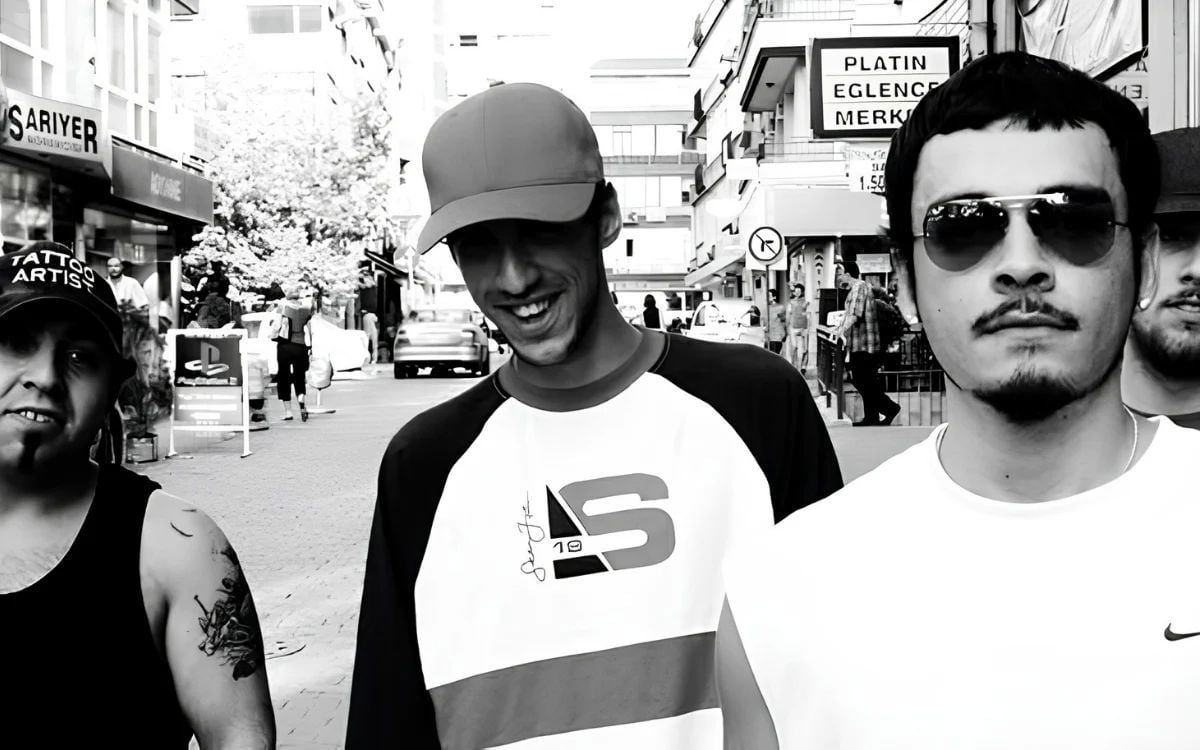
The early 2000s marked a period when computers and home microphones became widespread, making production tools more affordable. Bedroom studios and internet forums created “autonomous zones” aimed at breaking the monopolies in the music industry. The pseudo-libertarian atmosphere felt in the country from the mid-2000s through 2013 led to different subcultures coming into contact with one another. Underground rap broke out of its ghetto and seeped into the gaps left by popular culture. Independent collectives established in many cities, along with underground albums and low-cost concerts, demonstrated that fully independent production and distribution were possible without relying on the capitalist industry.
As is the fate of any subculture that reaches a wide audience, Turkish rap also came onto the radar of the capitalist media industry once it gained popularity. In the second half of the 2010s, as digital platforms swallowed up physical media, artists rediscovered by the mainstream were subjected to a process of cultural gentrification. The sharp edges of the culture were almost entirely smoothed out in the pursuit of market share.
Independent rappers who rapidly attained capital, fame, and massive incomes quickly became apolitical to avoid losing these comfort zones and to steer clear of backlash from the shifting, harsh political climate. Lyrics that previous generations used to voice social injustices have given way to 808 basslines, pop/trap formats, luxury cars, and a hollowed-out mafia romanticism. The street has ceased to be a lived reality and has transformed into a synthetic image seen only in music videos.
The concept of “Battle Rap,” which has grown unchecked within rap culture and is used solely for quick social media engagement, has stripped musical production of its substance. Shows built entirely around “dissing” have completely overshadowed the literary depth and musical quality of the songs. The art of writing good lyrics and crafting compositions has been replaced by the pursuit of insulting one’s opponent and capitalizing on the energy of a hooligan-like crowd.
Amid this apolitical lethargy, one exceptional example that integrated into the mainstream while delivering political and social criticism through a modern trap/reggae sound was Ezhel’s album *Müptezhel*. The album, which combined class inequality, poverty, and a lack of future prospects with high-quality production, sparked a massive awakening. However, the state apparatus’s response to this dissenting reflex was ruthless. The legal proceedings, imprisonment, lynch campaigns, and life in exile that Ezhel was subjected to served as a clear ultimatum from cultural censors to the rap community. While this case institutionalized fear and self-censorship, the new generation of rap turned turning a blind eye to social issues into an industry standard.
Today, Turkish rap has completely lost its cultural influence, falling prey to bot streams, copycat songs, and a network of superficial connections. Looking at the works dominating the current market, it is evident that the culture reflecting the socio-cultural atmosphere has been replaced by caricatured mafia-style pretensions, misogyny, and hollowed-out identities. The vast majority of songs are confined to displays of synthetic wealth, meaningless choruses, and plastic gang simulations that normalize crime. As the quality of music and lyrics is sacrificed to the anxiety of going viral in 15 seconds, rap has ceased to be the language of rebellion and has transformed into a corrupt showcase of capitalist consumption.
So, is it possible to escape this aesthetic abyss?
We can look for the answer in America’s own historical cycle. Just as Turkish rap was born in Kreuzberg, American rap also took root in the 1980s and 1990s as a political line of resistance in the hands of Black poets. Figures like Grandmaster Flash, Public Enemy, Tupac, and N.W.A. used music as a tool of struggle against racism and systemic oppression. However, in the 2000s, this culture succumbed to the industry—just as is happening in Turkey today. During this era, known as the “Bling Era,” major corporations stripped rap of its political edge, transforming it into a plastic product based on luxury consumption, chunky necklaces, and misogyny.
Yet American rap managed to rise from the brink of death. In the late 2010s and 2020s, visionary lyricists like Kendrick Lamar, J. Cole, and Tyler, the Creator established themselves as influential figures in the industry not only through their literary talent but also through the organic business structures they built (TDE, Dreamville, etc.). Thanks to these structures, which freed production from exploitative corporate monopolies, profound sociological observations conquered the mainstream from within. The pinnacle of this awakening was Kendrick Lamar’s winning of the Pulitzer Prize for his album *DAMN.* Awarded for the first time in history to an artist outside the realms of jazz or classical music, this prize was the most concrete proof that the new generation could restore the power rooted in their heritage to American rap music.
The salvation of Turkish rap also lies in bold, intellectual steps that leverage digital possibilities. The path to lasting success in this poisoned industry lies in the emergence of strong lyricists, artists uniting by establishing independent structures, and reinterpreting the first existential rebellion in Kreuzberg as a cultural rebellion in today’s complex world. Because Turkish rap is not a sterile entertainment space or a commercial project; it is a survival reflex born out of oppression and marginalization. (ECS/VK)