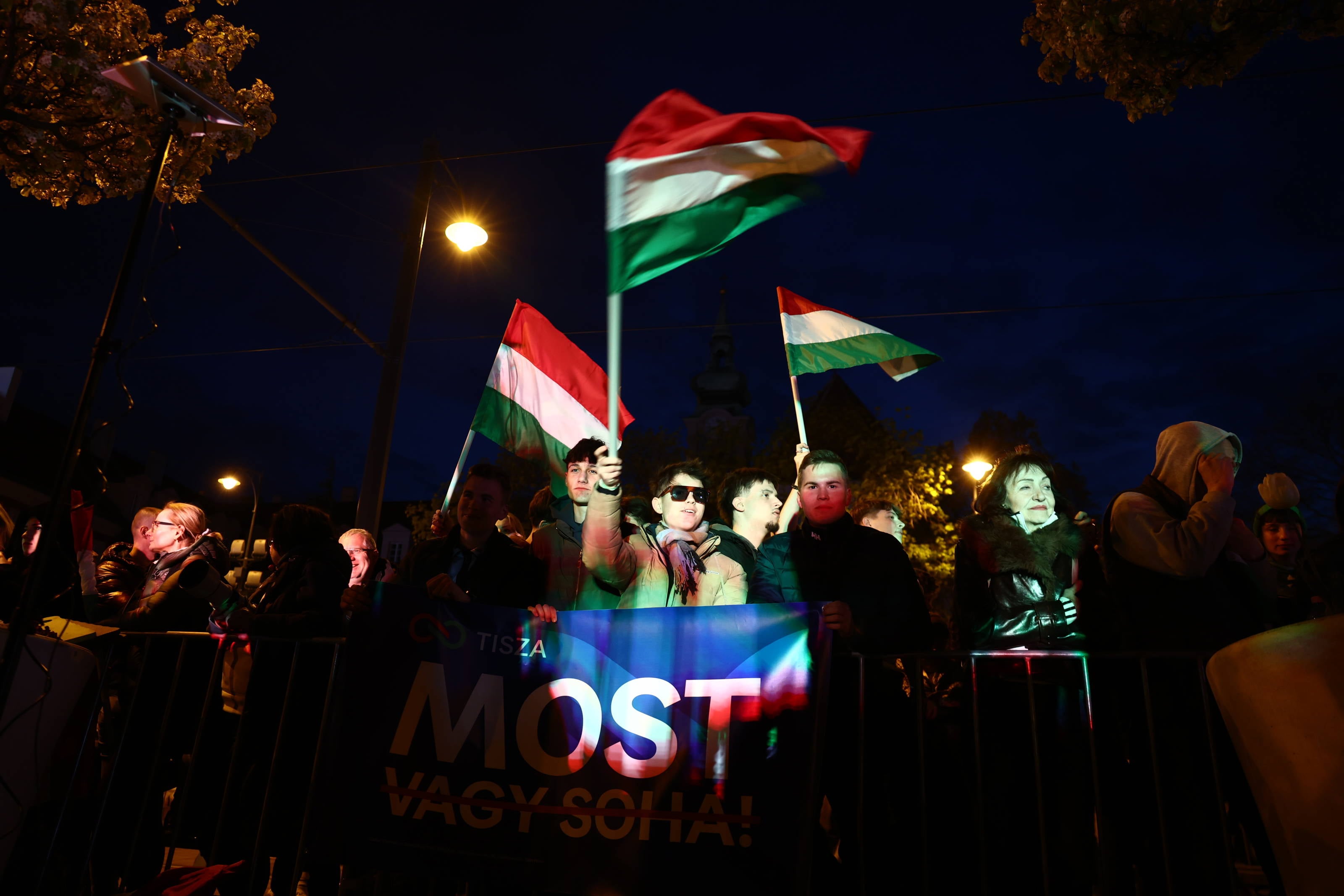




Minutes after Viktor Orbán conceded defeat in Hungary’s general election, tens of thousands of mainly young people spilled out onto the streets of Budapest in wild jubilation. Complete strangers high-fived, linked arms, broke into song and chanted Szabad Magyarország! (Free Hungary), and the revived 1956 revolutionary slogan Ruszkik haza (Russians go home!). I found myself embraced by one euphoric youngster who said “he’s gone, he’s finished! I’ve no clue who you are, but I adore you!”.
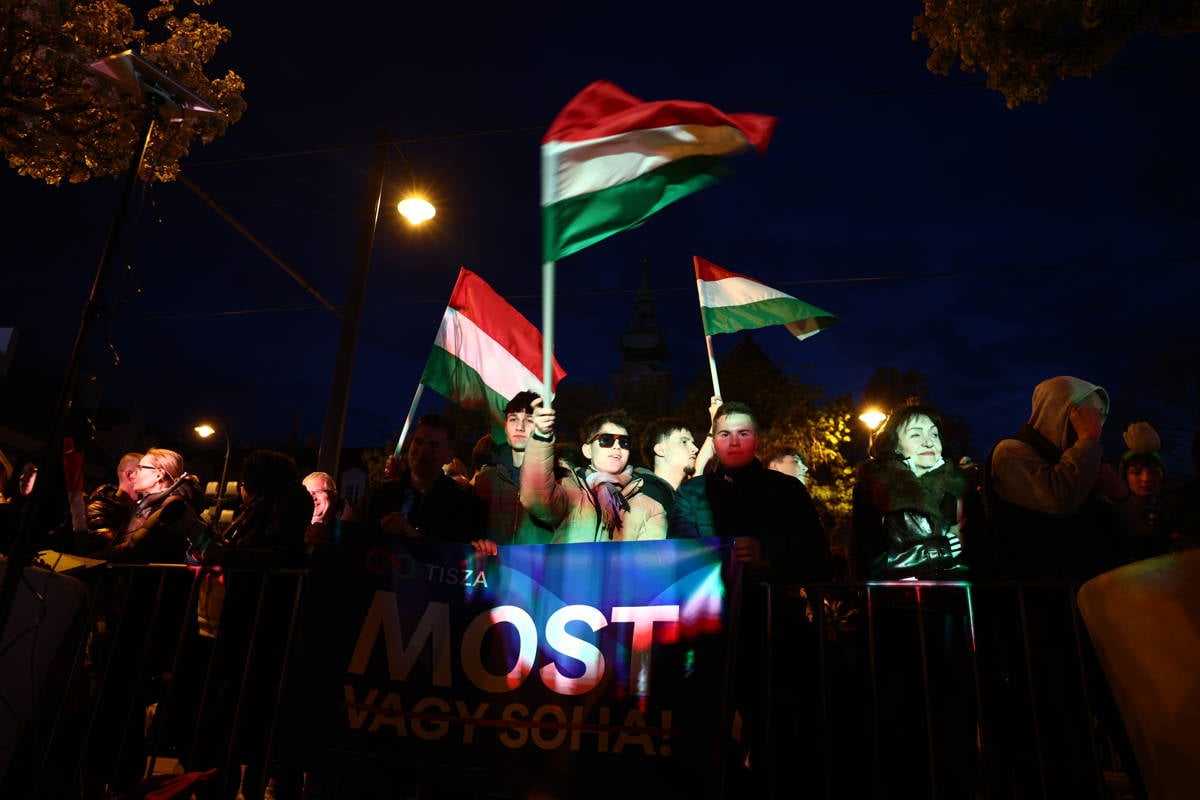
On a night like no other in Hungarian election history, amidst the cacophony of car horns blaring, and groups cheering and chanting, people waved EU flags, Hungarian tricolours, climbed on top of bus shelters, tore down, shredded and stomped on Fidesz election posters, and danced in the streets as the full extent of the regime’s defeat became apparent.
There can be no doubt that most of the celebrating masses of young urban left-liberals are more radical, more progressive, and more cosmopolitan than the Tisza party they voted for. But after 16 years of corrupt misrule and democratic backsliding, this election was make or break, summed up in the Tisza campaign slogan Most Vagy Soha! (Now or Never). Whatever the caveats, there can be no doubt that Péter Magyar’s victory has restored hope, and dashed the illusion of the invincibility and inevitability of autocratic rule in an illiberal democracy.
Beyond the euphoria at the regime’s humiliating defeat, and our unfiltered instant gratification at the spectacle of Orbán, vanquished and diminished, the task of democratic restoration – to undo the damage done, and keep hope alive – remains formidable.
The Hungarian Helsinki Committee cautioned that the restoration of democracy will require the dismantling of repressive practices that have undermined fundamental rights and the rule of law, alongside the reconstruction of institutions, including independent media and effective checks and balances: “This is a moment of both opportunity and responsibility: democratic renewal begins with the election, but its realisation depends on sustained commitment in the period that follows.”
In a statement issued the morning after the celebrations, Human Rights Watch (HRW) likewise called on the incoming government to “take immediate steps to restore fundamental rights, dismantle abusive laws and institutions, and strengthen democratic institutions, after years of backsliding.” It called for early action to restore judicial independence, end rule by decree, and repeal laws used to target critics to signal a clear break with the antidemocratic policies of the past 16 years.
Since the Fidesz election landslide in 2010, when the victorious Viktor Orbán proclaimed a “revolution in the polling booths” and “a new regime of national unity”, the ruling party combined a crude nativist brand of politics with state capture, and institutionalised deep corruption, where friends-and-family circles of oligarchs engaged in unhindered state larceny. In plain sight, the regime steadily dismantled all that is liberal in a democracy without any effective hindrance from the European Union for many years. By the time the European Commission had woken up, state capture by the regime in Hungary was, to all intents and purposes, a fait accompli.
Legitimate opposition figures were routinely defined as enemies of the nation, pawns of international cabals and conspiracies; civil activists who dissented or challenged arbitrary abuses of power could expect to be vilified in pro-regime media outlets as paid spies and traitors, and subjected to intrusive and illegal surveillance by the intelligence services.
Orbán’s virulent nativism, and repeated tirades about the need to maintain ‘ethnic homogeneity’, amplified by years of relentless official anti-migrant propaganda by state-controlled media, cultivated a toxic normalization of hostility and racism. In 2022, he sparked widespread condemnation following remarks that in contrast to Western Europe's ‘mixed-race world’ where people mixed with arriving non-Europeans, Hungary was not a mixed-race country.
When it came to minorities at home, Orbán described Hungarian Roma as a historical burden, and following a court case on school segregation in 2020, Orbán declared: “It cannot happen that in order for a minority to feel at home, the majority must feel like strangers in their own towns, villages, or homeland. This is not acceptable. And as long as I am the prime minister, nothing of the sort will happen. Because this is the country of the natives …”
In Brussels, the European Parliament declared in a motion that Hungary can no longer be considered a full democracy, condemned the “deliberate and systematic efforts of the Hungarian government” to undermine European values, and blamed the lack of decisive action from the European Council and Commission for contributing to the emergence of a “hybrid regime of electoral autocracy” in Hungary.
'It is time we reclaim our country from this criminal organization'
For many, the defeat of the regime in last Sunday’s elections seemed as momentous as the last ‘system change’ from state socialism in 1990. Among those celebrating was the 75-year-old Methodist pastor Gábor Iványi, who was charged with gang violence against a state official in a politically-motivated show trial in February, posted that he was experiencing “for the second time in my life, the euphoria of a regime change—the fall of a corrupt and inhumane regime.” His sincere hope was that “a renewing Hungary will set an example in how to care for the most vulnerable.”
The historian Krisztián Ungváry found that the morning after, “waves of pain are crashing over me, growing stronger and stronger. Even though I should be happy that we have freed ourselves from an abusive relationship, I cannot feel that pure joy. Now the bitterness of these sixteen years is surfacing within me. Not because of my own fate: I endured the destruction of my workplace, several years of unemployment, I got used to the insults, and I even came to see censorship and exclusion as recognition—indeed, as a kind of distinction.”
Ungváry stated he could neither remain silent about, nor forget the immense damage the criminal regime has done to education and healthcare, and the poisoning of public life: “I cannot forget the ruined livelihoods, the denunciations over Facebook posts, the system of institutionalized fear, the insidious climate of intimidation, the vote-buying schemes involving drugs and the threat of taking away children.”
The task ahead is one tall order, but such a victory at the polls was one massive step forward. The very idea that Péter Magyar could have led his Tisza party to secure a two-thirds supermajority was simply inconceivable to most back in 2024, when he declared: “Step by step, brick by brick, we are taking back our homeland and building a new country, a sovereign, modern, European Hungary.”
Since Magyar took over Tisza in 2024, he transformed the party from an obscure grouping of disenchanted conservatives, to a mass grassroots opposition movement with over 20,000 members. In the May 2024 European elections, Tisza came second with almost 30% of the vote, securing seven seats in the Brussels assembly.
The centre-right party resisted labelling and remained vague on ideology, and has been described by many as an extension of Magyar’s own politics, deftly manoeuvring between conservative and liberal values. Throughout the campaign, Magyar has refused to be drawn on ‘culture war’ issues, depriving Fidesz of propaganda points, and pledged to protect Hungary from illegal migration, and continue Fidesz pro-family supports. Tisza stayed on script and focused on combating corruption; normalising relations with the EU and unfreezing billions of withheld funds; and promising new investment in social housing, education, and healthcare.
More than anything, Magyar communicated hope for a better future and the prospect of a system change. His vigorous and relentless campaigning in towns and villages, and a particularly deft use of social media to compensate for his exclusion from national TV channels, Magyar managed to reclaim patriotism, and imbue it with a forward-looking verve and vision of a more humane Hungary, with shared expectations of fairness and accountability.
By contrast, the Fidesz campaign looked jaded. Promising ‘business as usual’, and fearmongering about threats from abroad, failed to convince undecided voters weary of economic stagnation, punishing inflation, and the visible decay in the vital infrastructure of health and education services and facilities.
As election day drew nearer, and Fidesz began to fall behind in the polls, the ruling party found itself swamped by a deluge of scandals and controversies, that included allegations of espionage, threats and blackmail by state agents, all manner of Russian interference, physical bullying at election rallies by pro-regime heavies, and allegations of massive vote-buying and voter intimidation in regions of deep poverty.
To add to their woes, US Vice-President Vance turned up to endorse Orbán, and without any sense of irony, accused the EU of the worst examples of foreign election interference he had ever seen. In response Péter Magyar stated, “No foreign country may interfere in Hungarian elections. This is our country. Hungarian history is not written in Washington, Moscow or Brussels – it is written in Hungary’s streets and squares.”
No time to waste
In his victory speech, Magyar called on the President of the Republic “to form a government and then leave office, and I call on all his puppets to do the same!” In a press conference the day after, Magyar reiterated his call for the “the puppet president of the republic to convene the parliament by May 5, because “there is no time to waste, the country has been robbed, indebted and ruined by the Orbán government.”
He reaffirmed that Hungary's place is in the European Union and announced that he has started negotiations to unfreeze the billions of Euros that have been withheld. Towards this end, he would join the European Public Prosecutor's Office; guarantee freedom of the press, and restore academic freedoms. On the question of justice, when asked if Viktor Orbán belongs in prison, Magyar replied “It is not the job of a politician, not the job of a prime minister, not the job of a party chairman to judge whether a former prime minister belongs in prison,” said Magyar, “the new government’s job is to ensure the independence and functionality of investigative authorities and the judiciary.”
As for the hopes of the young and what is to be done, perhaps the wisest words belong to the activist Lili Pankotai, who as an 18-year-old, first infuriated the regime with a spoken-word slam at a protest led by high-school students.
She recalled that over the past three years, during which she was fired, summoned to court, subjected to vile, misogynistic propaganda by state media, and investigated by state security on fabricated charges, she relentlessly campaigned for a Tisza two-thirds majority. And after Sunday’s result, she could confidently say that she would wake up Monday morning, still a government-critical ‘opposition’ person, because beyond removing the Fidesz regime,
“There is work to be done, fellow citizens! A new constitution, the reorganization of public administration, the creation of a pluralistic democracy—and the list could go on. The dancing and the work are only just beginning! Only after that can we speak about a true regime change, because ahead lies a longer and more difficult road.” (VK)