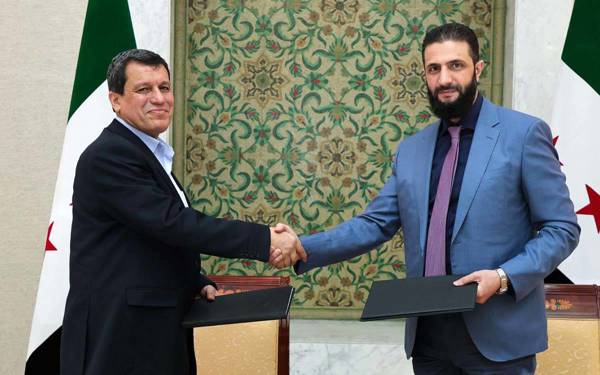




There are moments when political statements, initially ignored or dismissed, return years later with an almost unsettling clarity. What once sounded speculative, exaggerated, or implausible begins to resemble a map that had already been drawn, only not recognized at the time. One such moment emerges from a remark made by Abdullah Öcalan in the early 2000s, under conditions where speaking about global strategy from a prison island would hardly be taken seriously.
After years of tension between Iraq and the international community, a significant turning point occurred in 2002. On 16 September, Saddam Hussein notified the United Nations that Iraq would accept weapons inspections. Shortly after, on 13 November 2002, Iraq formally accepted UN Resolution 1441. Inspections began on 27 November, creating a brief moment of global relief, a sense that war might be avoided, that diplomacy had prevailed.
It was precisely at this moment -when the world exhaled, feeling to relieved from war pressure- that Öcalan, imprisoned on İmralı Island, offered a radically different reading of the situation. During a meeting with his lawyers, he reportedly responded to the prevailing optimism with a stark warning: Saddam’s acceptance would not save him. Iraq would fall anyway. Then Syria would follow. After Syria, Iran. And if Turkey continued its existing political line -implying if not to make a deal with the Kurds- it would be the next target. What he articulated was not a prediction in the narrow sense, but a broader interpretation of a regional trajectory shaped by long-term imperial strategy in the Middle East.
At the time, this statement did not resonate. Neither Turkish authorities nor wider political circles treated it as a serious geopolitical assessment. Yet, in retrospect, what stands out is not simply the sequence he described, but the structural logic underlying it.
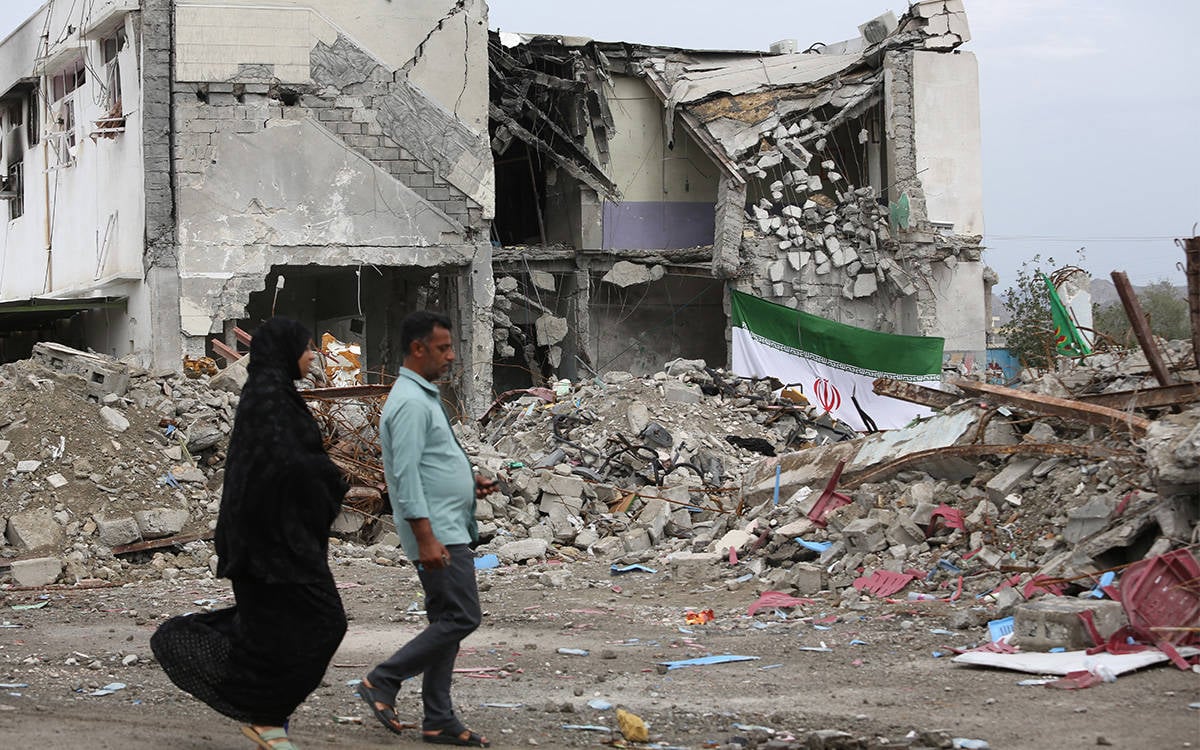
In 2003, the United States invaded Iraq, and the Saddam Hussein regime collapsed shortly thereafter. Less than a decade later, the Arab uprisings began, reshaping the political landscape of the region. Syria descended into civil war, culminating -after years of devastation- in the fall of the Assad regime in December 2024. Around the same period, escalating tensions with Iran, including direct confrontations involving the United States and Israel which the war is still going on, once again pushed the region toward wider conflict.
Seen from a longer historical perspective, these developments suggest something more than a series of disconnected crises. They point toward the gradual unraveling of a geopolitical order that had structured the Middle East for roughly a century; an order commonly associated with the Sykes-Picot Agreement. If that framework shaped the twentieth century, its limits became increasingly visible in the twenty-first. A critical moment in this regard emerged in 2014, when ISIS advanced across Iraq and Syria, effectively erasing large parts of the borders that had once been treated as fixed. At that point, it became clear that the previous regional design had lost its coherence.
What has been unfolding over the past decades can therefore be understood as a process of dismantling this older Middle Eastern configuration and the gradual, uneven imposition of a new one. This process, however, is far from linear. It is marked by unexpected turns, shifting alliances, and outcomes that cannot be fully anticipated. If there is a pattern, it lies not in precise prediction, but in recognizing that the region is undergoing a structural reconfiguration whose final form remains uncertain.
Within this broader transformation, the renewed circulation of a particular discourse is striking -especially in Turkey: the idea of a sequential geopolitical line- Iraq, Syria, Iran, and potentially Turkey. This narrative has gained increasing traction in political debates and public discussions. Yet many who now articulate this sequence do so without any reference to Öcalan’s earlier formulation of precisely this trajectory more than two decades ago.
This disconnection reveals something important: not only about Öcalan’s capacity for long-term geopolitical reading, but also about the selective memory of political discourse. Statements can be ignored when they challenge dominant assumptions, only to be later reproduced -detached from their original source- once reality begins to align with them.
At the same time, this situation exposes a second layer: a form of political hypocrisy or strategic amnesia. The same analytical frameworks that were once dismissed are now being adopted, but without acknowledgment. The voice that articulated them remains excluded, even as its analytical structure becomes normalized.
Yet the fourth element of Öcalan’s statement- concerning Turkey- introduces a more complex question. For a long time, this part appeared less plausible than the others. Unlike Iraq, Syria, or Iran, Turkey is a member of NATO, and under Article 5, an attack on one member is treated as an attack on all. Within this framework, the idea of Turkey being directly targeted by external military intervention has seemed unlikely, if not impossible.
However, this assumption rests on the stability of the alliance itself. What if that stability can no longer be taken for granted? What if the period of NATO -established in opposition to the Warsaw Pact- has already expired? In recent years, tensions within NATO, particularly in the context of shifting U.S. foreign policy, have raised questions about its long-term coherence. The approach associated with Donald Trump -marked by skepticism toward alliances and a willingness to disrupt established geopolitical arrangements- has already demonstrated that the transatlantic framework is not immune to internal erosion.
This opens up a new line of reflection. If NATO were to weaken significantly, transform, or even dissolve, the protective framework surrounding Turkey would also be altered. What has so far functioned as a structural barrier could become uncertain. In that case, the fourth element of Öcalan’s earlier statement would no longer appear implausible, but contingent; dependent not on Turkey alone, but on the fate of the broader alliance system in which it is embedded.
This does not mean that such an outcome is inevitable. Rather, it highlights the importance of considering geopolitical scenarios beyond their current institutional configurations. Just as the Sykes-Picot order appeared stable for decades before entering a phase of dissolution, contemporary alliances may also prove less permanent than they seem.
In this sense, the significance of Öcalan’s statement lies not in prophetic accuracy, but in its structural perspective. It attempts to read geopolitical developments as part of a longer continuum rather than as isolated events. What matters is not whether every detail unfolds exactly as stated, but that a particular way of interpreting the region -through sequences, transformations, and underlying strategic logics -was articulated early on and largely ignored.
Today, as discussions about the future of the Middle East intensify, the question is not only what will happen next, but how such developments are understood. The re-emergence of this earlier framework invites a reconsideration: not only of past statements, but of the conditions under which certain voices are dismissed, ignored, or later appropriated.
In this sense, the issue is not only geopolitical foresight. It is also about recognition: who is allowed to interpret the future, and whose interpretations are only acknowledged after they become unavoidable. (SD/VK)