











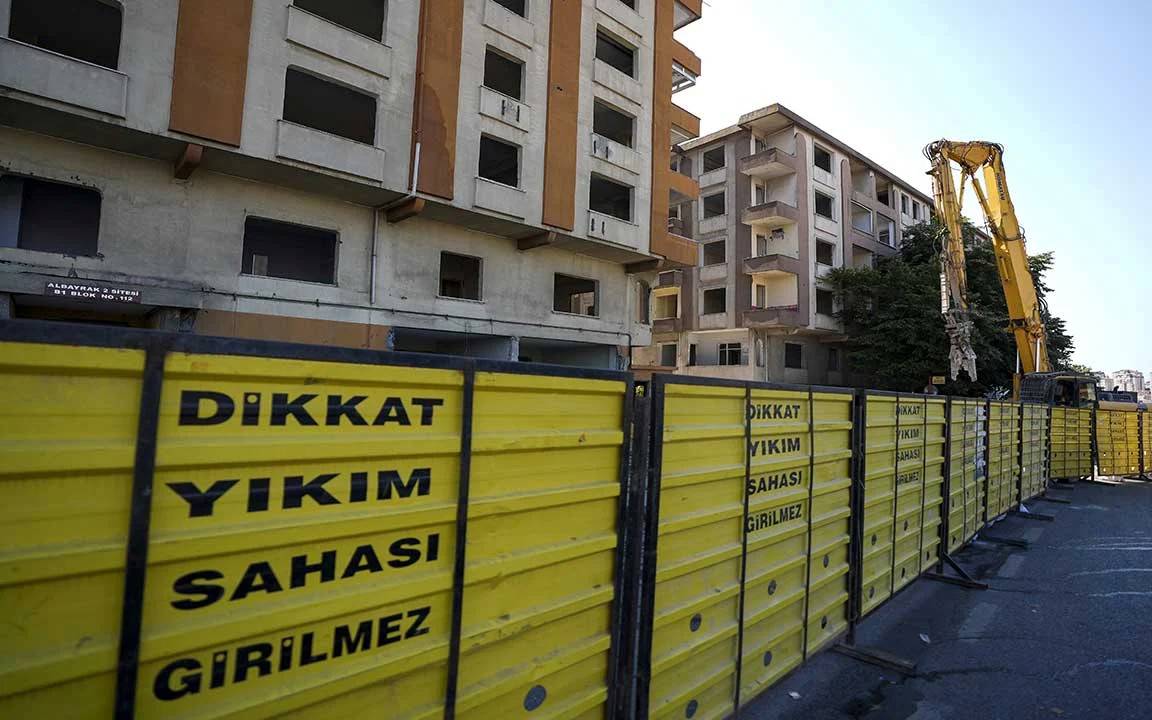



Urban transformation continues in İstanbul, Turkey's largest city of over 15 million people, alongside ongoing debates over the right to housing.
In the face of an imminent powerful earthquake which could claim thousands of lives, İstanbul accounts for approximately half of all urban transformation projects across the country, according to Environment, Urbanization and Climate Change Ministry data.
Avcılar is one of the most intensive urban transformation areas in the metropolis. Although designated as a priority zone due to its high risk, the transformation process causes significant financial distress for local residents.
Sevim İleri, a long-time resident of Avcılar, said her building's transformation process began when teams from the İstanbul Metropolitan Municipality visited on Jan 6, 2025.
"Municipal teams came and said our building appeared vulnerable to earthquakes under the system they call a rapid screening," İleri said. "They wanted to take a core sample. We did not allow them to take a sample at that time, saying we would negotiate with a contractor."
Residents failed to reach an agreement with a contractor due to financial constraints. Officials returned to the building on Jan 3, 2026.
"They told us we had no way back anymore," İleri said. "They said that damaged and old buildings on main arteries in Avcılar would be demolished, and that there was a ministry decision on this matter. A core sample was taken from our building on Jan 7. We have been trying to agree with a contractor since that date."
Costs too high for most people
Construction costs remain the most significant obstacle for property owners in the urban transformation process. İleri stated that the contractor they interviewed initially demanded 4.5 million liras for each apartment (1 US dollar = 46.9 Turkish liras).
The ministry is running a campaign to encourage urban transformation, covering part of the costs, but this is insufficient for most people. The government will pay 875,000 liras per apartment to both the homeowners and the contractor, meaning property owners must still find more than 2.6 million liras to renew their properties, an amount that remains far too high for the residents, most of which are pensioners, said İleri.
"Nobody is in a position to pay three million liras," she said. "Everyone is trying to make up this money by selling whatever they have. The support provided by the state is not enough."
The financial burden extends beyond construction payments. People must relocate and pay rent during the construction period. Monthly rents in Avcılar start at 40,000 liras, and there are additional expenses including deposits, real estate dealer commissions, and moving expenses. İleri, who has not been working unemployed ten years, started looking for a job to help cover the costs.
"Urban transformation has affected me both financially and emotionally," İleri said. "I had not been working for ten years, and our home had a single income. Now I am looking for a job. Even if I find one, we will struggle significantly. I think the number of people in Turkey who can pay three million liras without difficulty is very low."
The relocation will also disrupt the education of her two children, who are entering the second and fourth grades.
"If we move, they will have to change their schools, and their entire routine will be disrupted," İleri said. "When I start working, there is no one living near us who can pick up my children from school. Our lives have completely changed."
Urban transformation applications are based on Law No. 6306 on the Transformation of Areas Under Disaster Risk. According to the law, electricity, water, and natural gas services to risky buildings can be disconnected.
The ministry maintains that the goal of this practice is to ensure life safety and prevent citizens from living in risky structures, rather than causing grievances. However, İleri's experience highlights ongoing concerns regarding how displaced residents will access safe and affordable housing, who will cover transformation costs, and how low-income owners and tenants will be supported.
Targets do not match reality
A study on urban transformation policies by the municipality's İstanbul Planning Agency (İPA) points out significant discrepancies between the targets announced for Turkey and İstanbul by different environment and urbanization ministers.
According to İPA, the announced housing numbers and completion periods do not match, leaving differences of tens of thousands of residential units between target declarations.
İPA calculations show that if the construction cost per square meter is assumed to be 500 US dollars, only about 5,000 housing units can be transformed annually, even if the entire municipal budget is allocated to urban transformation and the central government covers half of the cost. The agency concluded that it is impossible to achieve a comprehensive transformation across İstanbul under the current financing model. (EY/HA/VK)


