










The European Court of Human Rights (ECtHR) has ruled against Turkey in the case of Ceyda Sungur, an academic and urban planner who was sprayed with tear gas at close range by police during the Gezi Park protests in 2013.
The high court ruled that there was a violation of the "prohibition of torture," as guaranteed under Article 3 of the European Convention on Human Rights (ECHR).
Court had previously ordered officer to plant trees
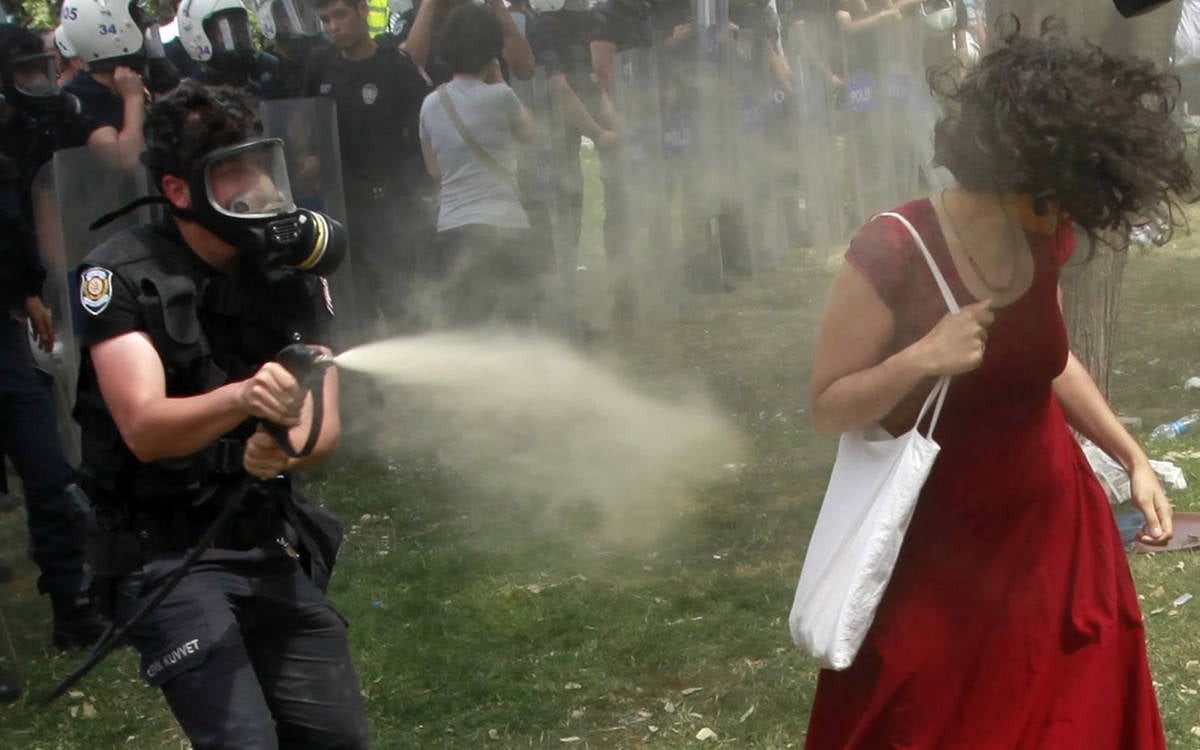
During a sit-in at Gezi Park on May 28, 2013, Sungur was targeted by police officer Fatih Zengin, who sprayed tear gas directly into her face from a distance of less than one meter.
Following the incident, Sungur became a symbol of police brutality during the protests and became widely known as the "Woman in Red."
The matter was taken to court. In 2015, a court sentenced Fatih Zengin to 10 months in prison for "injury" and "misuse of office." However, the court suspended the sentence and closed the case by ordering Zengin to plant 300 saplings instead.
Sungur filed an individual application with the Constitutional Court because the court had issued a "suspension of the announcement of the verdict" regarding the law enforcement officer.
In 2019, the Constitutional Court acknowledged that the police officer had "used physical force when it was not necessary," but found the penalty proportional and sufficient. It ruled that the prohibition of ill-treatment guaranteed under Article 17 of the Constitution had not been violated in either its substantive or procedural aspects.
Following this decision, Sungur took the case to the ECtHR. The final ruling arrived 12 years and 9 months after the incident. The high court reiterated that the use of force by law enforcement is only lawful if it is necessary and proportionate, stating that the intervention against Sungur failed to meet these criteria.
The court stated that although the physical effects on Sungur could be treated with simple medical intervention, being directly targeted and sprayed with gas reached the level of severity required to fall under Article 3 of the ECHR.
'The punishment was not a deterrent'
The European court found the criminal proceedings conducted in Turkey to be insufficient. It noted that because the 10-month prison sentence for the police officer was suspended and subsequently dismissed, the sanction lacked any deterrent effect.
The ECtHR remarked that this situation effectively created "impunity" and undermined the effective implementation of the prohibition of ill-treatment.
The court ordered Turkey to pay Sungur 6,500 euros in non-pecuniary damages and 5,400 euros for legal costs. The decision was reached unanimously. Turkey is required to pay the compensation within three months.
The ECtHR had previously rejected several applications regarding the use of tear gas by law enforcement to disperse protests, ruling that those interventions did not reach the level of severity required to fall under Article 3 of the Convention.
Article 3 of the European Convention on Human Rights guarantees the prohibition of torture. According to the article: "No one shall be subjected to torture or to inhuman or degrading treatment or punishment." (HA/VK)