









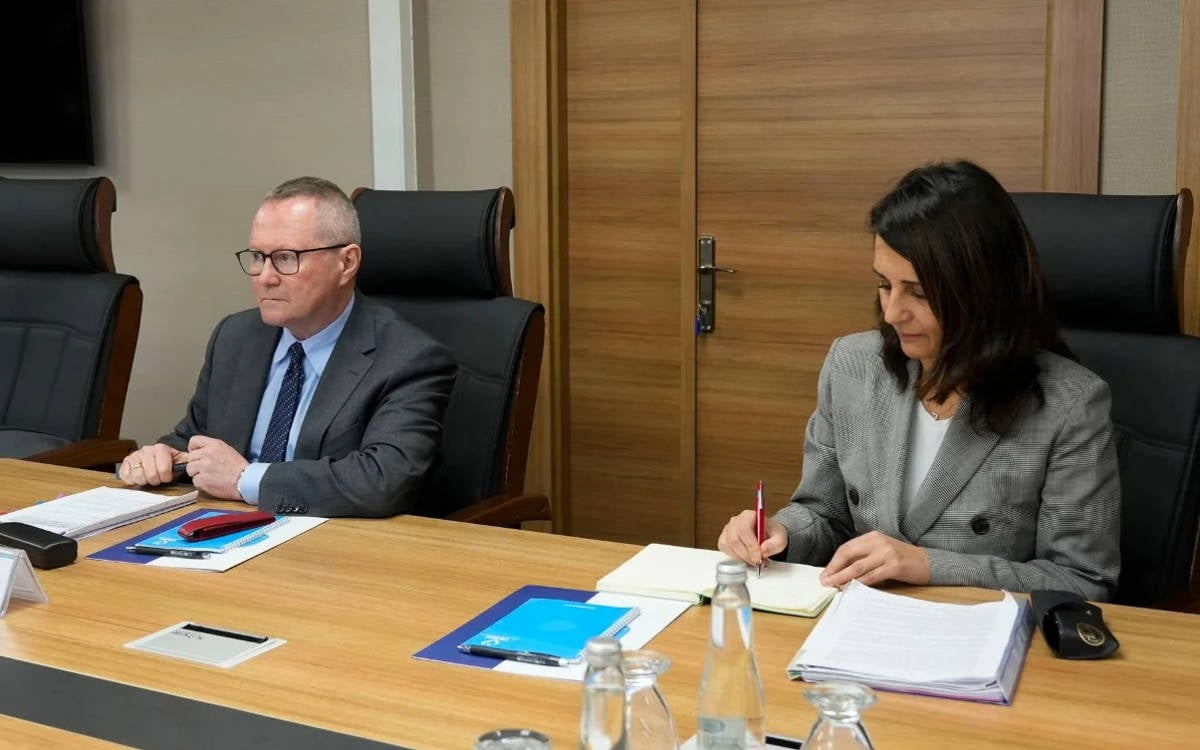



The Council of Europe Commissioner for Human Rights, Michael O'Flaherty, published a memorandum on Apr 22 based on his visit to Turkey on Dec 1-5, 2025. The report outlines structural issues and details recommendations regarding freedom of expression, peaceful assembly, association, and the judiciary.
O'Flaherty called for aligning Turkey's domestic laws and practices with the European Convention on Human Rights and ECtHR case law. He noted structural problems in the Turkish Penal Code, Anti-Terror Law, internet legislation, NGO oversight, the Council of Judges and Prosecutors (HSK) structure, detention practices, and the execution of high court rulings.
The report welcomed the inclusion of civil society in the parliamentary commission under the Kurdish peace process, labeled as "Terror-Free Turkey Initiative" by the government, as an opportunity to restore trust in democratic institutions.
Legislation restricting free speech
The commissioner stated that several penal provisions unjustifiably restrict free speech. He raised concerns over the use of the Turkish Penal Code and Anti-Terror Law by courts to limit expression, pointing specifically to articles on insult, insulting the president, degrading the state, and "spreading misleading information."
O'Flaherty urged amendments to Turkish Penal Code Articles 125, 299, 301, 217/A, 215, 216, 220, and 314, calling for the complete repeal of Article 299 on insulting the president.
The report noted that 29 journalists were detained in Turkey at the time of the report's release.
The commissioner also pointed to regulatory pressures on media through the Radio and Television Supreme Council (RTÜK) via fines and broadcast suspensions based on vague concepts like "national values."
He called for amending Internet Law No. 5651 and Broadcasting Law No. 6112, noting that over 1.2 million websites and URLs were blocked in Turkey between 2014 and 2024 without independent judicial oversight.
Right to assembly
Regarding the right to assembly, authorities reported 82,220 demonstrations in 2025 with over 32.6 million participants, asserting police blocked only 0.3 percent of the events.
However, the commissioner criticized the lack of official data on bans and force usage. He highlighted the Mar 2025 protests following the detention of İstanbul Mayor Ekrem İmamoğlu where 1,879 people were detained, 260 arrested, and 468 placed under judicial control. The report also cited restrictions on Pride Week, March 8 marches, and the Saturday Mothers.
O’Flaherty therefore called for Articles 125, 299, 301, 217/A, 215, 216, 220, and 314 of the Turkish Penal Code, as well as the relevant provisions of the Anti-Terrorism Law, to be amended in line with the case law of the ECtHR and the opinions of the Venice Commission.
Justice system
On the justice system, O'Flaherty criticized the structure of the HSK, noting that the appointment of members by the president and parliament, along with the justice minister's presence, allows executive influence.
He called for reform based on merit and independence. The report also raised concerns over long indictments, parallel trials, and prolonged detentions of journalists and activists.
The report emphasized the need for lawyers and bar associations to operate safely. O'Flaherty met with the İstanbul Bar Association, whose executives faced charges of "terror propaganda" over a Dec 2024 statement. Although acquitted in Jan 2026, the prosecutor appealed.
The commissioner also noted the trial of İstanbul Bar board member Fırat Epözdemir and urged Turkey to sign the Council of Europe Convention on the Profession of Lawyer.
'Deep concerns'
O'Flaherty expressed deep concern over lower courts refusing to implement Constitutional Court rulings, explicitly naming the Can Atalay and Tayfun Kahraman cases, where the Court of Cassation rejected violation judgments. He noted that Turkey has 445 ECtHR judgments awaiting execution, one of the highest numbers among member states.
Finally, the commissioner recommended that Turkey rejoin the İstanbul Convention to address protection gaps in violence against women and reform the Human Rights and Equality Institution of Turkey (TİHEK) to comply with UN Paris Principles. (HA/VK)

