













The Health and Safety Labor Watch (İSİG) has released a report on work-related deaths in Antep, southern Turkey, following the arrest of Mehmet Türkmen, general chair of the United Textile, Weaving and Leather Workers Union (BİRTEK-SEN).
İSİG stated it published the report to increase solidarity with Türkmen, who was formally arrested on Mar 16. Türkmen had supported workers at Sırma Halı who launched protests after not receiving their wages and had demanded accountability for severe workplace accidents.
Türkmen also spent more than a month in pretrial detention last year due to his union activities.
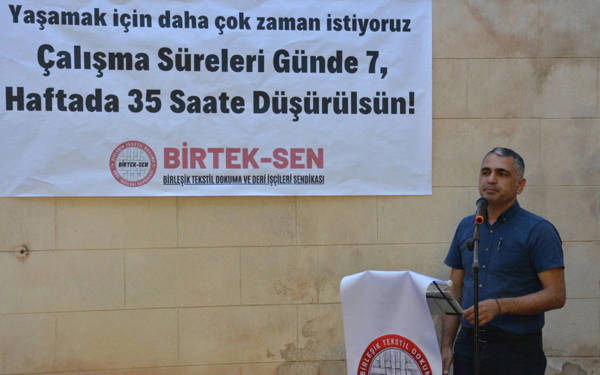
Mehmet Türkmen: A union leader behind bars after years of struggle
'Suppress labor movement to maintain production pace'
The İSİG report noted that authorities aim to suppress the labor movement to maintain the pace of production and exports in the city.
"Disruptions in production due to strikes or work stoppages led by BİRTEK-SEN are of critical importance not only regionally but also for supply chains, including international competitive pressures," the report said.
"As the textile sector enters a structural crisis in terms of production and export parameters, preventing actions and suppressing the union movement in the city becomes more significant. Mehmet was arrested for the continuity of this system. At this point, we repeat: 'Resistance and solidarity' are more important than ever."
'Slaughterhouse system'
According to the report, at least 555 workers have died while working in Antep over the last 13 years, including 45 last year and 11 in the first two months of this year.
Workers describe the working conditions as a "slaughterhouse system" due to frequent limb loss and severe injuries.
The report noted that many workplace accidents are not recorded. Treatments are often shown as "personal accidents" at private hospitals, which prevents workers from accessing justice.
Textile hub
Antep serves as the central hub of the Southern Anatolia basin, which handles 75% of textile production in Turkey. The city is dominated by companies manufacturing machine-made carpets and the synthetic yarns used for them.
Antep alone accounts for 91% of machine-made carpet production in Turkey, 91% of polypropylene yarn, 82% of non-woven fabric, 77% of acrylic yarn, 40% of PE or PP strip sacks, and 36% of cotton yarn.
While 29 companies from Antep are in the 'Top 500 Industrial Enterprises of Turkey' and 36 are in the 'Second 500' list, wages remain low. The average textile worker earns around 31,600 liras, while finishers earn 35,300 liras and machine operators earn approximately 42,000 liras.
Construction deaths lead, textiles in top four
The construction and road sector ranked first in workplace homicides with 122 deaths. This was followed by 102 workers in agriculture and forestry (58 laborers and 44 farmers), 66 in transport, and 64 in the textile and leather sector.
İSİG highlighted that Antep differs from the rest of Turkey because textiles are among the top four sectors with the most workplace deaths.
The report stated that Antep follows İstanbul as the city with the highest number of textile workplace homicides. However, while deaths in İstanbul occur mostly in garment workshops, deaths in Antep happen primarily in large textile factories.
"Antep is currently the center of the textile sector and worker deaths or disabilities," İSİG said. "A total employer whim prevails in the Organized Industrial Zones in Başpınar. While bosses multiply their profits, workers toil in poverty and without health and safety measures. Consequently, textile worker deaths are at 12%, which is four to five times the average in Turkey."
The group also noted that 31 construction workers died while working following the Feb 6 earthquakes.
Causes of death: Service accidents, crushing, falls
Traffic and shuttle service accidents were the leading cause of workplace homicides in Antep with 138 deaths. This was followed by 96 deaths from crushing or collapses and 78 deaths from falling from heights. The report also mentioned 38 deaths due to Covid-19, 36 due to explosions or fires, and 35 due to workplace violence.
İSİG stated that cases of workplace violence and explosions in workshop-style production areas in the city are above the national average.
Child worker deaths
The age distribution of workplace homicides reveals the extent of child labor. Over the last 13 years, 24 child workers aged 14 and under and 25 young workers aged 15-17 lost their lives.
İSİG pointed out that child worker deaths are nearly double the average of Turkey, while deaths of children under 14 are approximately three times the national average.
Women workers and suspicious deaths
The report identified 22 women and 533 men among the deceased. While the proportion of women worker deaths is below the national average, İSİG reminded that some public cases in the city involved discussions of mobbing, suspicious deaths, and suicides.
Migrant workers
Antep also stands out due to the high number of migrant worker deaths. In the last 13 years, 66 migrant workers died, including 64 Syrians, one Sudanese, and one Nepalese worker. The death rate for migrant workers, who are viewed as cheap labor, is 12%, more than double the average in Turkey.
Among the Syrian workers who died in workplace homicides, 22 worked in construction, 17 in textiles, 10 in agriculture, 6 in metal, 3 in general works, 2 in food, 2 in trade, 1 in chemistry, and 1 in accommodation.
Lack of unionization
İSİG reported that only eight of the workers who died in workplace homicides were union members, while 547 were non-unionized. The organization linked this to the prevalence of precarious work and employer dominance in the city.
Deaths concentrated in two districts
Regarding districts, Şehitkâmil ranked first with 234 deaths. There were 125 deaths in Şahinbey, 72 in Nizip, 43 in Nurdağı, 35 in İslahiye, 22 in Oğuzeli, 11 in Yavuzeli, 10 in Araban, and 3 in Karkamış.
İSİG stated that deaths in Şehitkâmil and Şahinbey, the centers of industry and logistics, were concentrated in the textile, metal, food, wood, municipal, and service sectors. In other districts, deaths in the agricultural sector were more frequent. (HA/VK)

