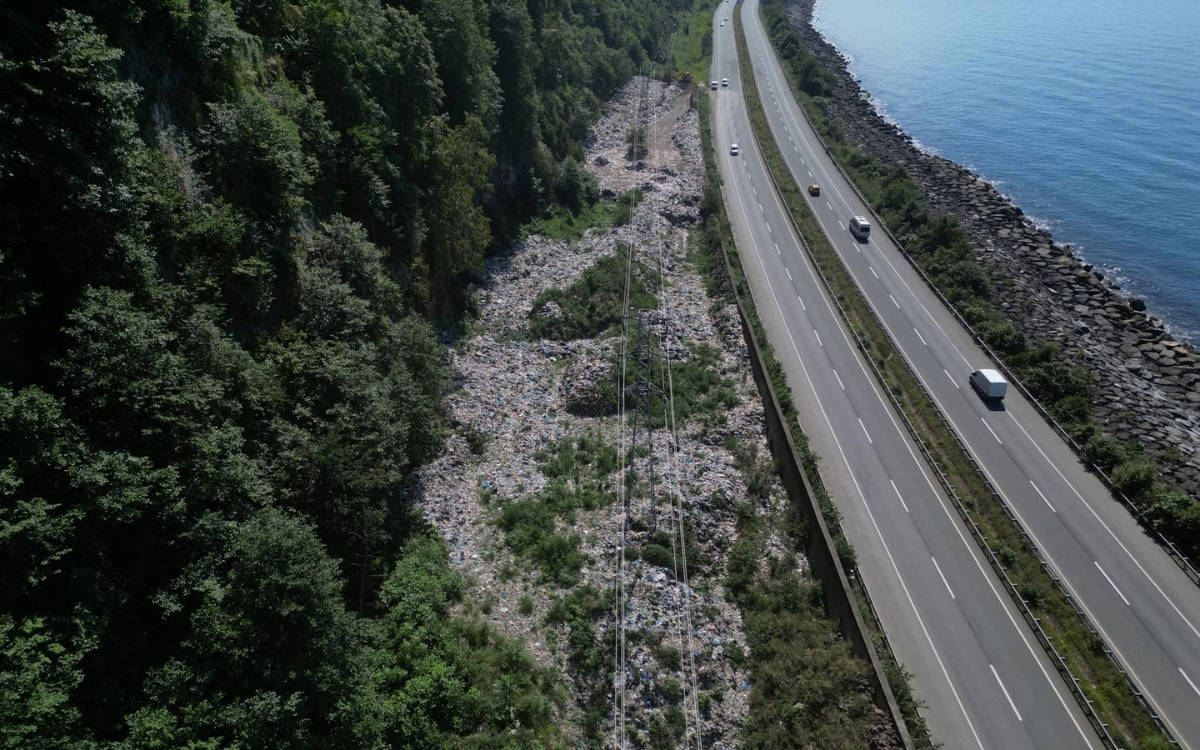

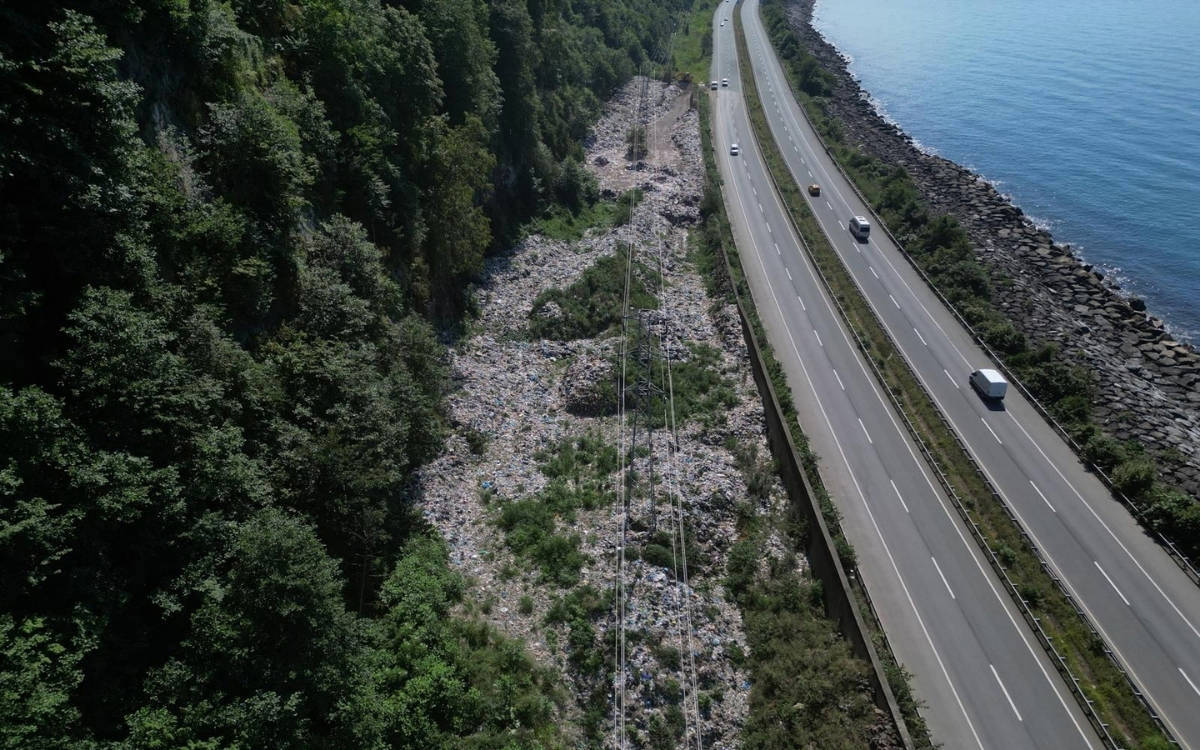



The solid waste problem in the Black Sea region persists not only as an environmental issue but also as the result of institutional gridlock.
This structural problem came under scrutiny after the Environment, Urbanization, and Climate Change Ministry fined Rize's Fındıklı Municipality 2,346,000 liras on Apr 22, 2026, for “dumping waste in an open area.”
The data shows that the issue is not unique to Fındıklı. Many districts along the Eastern Black Sea line, particularly Ardeşen, Arhavi, Borçka, Hopa, Kemalpaşa, Çamlıhemşin, and Pazar, have been forced to accumulate waste in open areas for many years. Defined in literature as "wild storage," this method involves leaving waste in nature in an uncontrolled manner without environmental precautions.
A search for a regional solution: TRABİKAP
Initially, solid waste from Trabzon was disposed of at a storage site in Sürmene between 2007 and 2008. However, this site was eventually decommissioned due to capacity issues and environmental impacts.
In 2014, the Trabzon and Rize Provinces Local Administrations Solid Waste Facilities Construction and Operation Union (TRABİKAP) was established to dispose of solid waste from Trabzon and Rize. This organization, of which municipalities are members, aimed to centralize scattered waste dumping and transition to a regular storage system. Within this framework, the system was gradually shifted to an integrated facility established in Araklı.
The established system is not a conventional incineration and energy production plant. Waste is primarily collected, sorted, and disposed of through regular storage methods. The operating model is based on a mixed structure where the municipal union and private firms are intertwined.
Today, TRABİKAP operates as a municipal union with 29 members. However, this structure does not cover many districts located in the eastern part of the Eastern Black Sea.
TRABİKAP did not respond to our questions despite three phone calls. We were told, "An authorized person will call you," but no return call was made.
‘It must be a public investment’
Ercüment Şahin Çervatoğlu of the main opposition Republican People’s Party (CHP), who has served as the mayor of Fındıklı since 2019, believes the issue transcends party politics.
"Waste was being stored wildly during the previous AKP administration, as well as during the former ANAP and SHP periods," Çervatoğlu said. He noted that the cost of incineration and energy conversion plants starts at a minimum of 25 million euros, making it impossible to cover such expenses from the municipal budget.
The municipality's request for land to establish a composting facility was not met by the government. Pointing out that current waste management practices result from necessity, Çervatoğlu summarized their efforts:
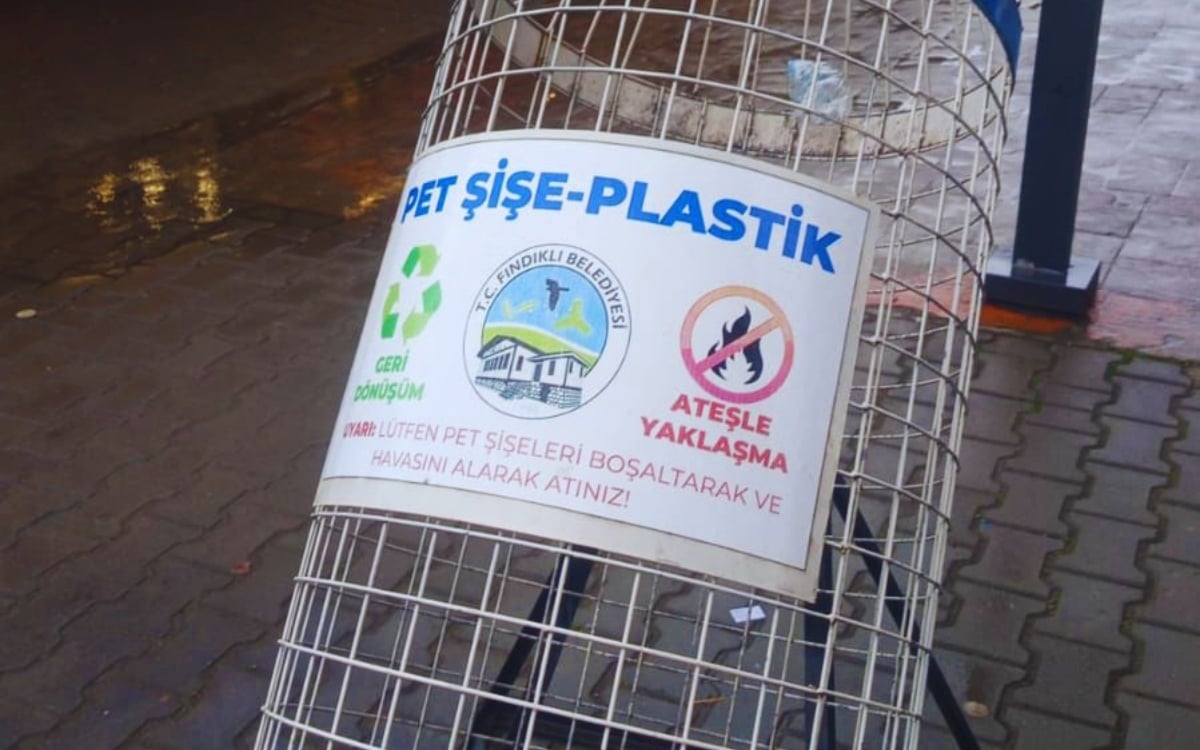
"When we took office in 2019, we considered how much we could reduce wild storage and formed committees. We quickly established a 1,000-square-meter indoor packaging waste collection facility for household waste. We began collecting recyclable household waste like paper, cardboard, metal, and plastic separately. In the next stage, we set up cages in the district. We tried to collect all PET bottles there.
"In 2019, we requested land for composting; they did not grant it. This area needs to be far from residential zones. We need public land for this. I even requested land again recently. On the day they issued the fine, the response came saying they cannot provide it.
"Citizens say, 'My land is in a hollow, dig it up and fill it so I can use it.' This is not legal, but we have no other solution. I am not saying this to justify it; I am also stating our shortcomings. It is not composting, but it is more benign. For instance, we do not pile it up in one spot like wild storage. If there is no state intervention, it is a pity for the Black Sea."
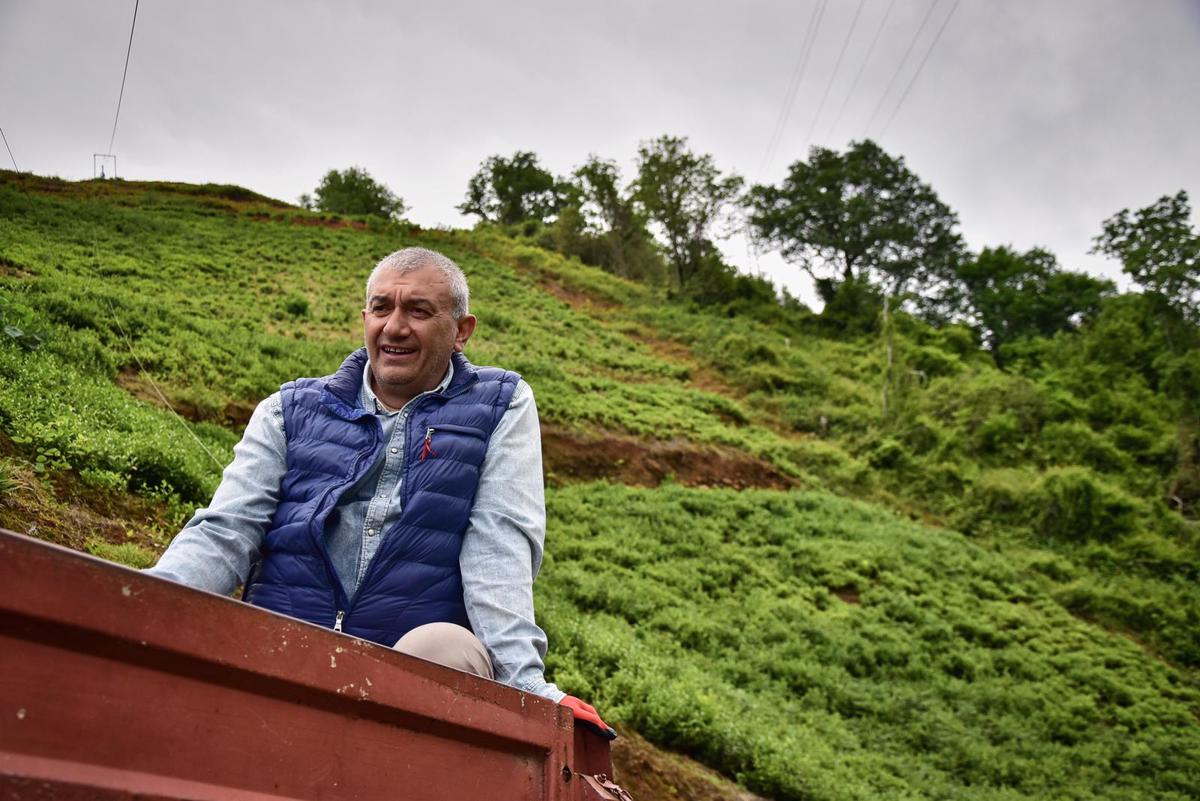
“13 ton çöpü iki kamyonla nereye götüreyim?”
Noting that 13 tons of waste is generated in the district daily, Çervatoğlu explained that they have resorted to roundabout bureaucratic methods to find solutions because the system is not functioning:
“We requested vehicles from the Environment Ministry, but they have not provided even a single car for years. Then we tried to find a workaround. Rize Special Provincial Administration made a protocol with the municipality. We sell our trash to Rize, and Rize sells it to TRABİKAP. We pay around 3,000 liras per ton.
"The transfer station operates during working hours but does not work on weekends or holidays. Or they say, ‘Our space is full, do not bring trash.’ Where am I supposed to take the 13 tons of trash generated daily with only two trucks? If Fındıklı Municipality is a part of this state, it does not matter where it stands politically; this is our shame, the state’s shame. I am also a part of that state. What should we do, stop collecting trash?”
Trash dumped on mountaintops and roadsides for 20 years
Hopa Mayor Utku Cihan, who was elected from the CHP in the 2024 local elections, also said that the problem is not new.
Emphasizing that the "wild storage" issue has persisted for about 20 years, Cihan said, “With the wild storage method, trash is left on roadsides, in empty areas, and on mountaintops. Unfortunately, our storage area is by the sea and the road, but this problem also exists in inland districts. For example, Artvin Municipality also takes its trash to a place on a mountaintop and burns it.”
Hopa Municipality’s attempts to join TRABİKAP have so far been inconclusive. Saying that sending trash to TRABİKAP is very logical in terms of logistics, Cihan noted he had applied to the institution one month after being elected mayor: “We said, ‘We want to send our trash to you.’ They said, ‘You must be a member of the union to send trash.’ So we wrote to the union. The union wrote back to us saying, ‘We currently have no expansion vision.’ But unfortunately, because they do not accept us, we have to put our trash in the same area.”
‘We are searching for a site’
While there is a local government union aimed at solving the solid waste problem of Artvin and its surrounding district municipalities together. However, Cihan says it has been unable to produce a solution to the problem for various reasons:
“The Çoruh Basin Development Union (ÇOKAB) was established in 2007. It applied for a European Union project. Funding was secured. At that time, the Mayor of Oltu was the president of the union, and mostly AKP municipalities were involved. Unfortunately, it could not progress in building a recycling facility and failed to produce a solution. Currently, the Mayor of Artvin is the president of ÇOKAB.
“We signed a protocol with Artvin Çoruh University through ÇOKAB. First, we tried to determine the method—whether an incineration plant is suitable or a recycling and composting facility. We are looking for a site where there will be no leakage, no harm to the environment, no wind, and it will not be close to residential areas. After that, we will look for investment. We are trying to speed up this process.”
Cihan noted that the Special Provincial Administration is responsible for collecting trash in villages:
“They collect it, but where do they take the trash? They bring it to our dump. If a fine is to be issued to me, it should also be issued to the Special Provincial Administration. The most important criterion for these facilities is to be far from living areas.
“However, there is no possibility of being far from a living area within municipal boundaries. Outside municipal boundaries, the municipality has no authority. Who has the authority? If the state does not step into this matter, it is not possible to solve it anyway. I have written 19 land allocation requests so far. They did not give me a single square meter of land; they did not give it to anyone.
“For a recycling facility to be viable, about 100-150 tons of waste needs to be processed. In the whole of Hopa, we only have 25 tons of waste daily. That is why it is necessary to include Arhavi, Borçka, Kemalpaşa, and other districts and to act together.”
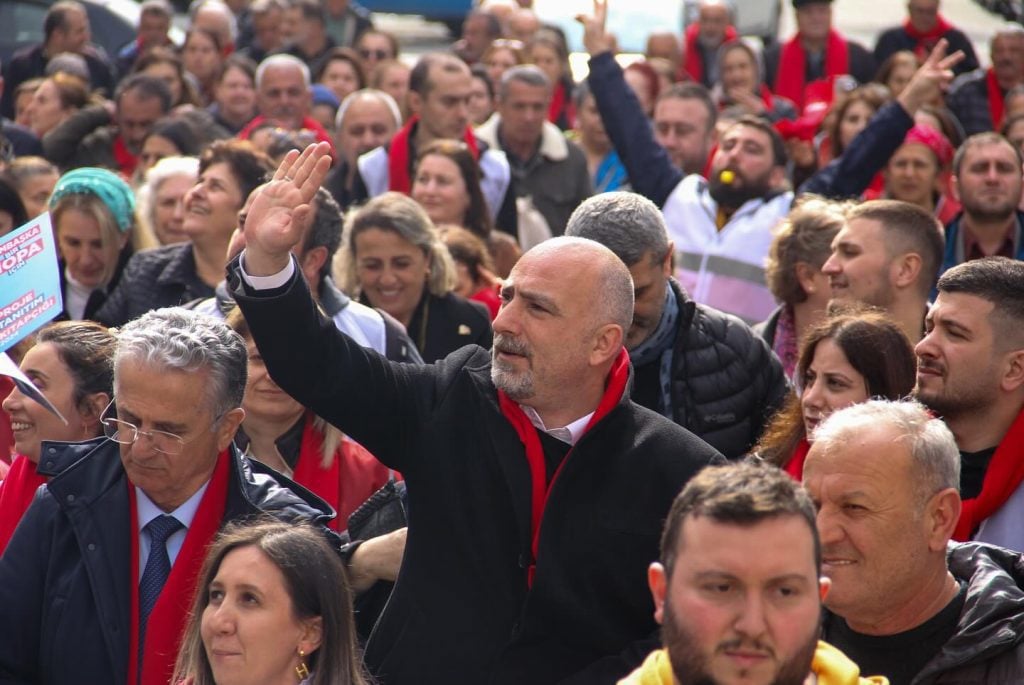
Ataselim: 20 yıl kaybedildi
Ataselim said unions established in the past have remained dysfunctional and believes the problem has been delayed:
"Sanitary landfilling is also a type of wild storage. A waste sorting system is an absolute necessity. I was a member of the municipal council for three terms. Now I am the mayor. If mayors had worked smartly at the time, for example, if a cooperative had been established, this problem would have been solved.
"I was a member of the Kaçkar Fire Brigade, Slaughterhouse, and Solid Waste Union; I left. My reason for leaving was that they said for 15 years they would establish a waste treatment system but did not take a single step. Now I am a member of ÇOKAB. No one took responsibility and said, 'Let's solve this.' No one should be offended, but the fault lies with the mayors. Just as we need water and sewage, we also need a waste sorting system. If we do not do this, we will destroy the Black Sea."
They are working to establish a facility in Arhavi that will provide waste storage and energy production simultaneously, Ataselim noted, while warning that the problem cannot be overcome without a regional solution.
‘Sending garbage to Trabzon is not a solution’
Enver Atagün, who was elected from the CHP as the mayor of Ardeşen, Rize, in 2024, said serious disruptions occur even when waste is sent to transfer stations in Trabzon, the nearest sanitary landfill area.
They transport the waste from Ardeşen to Yomra in the adjacent province of Trabzon, Atagün said, adding, "The storage area there is full. On the other hand, neither the transportation cost nor the disposal fee is reasonable at all. From time to time, the facility is not available; sometimes, waste cannot be accepted at the transfer station due to personnel issues or other reasons. As a result, we are forced to dump the trash on top of the area that was previously a dump site."
Emphasizing the lack of financing and planning at the point of solving the problem, Atagün said that establishing a large-scale sorting and storage facility is not a project that municipalities can handle on their own.
Atagün further pointed out that establishing the facility at a single point could also create new problems:
"Doing it in one place also creates problems. Let's say such a facility is established in Ardeşen; the waste from the line extending to Hopa, Borçka, and Rize will be stored here. This would cause a local reaction due to reasons like traffic and smell. People would ask, 'Why are we storing another district's trash?' That is why I think solutions are needed on a district basis.
"Today, transportation and fuel costs are very high. It is important to collect waste by sorting it at home, at least reducing it this way and utilizing those that can be used for recycling. But as a society, we are not at this level. I have been mayor for two years, but I have not made such an attempt."
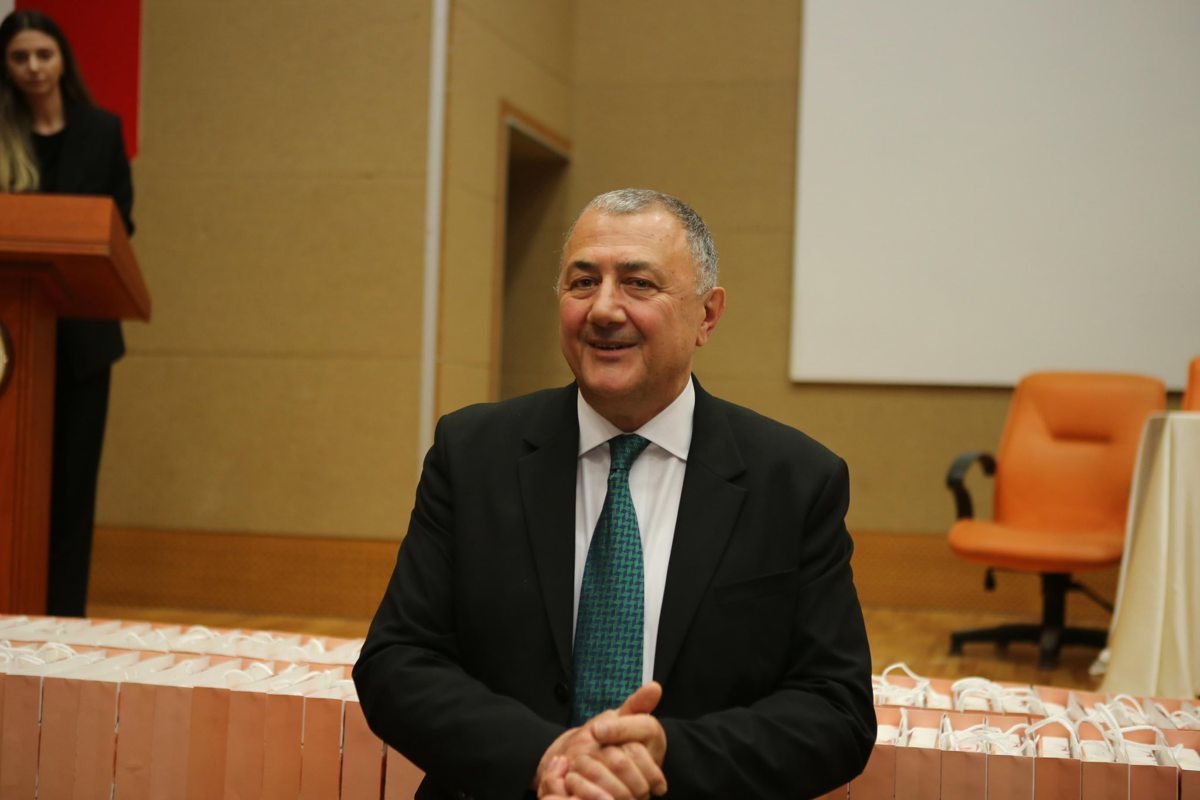
'Nowhere else but riverside' to store dump
Ercan Orhan, who was elected from the CHP as the mayor of Borçka in 2024, summarized the situation:
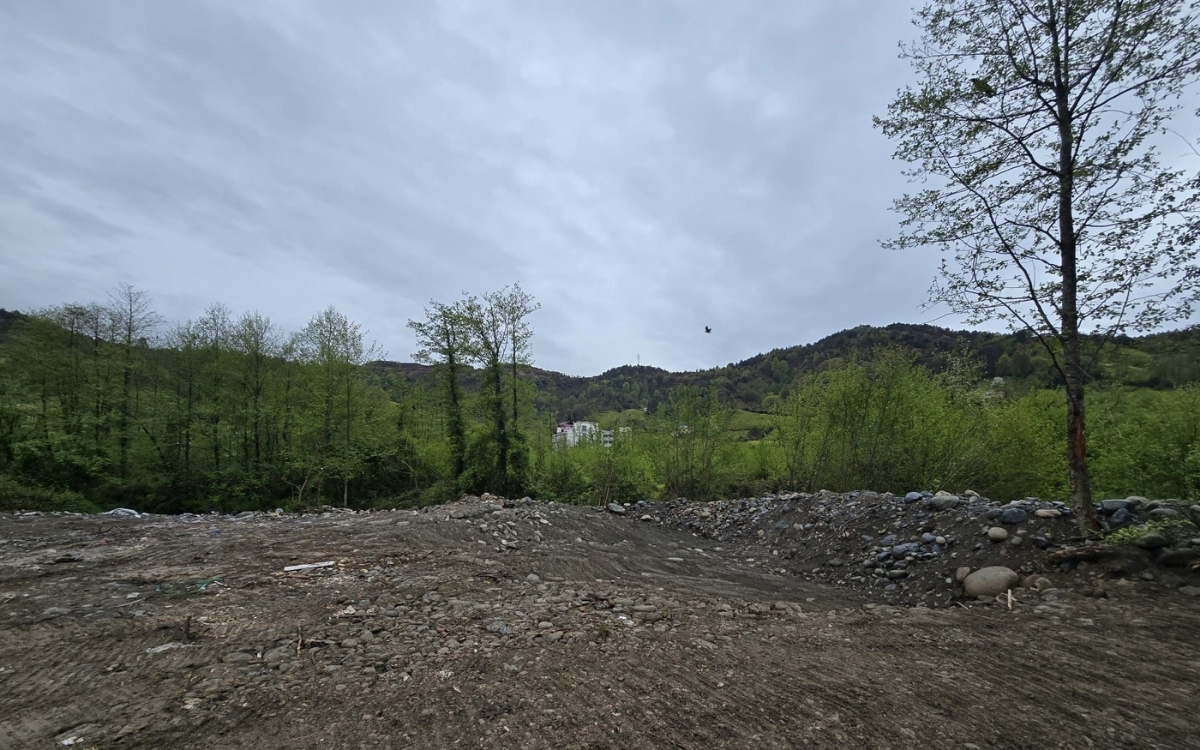
"We dispose of our trash through wild storage on the banks of the Çoruh, outside of Borçka. There is no other choice. Trash from 41 villages comes there. We fill it with soil. We talked to Erzurum and Trabzon but could not get a positive response. There is a settlement across from the disposal site. They are disturbed. the region has not been looked after. Politicians have not looked after it either. Municipalities have not been able to come together, or even if they have, they have not been able to produce a full solution."
Solid waste management in the Eastern Black Sea has existed for over 30 years as a problem that exceeds the capacity of local administrations and requires regional coordination. However, it is observed that the system does not function in an integrated manner. In its current state, municipalities try to dispose of waste largely through their own means and with fragmented and temporary methods. The waste is not eliminated; it only changes location. Therefore, the problem remains as an environmental issue that has gone unnoticed or even been taken for granted for years.
Assessments made by local administrators from different political positions intersect at a common point: In a model where the central administration is not directly involved, it does not seem possible to solve the trash problem in the Black Sea permanently.
This report was produced with the support of the "Copyright Support Program" within the scope of the "Support for Media Freedom - Strong Solidarity, Free Media Project" carried out by the Journalists' Union of Turkey (TGS) with European Union financing.
(FG/TY/VK)