





DİYARBAKIR MASS GRAVE
Bones in Mass Grave 100 Years old? Experts Doubt it...

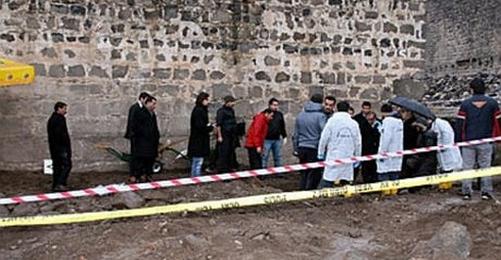



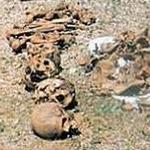
The Forensic Medicine Institute recently announced that the 34 skulls found in a mass grave in Diyarbakır were at least a hundred years old.
The excavation was carried out right next to a building that had been used as headquarters of the clandestine gendarmerie's intelligence and counterterrorism unit JİTEM in the 1990s. Excavations in the quarter of Saraykapı had started on 11 January in the neighbourhood of the Diyarbakır Closed Prison and the Courthouse.
The Forensic Medicine Institute announced in a statement, "The determined morphological changes suggest that the bones were lying in the earth for at least one hundred years. One part of the bones belongs to animals. Regarding the human bones no findings were revealed that would clarify the reason of death".
It was also stated that "the bone tissue did not show any probable injuries caused by firearms, cutting or crushing devices or any explosions".
Prof Ümit Biçer, Chairman of the Forensic Medicine Experts Association, claimed to the contrary, "We know that the person's sex and age can be estimated if the skulls were preserved as a whole. Yet, it was announced that not even that was done".
Writer Mıgırdiç Margosyan who is conducting studies about the history of Diyarbakır said that a hundred years ago Armenians lived in this area which is known as "İçkale". "In the 1940s, there were government buildings like the courthouse in the İçkale area", Margosyan indicated.
DNA analysis
bianet asked Prof Biçer for his opinion on the statement of the Forensic Medicine Institute which was released on 28 February. He said that he did not know whether the bones found in the excavation were preserved as a whole. In general, the examination of bones gave information about the age of that person, the gender, height and even if the person was right or left-handed, the expert explained.
"After this evaluation, a DNA analysis is being applied. If the bones were not preserved as a whole it would be more difficult to achieve a sound result from the DNA analysis", Biçer said.
He noted that a DNA analysis with teeth was easier to do and even if the bones were crumbled DNA could still be extracted from the teeth.
"I can only comment on the reported news since I did not see the actual report. The information disclosed is insufficient. Even if the Forensic Medicine Institute does not inform the public, they could share their information with experts on the topic", Biçer said.
He mentioned that the lawyers of the families of the disappeared might apply for an investigation of the findings by an independent delegation. Such a request would not breach the confidentiality of the investigation, he indicated.
Factors that affect the deterioration of bones
"We announced in the beginning of the process that the Forensic Medicine Experts Association or other experts could give an independent opinion and that we could provide for an evaluation of the forensic medicine process".
Biçer emphasized that an evaluation was impossible just by looking at the bones alone. He added:
"Soil properties, humidity, salt and minerals can slow down or speed up the deterioration of bones. Without such an evaluation it is impossible to state that the bones are a hundred years old".
"However, from what was reported to the public it was understood that the investigation remained limited to the analysis of the bones only. It is of course impossible to make a final interpretation before having seen the examination methods, the analysis of the soil and the prepared report", Biçer concluded. (AS)


bianet İnsan Hakları Editörü (2011-2024). BirGün’de Anonim adlı köşeyi yazıyor. Vatan, Akşam, HaberTürk ve Hürriyet gazetelerinin yazıişleri ve dış haberler bölümünde çalıştı. Güncel Hukuk dergisinde yazıları yayınlandı. Mimar Sinan Güzel Sanatlar Üniversitesi Sosyoloji Bölümü'nde yüksek lisans yaptı. Boğaziçi Üniversitesi Felsefe Bölümü mezunu.

bianet submits shadow report to UN Human Rights Committee
Imprisoned lawyer exposes use of disciplinary investigations to pressure political prisoners
Tap water ‘smells of bleach’ in Muğla prison
Censorship on a letter from prison describing hunger
Prisoner on hunger strike: 'I am alone without sunlight'