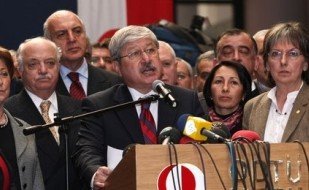






"Day of Working Journalists Is a Joke"



Cengiz Erdinc, former editor for the Sabah newspaper, was dismissed because of trade union activities. He evaluated 10 January, the "Working Journalists' Day" for bianet:
"In Turkey, the Minister of Justice is a minister of something non-existent. There are many such ministers and directors of non-existing things. They only exist on paper. The 'Day of Working Journalists' is a similar caricature. As a non-working journalist I can express my opinion more freely. One could ask those who do work how they can continue with so much censorship."
Erdinc is suing Sabah in order to get his job back and to claim trade union compensation. The fourth hearing of the case is on 30 Janary, and he is awaiting the result with "curiosity."
Like all sectors, more difficult for women
Sibel Ünlü, one of 40 journalists who were dismissed by the Radikal newspaper on 29 June 2007 emphasised the difficulties for female journalists:
"A week ago I gave birth to a baby. It is not clear where the sector is going. When normal people find it hard to get work in media, then it is the same as everywhere else, it is more difficult for women."
Erdinc said that he had been receiving unemployment benefits for a while and was now working in a different sector. He was bitter about all anniversaries, including this day:
"The progress, albeit slow, made by the law since the Tanzimat period (a period of reform in the Ottoman Empire in the mid-19th century), has been obstructed by today's understanding of power. We can see this clearly in the Hrant Dink case. A year has passed since the murder of a journalist."
If there is democracy, journalists feel safe
The Turkish Journalists' Society (TGC) made the following statement on the occasion of the 47th anniversary of the "Day of Working Journalists":
"In 1961, Law No. 212, which brought journalists some important rights, was passed. The law provoked reactions from newspaper owners on the day it was passed, and they still want to abolish it after 47 years."
"The most democratic countries are those where journalists feel most comfortable," said the statement. According to the TGC, both employers who ignored the law and the bureaucratic layers which did not fulfill their duties were responsible for the current state.
"The latest development is that they are trying to abolish the right of journalists to retire. The law can be criticised for bringing journalists some advantages. But on the other hand, it is also a reality that journalists face imprisonment, beatings, injuries and even death in their work."
According to the Contemporary Journalists' Association (CGD),
- Only 15,640 journalists in the newspaper sector have social security (2007 data from the Ministry of Labour and Social Security).
- This means that of the estimated 40,000 people employed in the media, around 24,000 work without social security, thus inofficially.
- Only 600 of the 4,531 journalists organised in trade unions are currently benefitting from rights such as collective work contracts. (GG/TK/AG)

Controversial Job Cuts at Radikal Newspaper
Turkish Journalism Awards Announced

WORKING JOURNALISTS DAY
"Freedom and Security for Press Workers"
Protests against Cumhuriyet Journalist's Dismissal

DAY OF WORKING JOURNALISTS
"Nothing to Celebrate"

Journalists Want Organized Labour in Media
Turkish Journalists Campaign For Union
Lay-Offs Not Due to Finances
TGC PRESS AWARDS
2009 Award for Successful Journalism in Turkey

Journalists Take Media Group to Court
Controversial Job Cuts at Radikal Newspaper
Turkish Journalism Awards Announced
WORKING JOURNALISTS DAY
"Freedom and Security for Press Workers"
Protests against Cumhuriyet Journalist's Dismissal
DAY OF WORKING JOURNALISTS
"Nothing to Celebrate"
Journalists Want Organized Labour in Media
Turkish Journalists Campaign For Union
Lay-Offs Not Due to Finances
TGC PRESS AWARDS
2009 Award for Successful Journalism in Turkey
Journalists Take Media Group to Court
AKP: “Closure Trial will Give Us 70 Percent of the Vote”
Reactions to AKP Closure Request

Peace Initiative: Operations Not the Solution
IPS Communications Foundation and Press Now Organised Workshop in Antalya
Headscarves Not “In the Clear” Yet