



Since the Gezi Uprising, Turkey’s political regime has gradually evolved—from what Steven Levitsky and Lucan A. Way conceptualize as “competitive authoritarianism”—into what can be described as “naked authoritarianism.”
Levitsky and Way’s term “competitive authoritarianism” refers to regimes that are not fully authoritarian but also not genuinely democratic. In such systems, elections, opposition parties, and media formally exist; yet the ruling power continuously turns these mechanisms to its own advantage through unequal conditions, partisan use of state resources, and control over the judiciary and bureaucracy.
The shift from competitive to naked authoritarianism thus marks the stage at which even these formal elements of competition have vanished—where elections, opposition, and judiciary exist only symbolically, under the absolute control of power.
One of the most critical turning points of this transformation was the June 7, 2015 general election, when the Peoples’ Democratic Party (HDP), under the co-leadership of Selahattin Demirtaş and Figen Yüksekdağ, achieved a historic success. On that day, the political line represented by HDP brought together for the first time in the history of the Republic social groups that had long been isolated from one another—around a shared democratic vision. This created a social dynamism that directly threatened the government’s political strategy.
While the ruling bloc sought to further centralize and solidify its authoritarian control—even attempting to neutralize the ballot box through manipulation—the HDP’s success under Demirtaş and Yüksekdağ opened up a completely new political atmosphere in Turkey.
For the first time since the foundation of the Republic, social groups long confined to separate compartments began to talk and deliberate together. The idea that “we can solve Turkey’s problems by talking to each other” began to take visible shape.
Just as Turkish society was approaching a moment of collective reason and conscience—of speaking and resolving differences together—a government minister declared that night: “From now on, you can only make a movie about peace.” With this, the state practically declared war on social reconciliation.
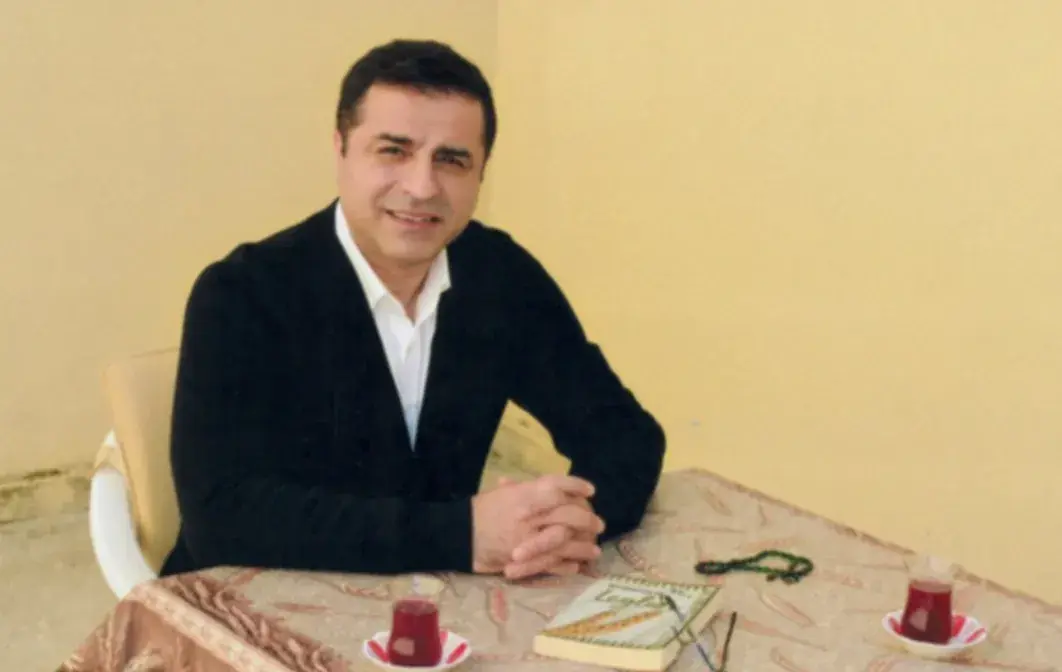
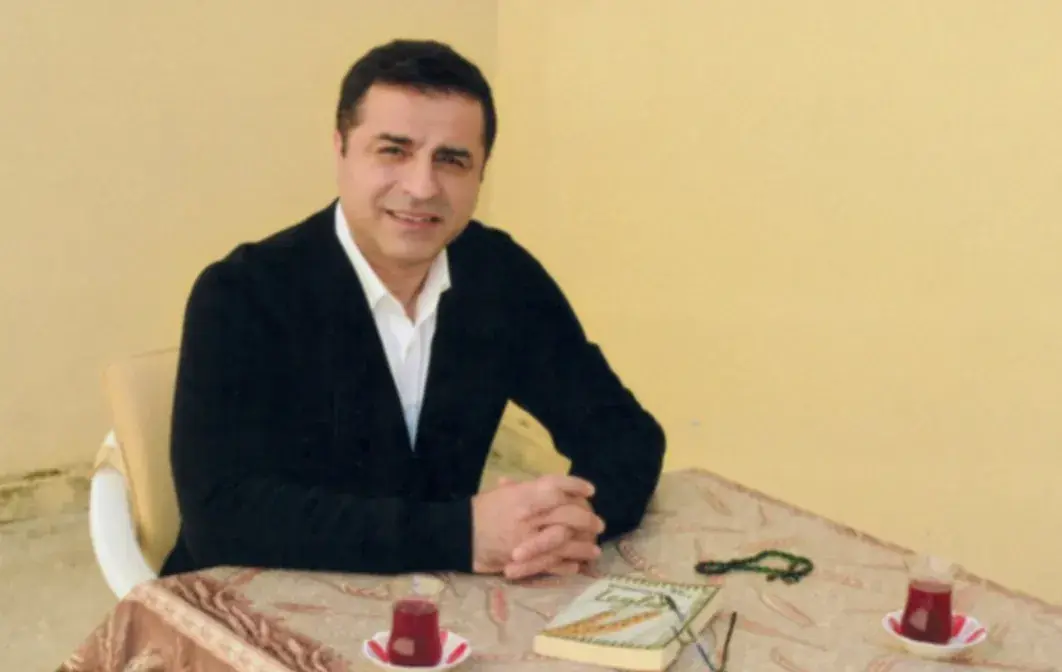
Demirtaş’s politics prioritized coexistence amid diversity—an ability to speak to all segments of society around shared principles, and to do so with a smile. It pointed toward happiness, peace, and togetherness across differences. Of course, to attribute all of this solely to Demirtaş would be incomplete; this optimism and inclusiveness were carried by the entire HDP movement and all those who contributed to it with their labor and courage.
April 19, 2016
In a country where the motivation for governance is always to remain in power, even the people’s capacity for happiness becomes dangerous. Yes, happiness is contagious.
When this collective joy met across all segments of society, a regime that thrived on division, polarization, and fear found itself in peril. Perhaps for this very reason, on the night of June 7, 2015—when another life became visible through joy and solidarity—the whole of society was placed on the target board. Whatever remained of democratic tendencies, practices, and laws was thrown into the freezer.
Exactly ten years ago, on April 19, 2016, President Tayyip Erdoğan declared: “We have put the peace process in the freezer; now it’s time for operations.” He continued: “The situation is clear. We have suffered great losses. Over 40,000 of our citizens have fallen victim to terror over the past 35 years. We tried the democratic initiative, the national unity and brotherhood process, but it didn’t work. So we’ve put the peace process in the freezer. Now it’s the era of operations. This time it will end.”
With this statement, Turkey was once again dragged into a deep darkness. As the guns were rearmed and the war resumed, Demirtaş was abroad. Amid debates over whether he would return, he told a close friend at the time: “I’ll come back—and I’ll serve ten years if I have to.” A few months later, he was arrested, and on November 4, 2016, imprisoned in Edirne Prison.
Nine years have now passed since that day—since this captivity that every person in Turkey’s struggle for democracy and freedom knew could one day find them too. What, then, has changed since Erdoğan’s 2016 declaration that “we have put the peace process in the freezer, now it’s time for operations”? What transformed him into the leader who, on October 1, 2024, proclaimed: “We are all one, united in service to the nation and homeland. We are all one and together on the road to a great and strong Turkey.”
And what truly “ended” in that earlier statement when he said, “This time it will end”? In the same 2024 speech, Erdoğan added: “I also extend my gratitude to the DEM Party delegation and leadership, who through their constructive stance and efforts over the past year have made important contributions to ridding Turkey of terrorism. I also commemorate, with mercy, Istanbul MP Sırrı Süreyya Önder, who to his last breath devoted himself to tearing down the wall of terror and making peace and brotherhood prevail in every inch of our country.”
Sırrı Süreyya Önder was among Demirtaş’s closest comrades in struggle. We all believed in that struggle. Önder entered politics in the prime of his life, full of hope and conviction that his country could be liberated through socialist values. Had he not re-entered active politics in the final stretch of his life, he would likely still be with us today—signing his books, shooting films, and organizing open-air cinema for children across Anatolia and Mesopotamia.
October 1, 2024
Now it is time to pause and reflect: what has been gained since April 19, 2016? Those who view the Rojava reality as a victory for all who seek freedom in this geography must also see that the government’s attempt to consolidate a political project of “naked authoritarianism” through the state’s monopoly of violence has ultimately failed. Persisting in this mistake benefits no one.
If, since October 1, 2024, there truly exists a “state reason” that recognizes the need to reconcile with the Kurds, then this must be accompanied by symbolic steps. Nothing remains to be gained through war and conflict.
If we have reached the point of acknowledging this—and if we have chosen the difficult but necessary path—then we must wish for the children of Anatolia and Mesopotamia to run freely, to grow in their own languages, emotions, and loves, and to join life with confidence.
This is what it means to make peace—and to be liberated through peace. If we will not abandon the future of a country to the dreams of an authoritarian power, then one of the most symbolic steps we can take today is to let Demirtaş walk freely among those very streets again.
Demirtaş’s release is not a favor or a matter of negotiation; it is the return of what was unjustly taken from him by the government. The freedom of Demirtaş, Figen Yüksekdağ, Osman Kavala, Can Atalay, and all political prisoners is the restitution of rights that were unlawfully seized.
Their release is not up for negotiation—nor will Turkey automatically become democratic once they are free. But it will mark a meaningful step toward peace. When that step is taken, we will continue our struggle for the construction of social peace with renewed strength.
Once again, it must be emphasized: Demirtaş’s freedom is not a gift—it is the restitution of a right seized by the state. At the same time, it is a symbolic and concrete act toward peace and democratic reconstruction. No single individual can dismantle authoritarianism alone.
Yet when political prisoners are released, the conditions for social trust, dialogue, and political normalization become stronger. If we truly wish for the children of Anatolia and Mesopotamia to grow freely—in their own languages, joys, and dreams—then the path lies through the release of imprisoned hopes, the reckoning of justice, and the restoration of politics itself.
The freedom of Demirtaş, Figen Yüksekdağ, Osman Kavala, Can Atalay, and all prisoners of conscience is not only for them—it is a restoration for us all, a beginning for peace. This society needs that beginning. (EJA/VK)