



*Rector appointed directly by the President himself, in lieu of the university’s elected leadership
Since 2021, I could never have imagined the experiences that awaited me at Boğaziçi University…
As an academic, I returned to Turkey from abroad in 2000 with the belief that I could be more useful in the country where I was born and raised. After seven years of various disappointments at private universities, I joined Boğaziçi University in 2007. I still remember what the university’s elected rector said to me at the time: that her duty was to support our work—ours, meaning her colleagues’—and to clear the way for us. I understood this to mean that this public university was neither under the control of political power nor beholden to a university “owner” or the capital behind one.
BOĞAZİÇİ SPEAKS OUT
Mathematics against the debasement of University
By the end of 2020, in my thirteenth year at Boğaziçi, the term of the rector—who had not been elected but had somehow received a vote of confidence from colleagues during the 2016 state of emergency—was coming to an end. Instead of initiating a process to elect a new rector, we continued with our lives under the illusion and hope that the unelected, appointed rector would be reappointed, perhaps out of a desire not to draw attention or become a target of the authoritarian political power. That is, until we received the news of Melih Bulu’s appointment on January 2, 2021…
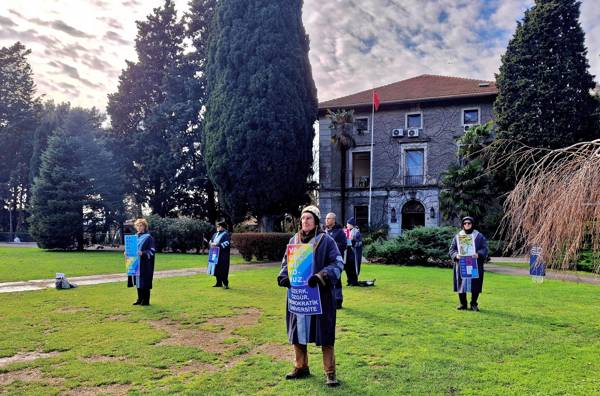
With this appointment, Boğaziçi came to its senses and launched a struggle to remain an autonomous, free, democratic institution of higher education at international standards. For five years now, all of our constituents—academics, students, alumni, and staff—have continued to write an important chapter of resistance in the history of universities in Turkey. Over these five years, almost nothing that could happen to those who resist has been left undone. As someone who was targeted during this process and punished for resisting, I would like to share what happened to me, both to leave a historical record and to unburden myself.
As soon as Melih Bulu was appointed, the university was surrounded by heavily armed police. It was the first time I had seen Boğaziçi under such a siege. What little free press remained was prevented from entering the campus and from conveying to the public what was happening and what we were saying. I believed that my most effective contribution to this struggle was to document our resistance through photographs and videos and to share them. Moreover, as an academic, I believed that my responsibility to the public required me not to remain silent in the face of wrongdoing, illegality, and injustice, but to criticize them and speak the truth as I saw it. Exercising my constitutionally protected freedom of expression, I began sharing my thoughts and feelings with anyone willing to listen. So, how dare I speak out? A smear and targeting campaign immediately began, orchestrated through pro-government media.
As soon as protests began at the university, one of the chronic ailments of our society—fear of LGBTI+ people—was easily activated by political power and all its apparatuses. LGBTI+ identities, students carrying rainbow flags during protests, a collage artwork including LGBTI+ flags displayed in an art exhibition organized on campus as part of the protests, and the Boğaziçi University LGBTI+ Studies Club (BÜLGBTI+), for which I was the official academic advisor, were all targeted. Students were detained in dawn raids by heavily armed police and arrested; the LGBTI+ Studies Club office was attacked and the rainbow stickers on its doors and windows were scraped off; during a night curfew imposed due to the pandemic, police raided the club office. Videos of all this were circulated through media outlets aligned with political power in order to engineer public opinion and criminalize those involved. Soon afterward, accompanied by a government-supported social media campaign, the club was shut down.
One of the first actions of the trustee administration was to remove from the university the most precariously employed among the resisting academics—part-time lecturers. During this period, Özcan Vardar, who had taught for years in the Film Studies Program and with whom I had also collaborated on my documentary projects, was banned from entering the campus. I was prevented from working in my office with a colleague who was part of the team of my independent documentary project Nuclear à la Turca—in other words, from doing my job. In response to my written objections, Naci İnci, who at the time was still Melih Bulu’s vice-rector, wrote that I had no duty to engage in such activities; that Özcan Vardar’s name did not appear on the Nuclear à la Turca website; that he claimed to have formed the impression that the documentary targeted a political party; and that it was unclear who financed the documentary—therefore he did not find it appropriate for Özcan Vardar to enter the university. This was a clear violation of academic freedoms and an attempt to impose censorship, for political reasons, on a documentary film still in production.
In July 2021, the day after we succeeded in removing Melih Bulu, Naci İnci—appointed as acting rector—took as his first executive action the decision not to renew my contract, thus terminating my position. After fourteen years as a full-time faculty member at Boğaziçi University, during which I had never had any issues with the administration and had been recognized and appreciated for my work both inside and outside the university, this treatment was shocking and entirely unacceptable to me. I had been hired by Boğaziçi University’s elected administrators and colleagues, and only they could legitimately terminate my employment. The action was unjust and unlawful and therefore null and void in my view, and I filed a lawsuit for its annulment.
When the fall semester began in October 2021, my colleagues asked me to give an open lecture on campus. That day, my entry was blocked at the university gate by private security and two busloads of armed riot police with shields. Thereafter, my participation in invited classes and academic events on campus continued to be obstructed—every time I came to the gate, I was stopped by private security in front and plainclothes police behind them.
Among the justifications cited for my dismissal was a Twitter post I had shared in June 2021. I had reposted, verbatim and with quotation marks and attribution, a news item quoting Erkan Baş, Chair of the Workers’ Party of Turkey, regarding the trustee rector. Forty-one days later, it was claimed that a disciplinary investigation had been launched because of this post. Not only was I never officially notified of such an investigation, but I was subjected to a summary judgment—as if I had already been found “guilty”—and this was used as grounds for my dismissal. When the administrative court examining my lawsuit asked the trustee administration where the documents related to this disciplinary investigation were, they panicked months later and hurriedly produced documents that were not even registered in the trustee administration’s official records system.
As a result of the lawsuit I filed, the administrative courts first suspended the execution of my dismissal and then annulled it entirely. Eight months later, in March 2022, I was able to return to my university and my job, thanks to all the resisting constituents, in a moment of collective celebration.
In April 2022, however, a disciplinary sanction was imposed on me—ten months after my Twitter post—by a disciplinary commission in which the majority was under the control of the trustee administration. It was plainly evident that the words in question did not belong to me. Naturally, we filed a lawsuit against this as well.
In May 2022, those who participated in the 9th Boğaziçi Pride March were beaten before my eyes by police who entered our campus at the invitation of the trustee administration; seventy students and one academic were unlawfully detained. That same month, film screenings planned by the Boğaziçi University Cinema Club (BÜSK) as part of Pride Week were banned by the trustee administration, and the appointed dean of students openly told our students, “You cannot organize any LGBTI-themed events.” Later, in July 2022, three LGBTI+-themed films that BÜSK planned to screen as part of its annual outdoor cinema program were banned without justification by the trustee administration. One of them was my documentary My Child, which had its academic premiere at our university in May 2013 with the support and participation of the university’s last elected rector. Officially classified and approved by the Ministry of Culture, it was censored at my own university, and that censorship continued. (In December 2023, a planned screening of My Child by BÜSK would once again be blocked by the trustee administration.)
By August 2022, despite the earlier court ruling, my contract was once again not renewed and I was dismissed for a second time. I was then ordered to vacate, within a few hours, the office I had used for fifteen years and where my books and film archive were kept. To avoid suffering the same fate as the university’s research centers, I was forced—with the support of colleagues and students—to move my belongings to other offices. Fortunately, I effectively had hundreds of offices across the university, thanks to my colleagues’ solidarity. Of course, I filed another lawsuit against my second dismissal.
In the spring of 2023, the administrative courts first annulled the disciplinary sanction [1] and then ruled that I should be reinstated. Three hundred and eleven days after my second dismissal, I was returning to my university for the second time. However, this return was short-lived: in July 2023, I was dismissed for a third time. And naturally, I filed yet another lawsuit.
During all this, we academics reported Naci İnci’s unlawful actions to the Council of State (Danıştay) and requested that an investigation be opened. The Council of Higher Education (YÖK) decided that no investigation was necessary. We then filed a lawsuit against YÖK, and these legal proceedings are still ongoing.
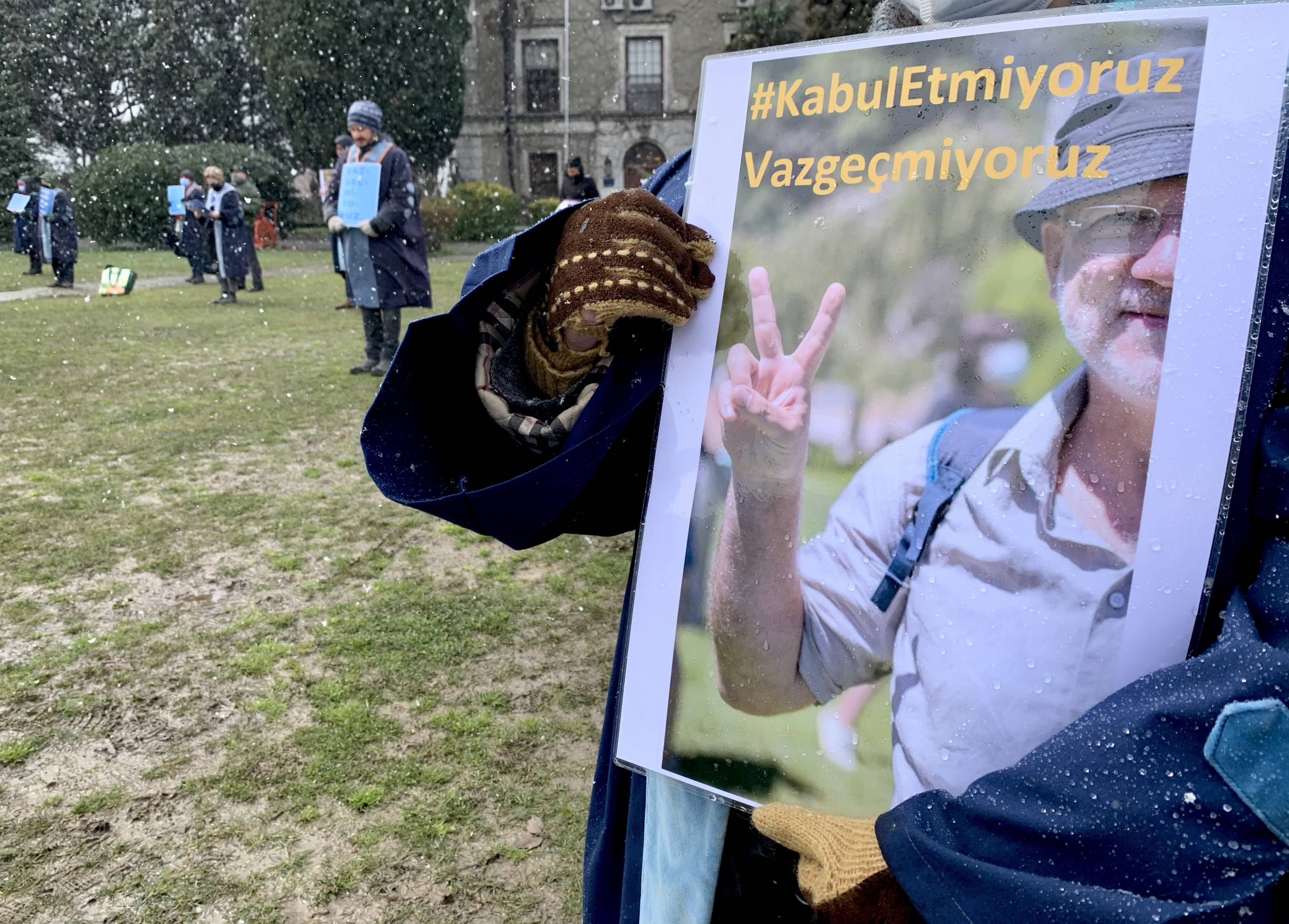
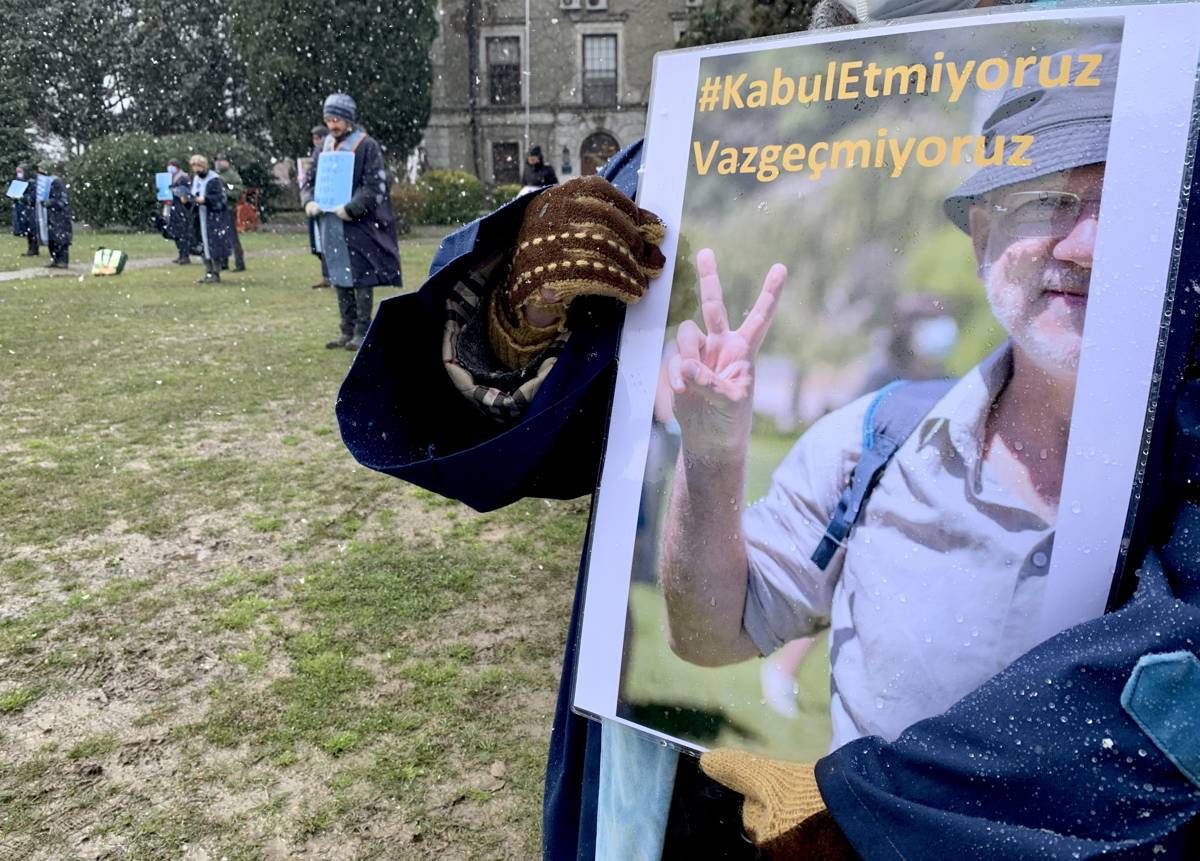
As the sixth year of the resistance at Boğaziçi University continues, for the past nine semesters—four and a half years—I have been prevented from teaching and from freely entering the campus. Two reinstatement lawsuits I have filed against the university’s trustee administration are still ongoing—one before the Council of State, and one before the regional appellate court (regarding my third dismissal). In the thirty-first year of my academic career, I am waiting for justice to be served, for the unlawfulness of what has been done to be clearly established, and to return to my rightful job, my university, and my students. In the meantime, every day I continue to share photographs and videos from the campus I cannot freely enter, through social media and the press, and to lend my voice to our collective voice. In the sixth year of the resistance, with the same determination as on the first day, we continue to say: “We do not accept! We do not give up!” We persist in this just struggle because academic responsibility demands it.
One final note: As an academic who contributed to the establishment of the Sexual Harassment Prevention Commission (CİTÖK) at Boğaziçi University in 2012, and who later served for a time as the commission’s chair, I would like to add the following to what we experienced during the resistance: while dealing with the attacks of the trustee administration, we also had to remove male academics from within the resistance itself who were responsible for sexual harassment and misconduct from our university… (CC/VC/VK)
Footnote
[1] Although the court of first instance recognized this injustice, unfortunately we were unable to persuade the appellate court, and the judicial path was closed.