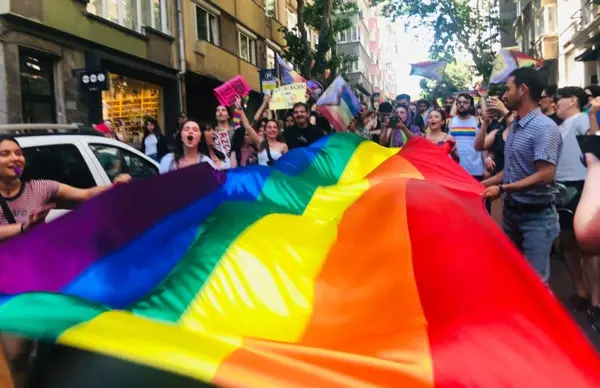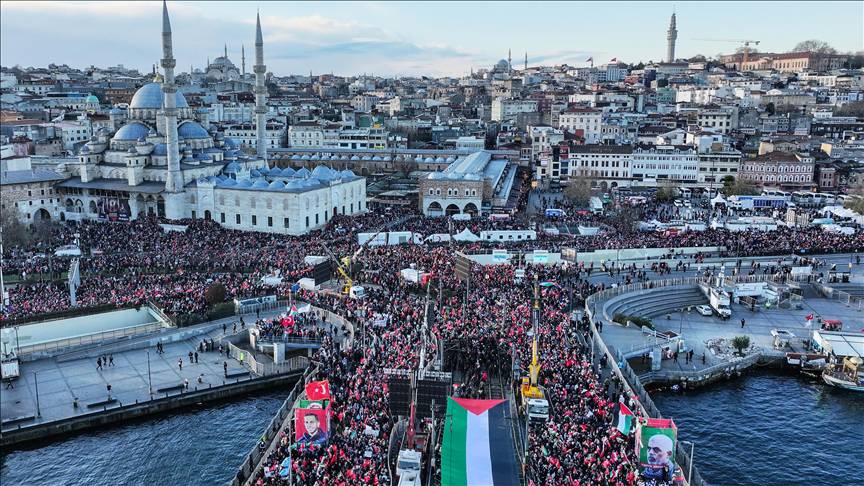

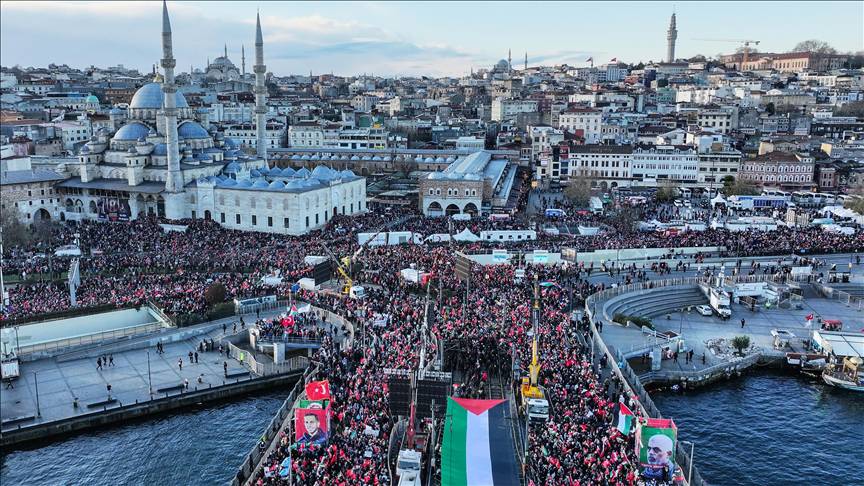



To mark the new year over 500 thousand people gathered on Istanbul’s Galata Bridge to protest the genocide in Gaza at a demonstration where Turkish flags seemingly outnumbered Palestinian ones. This sort of mass demonstration has become increasingly common in Turkey over the past few years.
However, many of those who organized the action that garnered global attention are themselves complicit in Israeli occupation.
The coalition of civil society groups organized under the banner of the Humanity Alliance and the National Will Platform includes The Independent Industrialists and Businessmen Association (MÜSİAD), a business association known for close ties to the ruling Justice and Development Party (AKP). MÜSİAD is a key part of the National Will Platform and has been accused of breaking Turkey’s trade embargo implemented in May 2024 to maintain business with Israel.
Notably, one of the march organizers was President Recep Tayyip Erdoğan’s son Bilal Erdoğan, who also spoke at the rally.
Israel’s largest steel suppliers
Several MÜSİAD companies, such as İÇDAŞ, Pamukkale Kablo and Limak Holdings, are major targets among Turkish Palestine activists. Before October 7th, MÜSİAD steel exporters supplied 65 percent of Israeli steel, the largest among them being İÇDAŞ. And according to reporting by Karar, the majority of Turkish companies under fire for continuing trade with Israel are MÜSİAD members. Pamukkale Kablo’s Turkish Electromechanics Team’s About Us page still openly references trade with Israel and Limak offers several shipping lines to Haifa and Ashdod.
It is normal to expect some Turkish flags at Palestine rallies to demonstrate solidarity between the two peoples. The vast majority of attendees showed up with only this goal in mind. However, it’s become a cliche where marches that feature more Turkish than Palestinian flags often serve as a self-congratulatory campaign organized by the ruling party — one that hasn’t even enforced its own trade embargo.
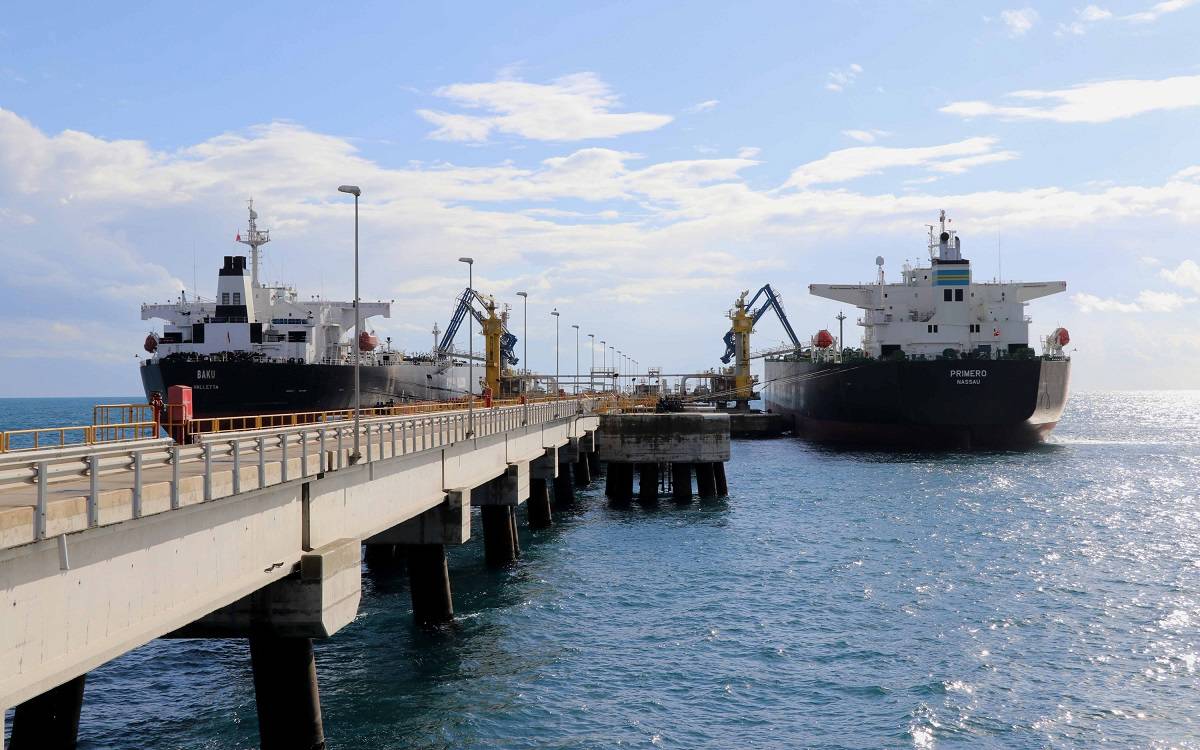
Activists across the globe, such as in the Palestinian Youth Movement (PYM), have been using publicly available shipping data from sites like MarineTraffic to track cargo ships entering Israel. PYM and No Harbor for Genocide researchers found that the Nissos Tinos crude oil tanker docked in Turkey’s Ceyhan port on October 4th prior to departing for its final destination in Israel, a route that it has made several times before. Israeli shipments routinely come through Turkish ports and this has not changed even after the embargo. Many of these shipments include Azerbaijani oil from the Baku-Tbilisi-Ceyhan (BTC) pipeline.
This suggests that those closest to the AKP, such as Bilal Erdoğan, who in his speech referred to those accusing Turkey of trading with Israel as “influence agents,” are directly at odds with the broader international Palestine solidarity movement. These groups have repeatedly demanded Turkey fully cut trade with Israel.
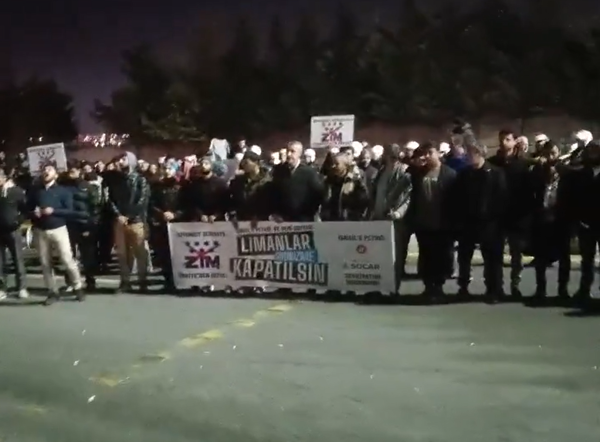
Protesters clash with police at İstanbul port over alleged shipment to Israel
Marches are one of many tools to affect political change, but these are meant to pressure governments into ending complicity. Meanwhile, the organizers of this rally have direct ties to the government of Turkey and business with Israel.
Simply put, if the goal is to actually end genocide, the AKP and those close to it should spend their time legislating instead of parading, at least until Israeli ships stop docking at Turkish ports.
Profitting from 'rebuilding' Gaza
Over the past few months, western media attention has focused on Turkey’s role in Palestine’s “rebuilding” process. Much of this highlights Israel’s opposition to Turkish involvement. As such, western media has framed Turkey's role in negotiations as a proxy representative to Palestinians, who are excluded from this process.
Palestinians are the only true representative of the Palestinian people and this dispute between Turkey and Israel about reconstruction is one between regional powers vying for influence across the entire Middle East, not just Palestine. In fact, the competition bears far more resemblance to the European scramble for Africa in the late 19th century than one of Muslim or anti-imperial solidarity. This will continue to be the case until Turkish trade with Israel is fully cut and Ankara takes a stance against genocide that extends beyond condemnation and concealed shipments.
The Turkish government maintains a delicate balance between satisfying a pro-Palestine constituency with its duties as a NATO member, but ultimately Turkey is largely in the western bloc. So much so that US Vice President JD Vance has praised Turkey’s role in brokering a ceasefire.
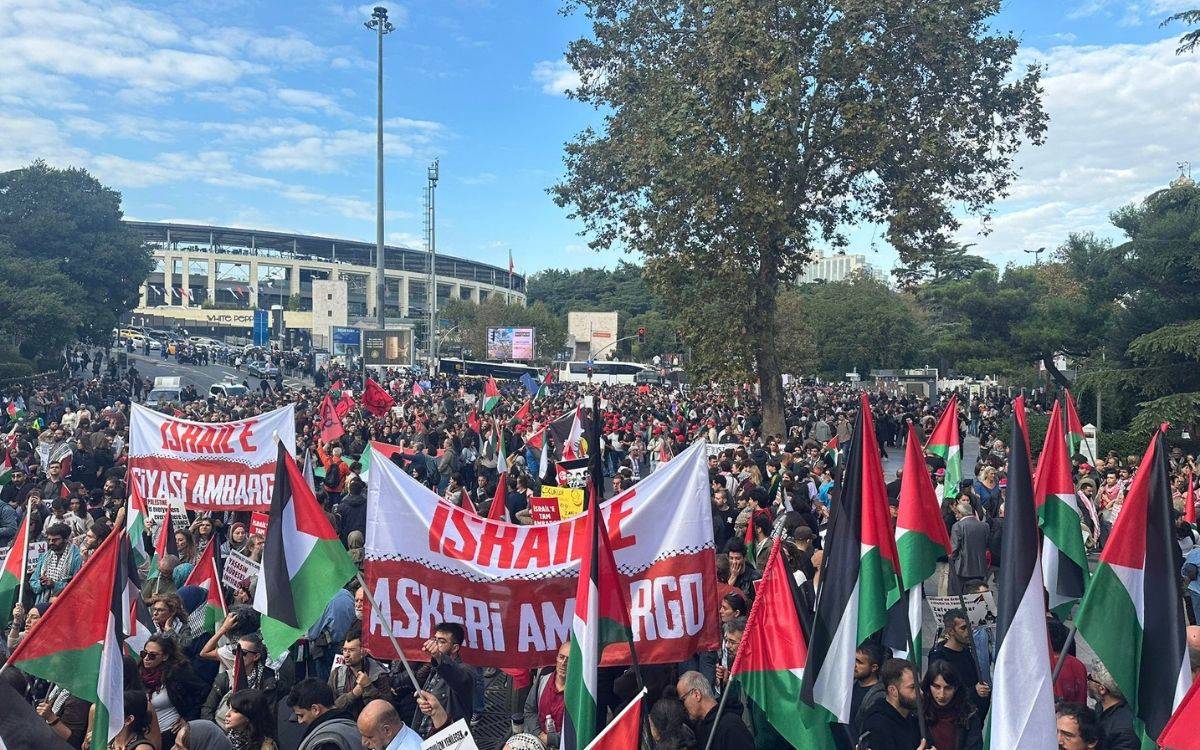
Thousands raise their voices in İstanbul, demanding 'full embargo' on Israel
Turkish capital could also be poised to benefit after the genocide just as they are during it. Former MÜSİAD President Mahmut Asmalı even spoke about the goal of opening a major trading and logistics center in Gaza in a January 2025 speech. These same businesses that conduct trade with Israel were marching for a free Palestine on New Years Day. After public pressure, MÜSİAD announced in February 2025 that it would investigate any members trading with Israel, but this internal investigation has yet to yield any substantive, public results.
Ultimately, much of what the speakers said at this march was not wrong. The people of Turkey largely stand with Palestine as a bulwark of humanity against this genocide. The question is will our leader do the same. At this moment, the answer appears to be no. (İK/VK)