
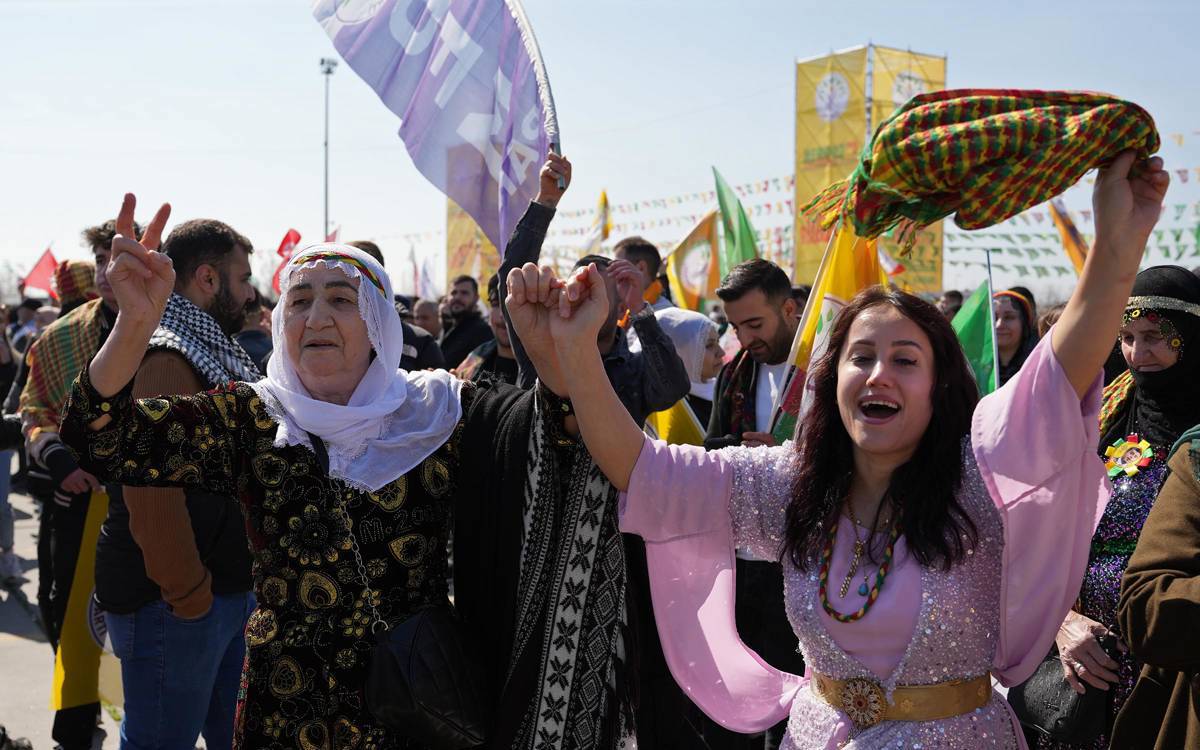



"As long as society sees women as reproductive machines, domestic slaves, and mere complements to men, revolution remains incomplete." — Emma Goldman
Murray Bookchin does not view capitalism merely as an economic system, but as a hierarchical form of civilization that instrumentalizes both nature and human beings. For him, capitalism is the root cause of both ecological destruction and social alienation[1]. Peter Kropotkin argues that capitalism violates the principle of “mutual aid,” undermining social solidarity by fueling competition and greed among individuals[2]. Emma Goldman defines capitalism not only as an exploitative system that robs workers of their labor, but also as a patriarchal structure that systematically oppresses women and the marginalized[3]. According to all three thinkers, capitalism is incompatible with freedom; it is a system of domination that destroys human potential and ethical relations with nature.
Abdullah Öcalan, who defines capitalist modernity as the latest peak of a five-thousand-year-old hierarchical civilization that corrodes ethical relationships and drives societies toward collapse, states: “Capitalism is ahistorical and immoral. It is neither a form of society nor civilization. It is merely parasitic”[4]. For Öcalan, capitalist modernity—particularly at the center of his criticism for the last 25 years—is a system that suppresses all possibilities of social liberation, prioritizing economic growth, centralized power, and a homogeneous society. Its political form is the nation-state. Across the world, the nation-state operates as an instrument that protects capitalist interests and suppresses the multiplicity of societies through the principles of one language, one nation, and one flag. Through functions such as tax collection, military formation, securing property, and disciplining labor, it institutionalizes capitalist relations of production.
The family structure shaped by patriarchal codes, the imagined nation built upon it, and finally the construction of the nation-state have all produced severe social and political consequences for humanity. Particularly in the context of Europe’s bourgeois revolutions, the nation-state became a functional tool for consolidating class interests. However, the borders drawn were not inclusive; rather, they were built on exclusionary and homogenizing principles. Structures that excluded peoples, workers, women, and LGBTQ+ individuals from political and social processes turned into graveyards of identities and beliefs through the monopoly of violence they enforced[5].
The French nation-building process assimilated many local, ethnic, and linguistic identities under the principle of "one nation, one language, one culture." This process intensified during the 19th century, especially under the Third Republic [post-1870]. The most suppressed identities included Bretons, Basques, Occitans, Alsatians, and Corsicans. Among them, the Basques and Corsicans continue to resist assimilation through collective struggle. Despite adopting a "civic nation" model, the French nation-state ultimately produced a homogenized French identity by repressing linguistic and cultural diversity[6].
In contrast, the German nation-building model, which can be defined as a cultural-ethnic model, was even more exclusionary due to its reliance on blood ties and ethnic origins. The German nation-state was formed in 1871 through the unification of fragmented German principalities under Prussian leadership. Based on a shared language, history, and culture, it adopted an ethno-cultural understanding of the nation. Romantic German nationalists such as Johann Gottlieb Fichte and Herder defined German identity through nature, history, and the “Volksgeist” [spirit of the people][7].
French and German nationalisms have become two dominant models shaping modern Europe’s political map. But both processes were not only about national unity and centralization; they also involved the suppression and exclusion of different peoples, identities, and languages. Each model actualized the inherent violence of the nation-state logic in different ways. During the rise of these exclusionary nationalisms, Ernest Renan, famously declared in his 1882 lecture “What is a Nation?” at the Sorbonne that a nation is not based on ethnicity or language, but on shared historical memory and the will to live together[8].
On the other hand, Russian revolutionary and collectivist anarchist theorist Mikhail Bakunin, along with French anarchist economist Pierre-Joseph Proudhon, advocated for federated, self-governed peoples’ unions against centralism[9]. In his five-volume Manifesto for a Democratic Civilization, Abdullah Öcalan identifies the nation-state as the primary source of modernity’s crisis. For him, the nation-state is not only the political form of capitalist modernity but also a mechanism of domination that suppresses the free life of peoples, beliefs, women, and nature. To use Proudhon’s words: “The essence of the state is authority and tyranny; whenever the state arises, freedom disappears.”[10]
In this work, Öcalan systematically analyzes the historical roots of the nation-state and its entanglement with capitalism. In the fourth volume, he extensively lays out the theoretical foundation for the democratic nation as an alternative paradigm to the crisis of the nation-state under capitalism. In the final volume, he further develops this crisis and the proposed solution in what is expected to be a new form: the Manifesto for a Democratic Society. This manifesto is not merely intended to replace the Road to the Kurdish Revolution Manifesto, but to lay the groundwork for a post-state, radically democratic and ethically grounded communalist politics.
I - Will the revolution be with or without the state?
II - The construction of actually existing socialist practices
III - The codes of democratic modernity through the critique of capitalist modernity
IV - The anarchist face of democratic modernity
Notes
1 - Murray Bookchin, The Ecology of Freedom: The Emergence and Dissolution of Hierarchy, AK Press, 2005.
2 - Peter Kropotkin, Mutual Aid: A Factor of Evolution, Penguin Classics, 2009.
3 - Emma Goldman, Anarchism and Other Essays, Dover Publications, 1969.
4 - Abdullah Öcalan, Capitalist Civilization, in Manifesto for a Democratic Civilization, Volume 1, Aram Publishing, 2009.
5 - Benedict Anderson, Imagined Communities: Reflections on the Origin and Spread of Nationalism, Metis Publishing, 1993.
6 - Ernest Renan, “What is a Nation?”, Lecture at the Sorbonne, 1882.
7 - Johann Gottlieb Fichte, Addresses to the German Nation, 1808.
8 - Isaiah Berlin, Herder and the Enlightenment, Princeton University Press, 1976.
9 - Mikhail Bakunin, Statism and Anarchy, Cambridge University Press, 1990.
10 - Pierre-Joseph Proudhon, The Principle of Federation, 1863.