



The 1931 constitution, which initiated the Second Republic in Spain, was adopted by a government of republicans and socialists, who had a majority in the June 1931 elections.
Inspired by the French Revolution, the 1931 Constitution reflected reactions against the old regime, the Church, and large landowners. The constitution emphasized that the democratic republic should be based on the separation of powers and people’s sovereignty. Within the adopted principle of secularism, church and state separated, and the church was excluded from family matters of marriage, divorce and education. Also, state financial support for churches ended. In addition to classical and social rights and freedoms, for the first time, women's suffrage was granted. A system of government was set up with a unicameral parliament and a president with limited powers, and although elections were held, the constitution was abolished due to the Franco coup and civil war of 1936.
The republican-socialist coalition government was determined to realize the comprehensive reforms introduced in the constitution. Laws were passed to improve working conditions and strengthen trade unionism, numerous new schools were opened, and religious education was made non-compulsory. Furthermore, to secure the army's loyalty to the new regime, full-pay retirement was offered to those who wanted it. Land reform, which caused strong opposition from large landowners and conservatives around the Catholic Church and the army, resulted in an unsuccessful coup attempt in 1932. In November 1933, because of economic crises, the government enforced elections, resulting in the establishment of a radical right-wing government. All reforms were reversed, and anti-republican officers, including General Franco, were appointed to high-ranking positions in the army. The radical right's reversal of all reforms caused social unrest and a general workers strike in 1934. This social uprising was violently suppressed by the army, and the death toll reached 1,500-2,000, with 3,000 wounded and 30,000 arrested, including prominent left wing figures.
Following corruption scandals that emerged shortly afterward in the radical right government, the left-wing coalition won the February 1936 elections. The newly elected government granted amnesty to all those who had been convicted or fled abroad during the 1934 uprising, and reinstated all the reforms of its previous government. However, in the tense political and social climate, socialists and workers were anticipating a revolution, while the radical right and conservatives were waiting for another military coup. As polarization intensified, street clashes escalated following April, and the coup attempt led by Franco on July 17-19, 1936, initiated the Spanish Civil War.
Franco's coup attempted to overthrow the democratically elected republican government by mobilizing the masses with conservative, nationalist, and anti-communist rhetoric. He voiced nationalist discourse based on Catholic values as fundamental policies and principles, characterizing the military coup attempt as a kind of "crusade." Franco vowed to restore the privileged status of the Roman Catholic Church and completely eliminate secular or anti-religious Republican laws, Marxism, anarchism, and left-wing political movements, which he accused of destroying traditional Spanish society. Franco also wanted a unified Spanish structure with a centralized military and political power, rejecting regional autonomies (such as in Catalonia and the Basque Country) and liberalism. During and after the civil war, Franco chose to eliminate his opponents and leftists through mass, violent extrajudicial executions.
During the civil war, Franco frequently repeated slogans reminiscing the imperial history of Catholic monarchs Ferdinand and Isabella. Franco's close associates also popularized the slogan "One Fatherland, One State, One Leader," echoing the German "Ein Volk, ein Reich, ein Führer," a European fascist slogan. Furthermore, the nationalist’s war cry "Long live death!" emphasized a fatalistic soul to death among Franco's troops; and the slogan "For God and Spain" highlighted Franco's Catholic values, defining the war as a holy crusade to liberate Christianity from communism and secular republicans.
The developments after 1931 that led to the civil war summarized above show that the conflicts between the two fronts was essentially class struggle involving the Church. As shown, implementation of the social reforms caused immense reactions from the radical right-wing, fascists, and the large landowners — and Franco, as he openly voiced, launched the coup in the name of these class interests.
Rival fronts and international volunteer brigades
On July 17, 1936, General Franco, with an army composed of loyal soldiers, launched a coup aimed at overthrowing the elected republican government, the Popular Front. The Spanish Popular Front was a coalition government of republicans, the Socialist Party (PSOOE), the Stalinist Spanish Communist Party (PCE), and the left-wing Marxist United Workers' Party (POUM). It was supported from the outside by the anarchist-syndicalist National Confederation of Labour (CNT).
While Britain, France, and the USA adopted a policy of non-intervention in the civil war, Nazi Germany and Fascist Italy supported Franco with tens of thousands of soldiers, aircraft, tanks, and other weapons. Fascist Italy sent approximately 75,000 soldiers, in addition to pilots and aircraft. Italian planes, along with German air support provided by approximately 5,000 air force personnel, bombed Republican cities from the air. The most intense of these attacks happened on April 26, 1937. German and Italian planes, in a three-hour bombing raid, demolished the Basque town of Guernica, killing over 200 civilians. The Spanish Civil War became a military testing ground where the newest weapons were tested in battlefield conditions.
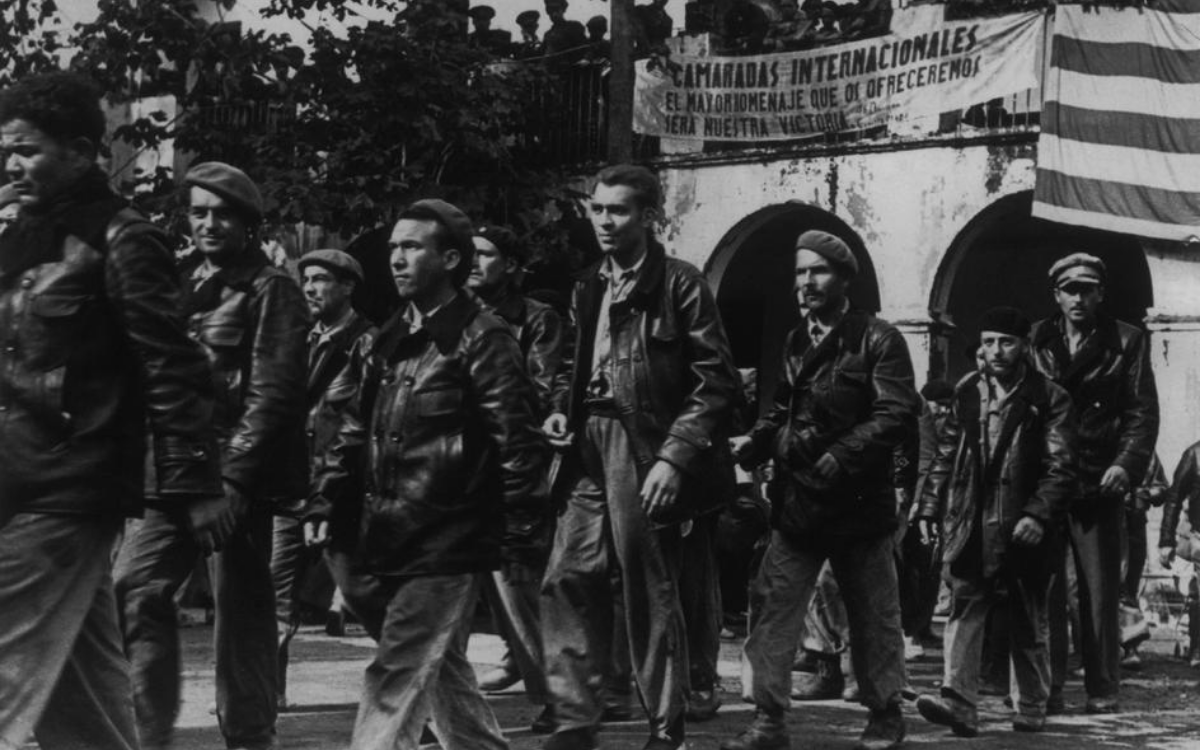
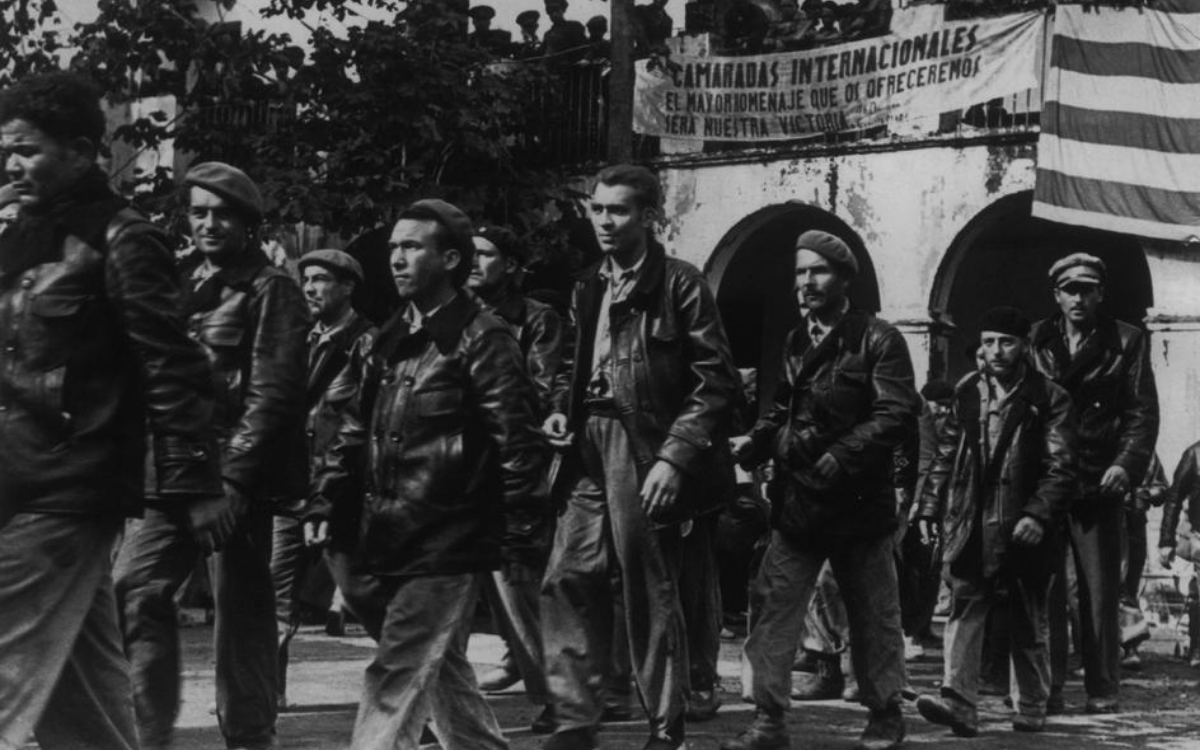
The Republican Popular Front, opposing Franco, received significant support primarily from weapons and soldiers sent by Stalin, and tens of thousands of volunteer fighters from around fifty countries, known as “international brigades,” who came to Spain to fight against fascism. While the majority of volunteers were socialists, there were also libertarians and anarchists who wanted to prevent the spread of fascism in Europe. The French formed the largest group of volunteer fighters with 28,000 people; Germany, Austria, Poland, Italy, the United States, the United Kingdom, Yugoslavia, Czechoslovakia, Canada, Hungary, and Belgium were also represented by numerous volunteer fighters. The International Brigades were assembled, organized, and directed by Communist International, headquartered in Paris. There were seven brigades in total, each divided into battalions according to their nationality (e.g., the French-Belgian Paris Commune Battalion, the American Abraham Lincoln Battalion, the British Battalion). The combined number of volunteers changed throughout the course of the war. The total estimated number, including a small number of women, reached approximately 60,000.
In Spain, out of a population of 23.6 million, nearly 500,000 lost their lives in the civil war. 500,000 were forced to emigrate abroad, and 150,000 workers, artists, and leftist intellectuals were murdered behind fascist lines. After the war ended, 20,000 pro-republicans were executed by firing squads, and an estimated one million people were imprisoned in 300 concentration camps and prisons. It is accepted that approximately 200,000 of those who lost their lives in the Spanish Civil War died as a result of systematic murders, mass violence, and torture. Furthermore, anarchists and leftist radicals, seeing the Catholic Church as an obstacle to major reforms, launched attacks against them, resulting in the deaths of approximately 7,000 Catholic priests, monks, and nuns in the first months of the war. By May 1937, Franco's forces were recorded to have killed both liberal and Republican clergymen, because they were against Franco.
The conflict between Stalin and Trotsky in the Spanish Civil War
The Spanish Civil War, in a general assessment, reflects the major conflict in the 20th century between the international left and the working class against rising fascism in Europe. Another noteworthy point is that while the civil war was seen by left-wing and socialist parties as an opportunity for socialist revolution, Stalin's resolute pursuit of maintaining the power of the Republican People's Front led to conflict between opposing left-wing/socialist groups. In evaluating the Spanish Civil War and the roles of the international brigades in the war, it is also necessary to address the influences of Stalin and Trotsky on the groups/brigades close to them. In other words, it is necessary to examine the conflict between the Trotskyist movement and the Stalinists — observing that the political rivalry within the Soviet Union extended into armed conflict in Spain's civil war. It is worth remembering that Stalin, while establishing the strongest military front against Franco in the Spanish Civil War, was careful not to increase tension with leading Western countries; US, Britain, and France; in order to secure their neutrality. Therefore, he insisted that the Spanish Communist Party support the republican “Popular Front,” the prevention of the landowner property confiscations, and the cessation of radical workers’ movements and occupations. In short, while working to suppress the radical workers revolutions in Spain, Stalin engaged in violent clashes, particularly with left-wing groups close to Trotsky.
In the beginning of the civil war, Leon Trotsky, commander of the Red Army and leader of the October Revolution with Lenin, argued that victory was only possible if the workers seized power and continued to fight against Franco using revolutionary methods. Trotsky insisted that the Spanish working class separate themselves from the Popular Front, who he considered bourgeois; establish an independent workers' government; and combine military strategy with social revolution.
Trotsky argued that cooperation with the republicans would paralyze social revolution and inevitably lead to military defeat against Franco. Therefore, he recommended equipping the workers with arms. For this reason, he also strongly criticized socialist forces like the POUM (United Marxist Workers' Party) for joining the Popular Front instead of mobilizing workers to seize power. In short, Trotsky accused the Soviet Comintern and the local Stalinists of betraying the revolution, liquidating the workers' councils, and collaborating with the bourgeoisie.
The establishment and maintenance of the International Brigades in the Spanish Civil War was part of Stalin's goal to link his political aims with international communism, as a part of a larger geo-strategic vision aimed at creating a united opposition front against fascist aggression. He also hoped and expected the policy of supporting the Republican Front could bring Moscow and the West into a closer alliance. But the process of fighting and the method of deployment and use of the Brigades proved a historical failure due to mismanagement, conflicts between the factions of socialists and anarchists, and the insufficient supply of arms and logistics.
Other conflicts
It is also noted that armed conflict between Soviet-backed Stalinists and anti-Stalinist leftists and anarchists took place behind the lines of the Republican People's Front between May 3-8, 1937, which was particularly intense in Barcelona. Following the suppression of the uprising, the Stalinist security apparatus and Soviet NKVD agents declared POUM illegal. Its leader Andrés Nin was abducted, arrested, tortured, and murdered.
The conflicts between Stalinists and anarchists (excluding Trotskyists) during the Spanish Civil War over ideological and policy differences about Spain’s future are recorded as a regrettable event for the anti-fascist Republican Popular Front. While anarchists wanted to achieve a socialist revolution quickly by nationalizing land and industries, Stalinists insisted on preserving the existing order, the traditional structure, and the Republican Popular Front, especially to ensure the continued neutrality of France and England and the continuation of Soviet aid. The armed struggle between Stalinists and anarchists, which turned into open street clashes, had a seriously negative effect on the power of the anti-fascist Republican Front.
Another noteworthy massacre during the Spanish Civil War is what historians called the Red Terror: a series of attacks, killing thousands of Catholic priests, monks, nuns, and other clergy by anarchists, communists, and other leftist radicals. In the chaos that ensued during the first weeks of the Civil War, when law and social control collapsed, anti-religious violence included the widespread looting and burning of churches, destruction of graves, and public vandalism of religious statues.
The Red Terror massacre is recorded as the execution or killing of approximately 6,832 Catholic clergy by anarchists and leftist militias. Those killed included 13 bishops, over 4,100 diocesan priests and students, over 2,300 monks and priests, and approximately 300 nuns.
A brief look at the historical reasons for the massacre reveals that the Catholic Church in Spain drew the ire of leftists and anarchists due to its long-standing influential position in society supporting the monarchy and conservative policies. Furthermore, these groups viewed the Catholic Church as a corrupt institution, with a power to control educational institutions and extensive land ownership, along with its significant economic and social power and influence over society and politics. Thus, it constituted a serious obstacle to the country's modernization and social equality. During Franco's attempted military coup, leftists and anarchists saw the Church as an active political and military legitimate target on Franco's front, giving the coup the character of a holy crusade.
(NT/İK)