



The road makes you question things; it gathers thoughts and reflections. Some of the truths you believed your entire life suddenly invite you to see and learn anew.
I suppose that’s why I’ve always been excited by roads and the different states of being on the road. This time, I am traveling to deliver a one-day training on Social Ecology on the Axis of Democratic Modernity. But that subject deserves its own article—both to be written in depth and to allow for recovery from the wear of the road.
Three themes have been accumulating in my mind during this journey. The first is the issue of tourism; the second, the new debates on the Democratic Nation; and the third, a question: Who is called an internationalist? What is internationalism? However, I will try to move forward without touching on the second and third themes. The preparations are complete, the travelers are ready. We’re on the road.
This time, on Jun 19, Merdo and I set off from one inland country to another. Our tickets were bought weeks in advance, our suitcases packed with excitement, and our cat Uméa and our flowers entrusted to a neighbor.
Traveling from one “interior” country to another is not usually a problem, but we were nonetheless anxious. We’ve consistently faced challenges when crossing borders and dealing with passport issues. Since my dear traveling companion—also a political refugee—still hadn’t received her passport, we decided on alternative routes that would avoid official controls.
You may be wondering what I mean by “interior countries.” Let me explain: from the Northern Basque Country—officially northwest France—where we live together, we traveled first to the Southern Basque Country—officially northeast Spain—and then to Catalonia, which is officially part of southwest Spain. Crossing the bridge from Hendaye (Handey) in the north to Irun (Irrun) in the south, we continued on to San Sebastián/Donostia. It felt good to walk the streets of this city, where we had spent a few days together last year, and to focus on human stories by the beach.
We arrived at the bus terminal at midnight, handed over our suitcases, and went to validate our tickets—only to be told that the tickets we bought weeks ago were not valid and we weren’t on the passenger list. The company was FlixBus—and this wasn’t my first bad experience with them. With no solution offered, we walked into the city center in the middle of the night. We listened to the language of the crowds; mostly Spanish and English.
We searched the streets for a place to stay. Every hostel or guesthouse we knocked on was full. We told ourselves, “There’s nothing to do—we’ll sleep on the beach tonight.”
That night felt endless. Crowds flooded the beach—people more unrestrained and extravagant than they ever would be in their hometowns. You couldn’t help but think of the locals—how do they cope with this chaos?
Before sunrise, we left our beach spot in search of a bakery, thinking that a croissant and coffee would do us good. Then, through a car-sharing (covoiturage) app, we found a ride heading toward Barcelona, around 45 km away.
Luckily, the person who picked us up had a Basque Country scarf hanging in the car—a sign we were politically aligned. He turned out to be a kind, cultured young Catalan. Even though we didn’t share a common language, we understood each other with gestures and a shared sense of solidarity. He dropped us in a small town where we spent the night.
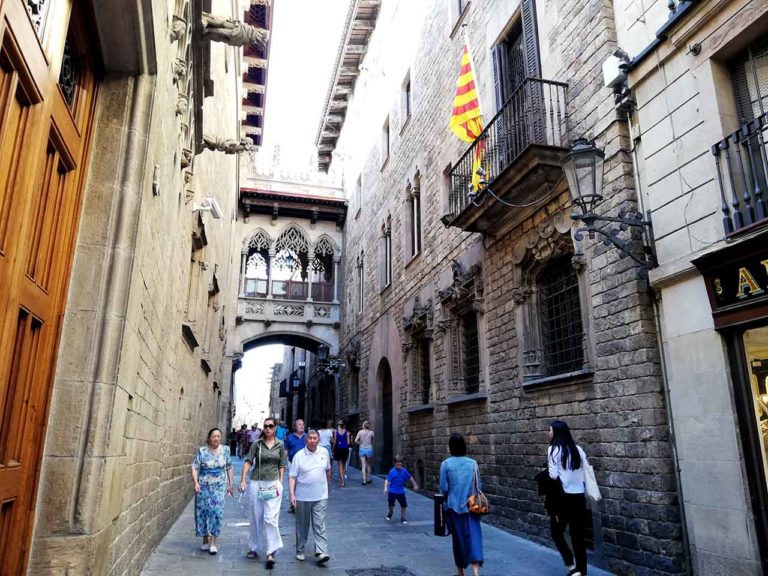
The next day, we finally arrived in Barcelona by train. It was my third time in the city and Merdo’s first, and I could hardly describe his excitement. Despite all the mishaps, we had arrived with our spirits intact. Leaving our luggage at a pawnshop, we lost ourselves in streets still preserving their historical architecture—their harmony soothed us.
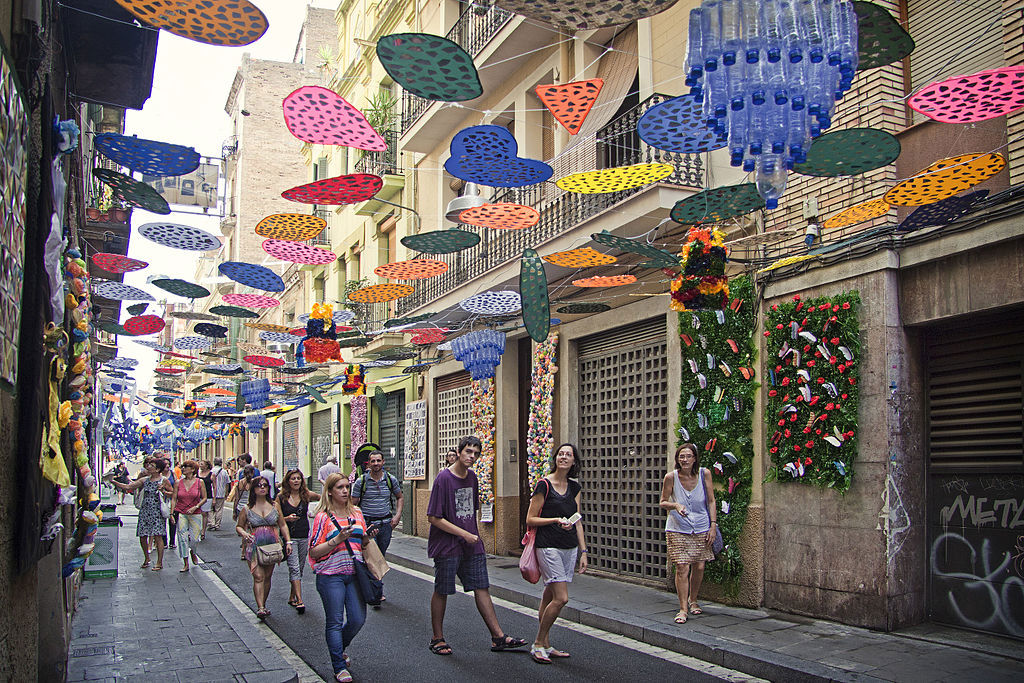
People from all over the world filled the streets with their sympathetic faces, speaking different languages, sharing music, dances, food...
But as we moved toward the main arteries, it was clear: these crowds were tourists.
You might ask: how can we tell who’s local and who’s a tourist? It’s not hard—tourists speak loudly, often unaware of their surroundings, with phones in hand, stopping constantly to point out sights.
You can barely take a step forward. In that moment, we couldn’t help but wonder: what do the real residents of Barcelona do in the summer? The city feels overwhelmed—its central streets, boulevards, and squares invaded by people whose money defines their presence.
Even before Ander, our host, welcomed us, he called to say, “I bought tomatoes and eggs—I’ll make menemen for you tonight!” When we heard the word menemen, Merdo and I exchanged a smile. After a day full of obstacles, hearing “hun çavane?” erased our fatigue. I’ll write more about Ander’s journey and how it intersects with the Kurdish movement in my next piece.
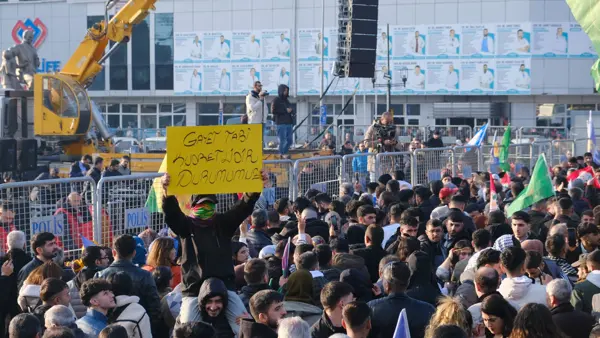
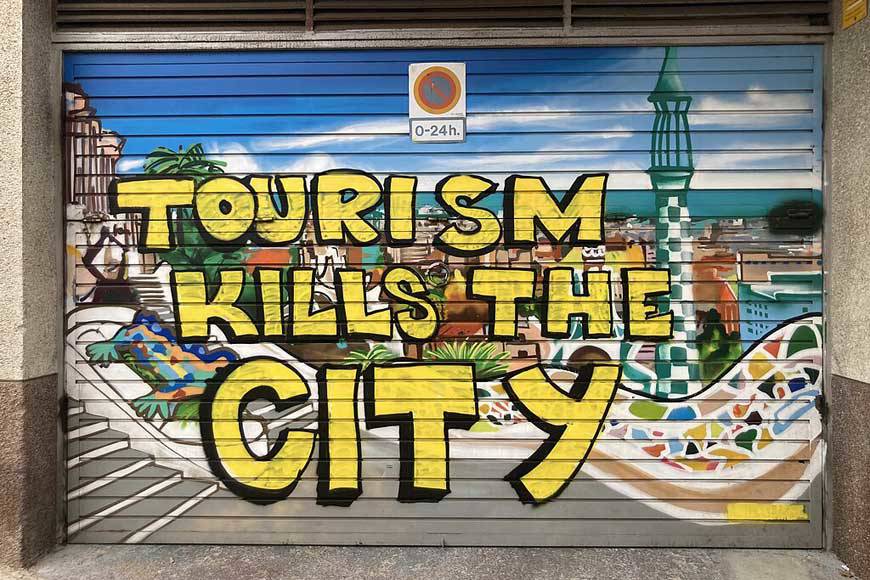
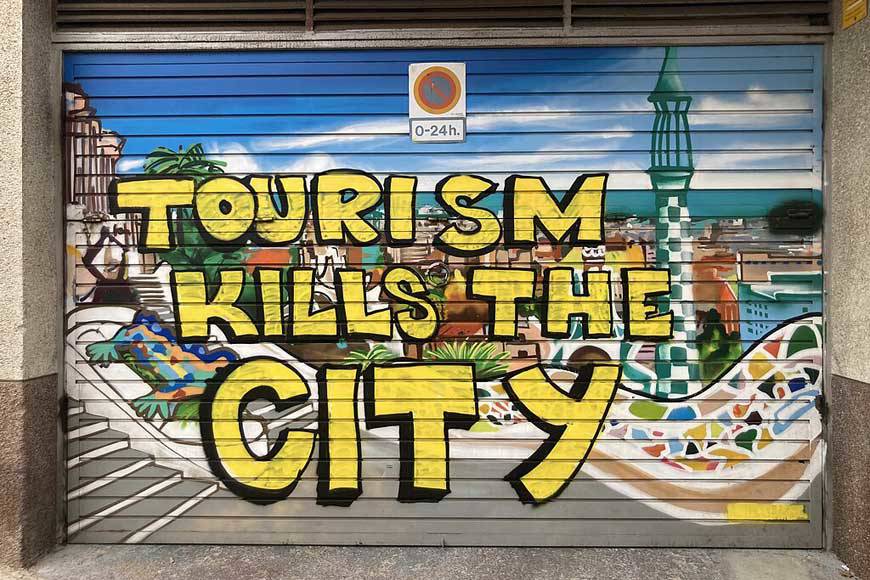
That night, we walked together along the beach. What we saw surpassed even San Sebastián. I dwell on this because a week earlier, Merdo and I had discussed a news article titled “Barcelona Residents Protest Tourists.” We had talked about how we wanted to act differently than tourists.
And honestly, from what we saw on the beach, it felt as though the purpose of most tourists was to use the city as a trash bin. We walked away, certain that distancing ourselves from this behavior was the right thing to do.
The cost of tourism in Barcelona
Let’s take a brief look at tourism in Barcelona, which is often equated with money and economic growth:
1. Deepening the housing crisis
The rise of Airbnb and short-term rentals has led to a 45% decrease in resident population in some neighborhoods (2007–2019). Rents have increased by 68% in ten years, making housing unaffordable for many locals.
2. Infrastructure and resource pressure
Overcrowded subways and buses, water shortages, and excessive strain on city systems have become routine due to high tourist numbers.
3. Loss of cultural identity
Traditional businesses are disappearing, replaced by souvenir shops and international chains. Over-tourism at sites like Park Güell (which receives 9,000 visitors a day) has forced limits on hourly access. The city’s identity is increasingly tailored for tourists.
4. Social unrest and resistance
Noise, behavioral issues, and garbage problems lower locals’ quality of life. Residents are fighting back with protests—for example, in June 2025, large demonstrations used slogans like “One more tourist, one less neighbor.”
Then we say: travelers, not tourists
1. Build relationships, don’t consume
Tourists tend to follow packages, stay briefly, and remain detached.
Travelers seek contact—with people, culture, nature—and truly see, not just look.
2. Break from capitalist tourism chains
Tourism is often controlled by global corporations, marginalizing locals.
Travelers support local producers and businesses and value sustainability.
3. Respect communities
“Acting like a tourist” often implies rudeness, indifference, or noise.
Travelers act like guests and are welcomed like locals.
4. Ecological sensitivity
Mass tourism harms nature—CO₂ emissions, water waste, trash.
Travelers choose eco-friendly transport, reduce waste, protect water and green spaces.
5. Seek experience, not consumption
Tourists follow checklists.
Travelers embrace spontaneity, learn from locals, collect meanings, not just photos.
Let’s not forget: to be a traveler is to know without consuming, to trace without leaving traces, to understand before seeing.
Cities like Barcelona don’t need more people to look at them—they need people who feel and respect them.
So, to build a more just, sensitive, and sustainable travel culture, we must say yes to being travelers, not tourists.
A traveler walks the road, gathers stories, and leaves seeds for the next journey.
Stay on the road. (EJA/VK)