



The invisible boundaries of our lives are no longer determined by people, but by screens, barcodes, and algorithms. These two texts, written through the lens of a travel experience, are a call to confront and question the effects of technology, digital systems, and capitalist life on our everyday existence.
The route I took with my companion Merdo is not merely the story of moving from one place to another; it is a narrative that reveals what one faces when pushed outside the system, what solidarity truly means, and why the idea that “another life is possible” is so valuable.
What we call “dystopia” may have already become life itself. We live in a world where being left out of the system, not appearing on a list, or having a card blocked can render a person invisible. Yet this text is also about hope, comradeship, the power of the collective, and the persistent will to remain human—even in the toughest moments.
I couldn’t not tell this story...
How fluent are we in the language of communication? How much control do we have over technology—and how much control does it have over us? Is it a dystopia or reality? Are we trapped? I had never asked myself these questions so intensely before. Everything started with a journey—but it didn’t end there. I had already written the first part of this journey for the readers of bianet.
In this piece, I mentioned: “Three main themes have accumulated in my mind along this path. The first is the issue of tourism, the second is new debates on the democratic nation, and the third is: who qualifies as an internationalist? What is internationalism?” Yet, I decided to move forward without delving into the second and third topics. I had previously written about the first—tourism—for the readers, saying: “Preparations are complete, travelers are ready. The journey has begun.” In the same text, I stated that I would leave the topics of “democratic nation” and “what is internationalism?” for other writings, and would instead focus on the questions I asked above, limiting the “I Can’t Not Tell” series to these two essays.
Barcode systems, passports, and the loss of humanity
After loading your luggage into the bus, you try to scan the barcode from your online ticket into the driver’s handheld device. But your name doesn’t appear on the list. “Could you please check again?” you ask in French. He replies in Spanish: “I’m checking, but I don’t see either of your names in the system.”
You’ve come all this way, having already navigated the border and passport stories in your own way, and suddenly you find yourself walking through the streets of the city where you planned a simple transit stop. Because if your name is not in the system, no human being can resolve it. People no longer possess such a capacity. If you’re not in the system, you simply don’t exist. And the barcode scanner on the driver’s phone tells him nothing else. The initiative doesn’t belong to the driver—or to you—but to the application that reads the code.
You are now in the streets, searching for a place to spend the night. You ring the bells of hostels and pensions, or make phone calls, but to no avail. The only way to secure a place to stay is to track down a reservation you’ve purchased online. But now, there’s no reservation to follow. And suddenly, you find yourself in a night that seems endless on the beach. Social human beings, it turns out, become strangely social creatures at night.
I didn’t know this before that night. No one is concerned with anyone else. What you go through remains with you alone. Police cars occasionally pass by, city dwellers walk their dogs in the early hours, seagulls scavenge food from garbage bins…
Through a ridesharing app, we find a car leaving from a town 50 km away from San Sebastian, heading to Barcelona. Merdo and I, having left our house 24 hours earlier, now sit quietly in the sweltering 34-degree heat of a town we hadn’t planned for—waiting. Eventually, Steve calls. From our very first hello, we understand each other—even without sharing a common language. Steve’s car is meticulously organized, not just like a taxi but more like a companion’s vehicle, ready to offer solidarity.
As we settle into the comfortable back seat, a scarf symbolizing Basque independence catches our eye and makes us smile. We assume he is Basque, but in a few short phrases, he tells us he is Catalan, with Basque friends. We look at him with an unspoken “and now you have comrades from Kurdistan too” kind of glance. After 24 hours of unrelenting chaos, we finally breathe.
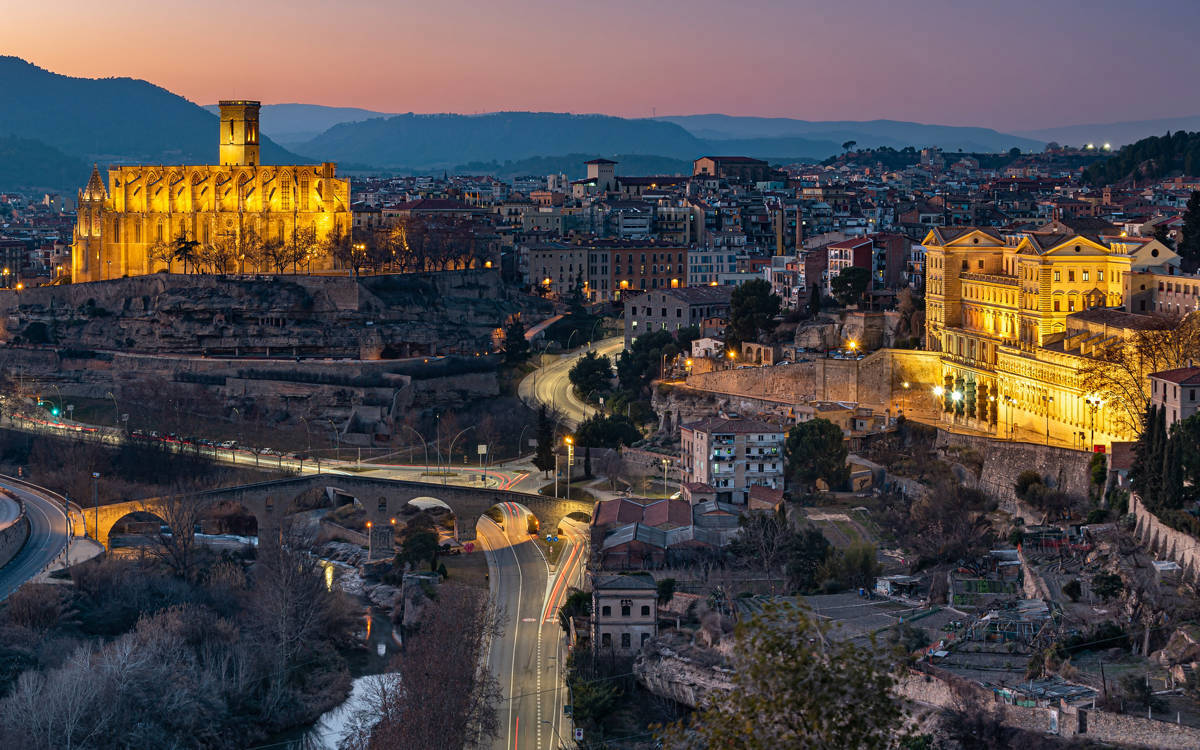
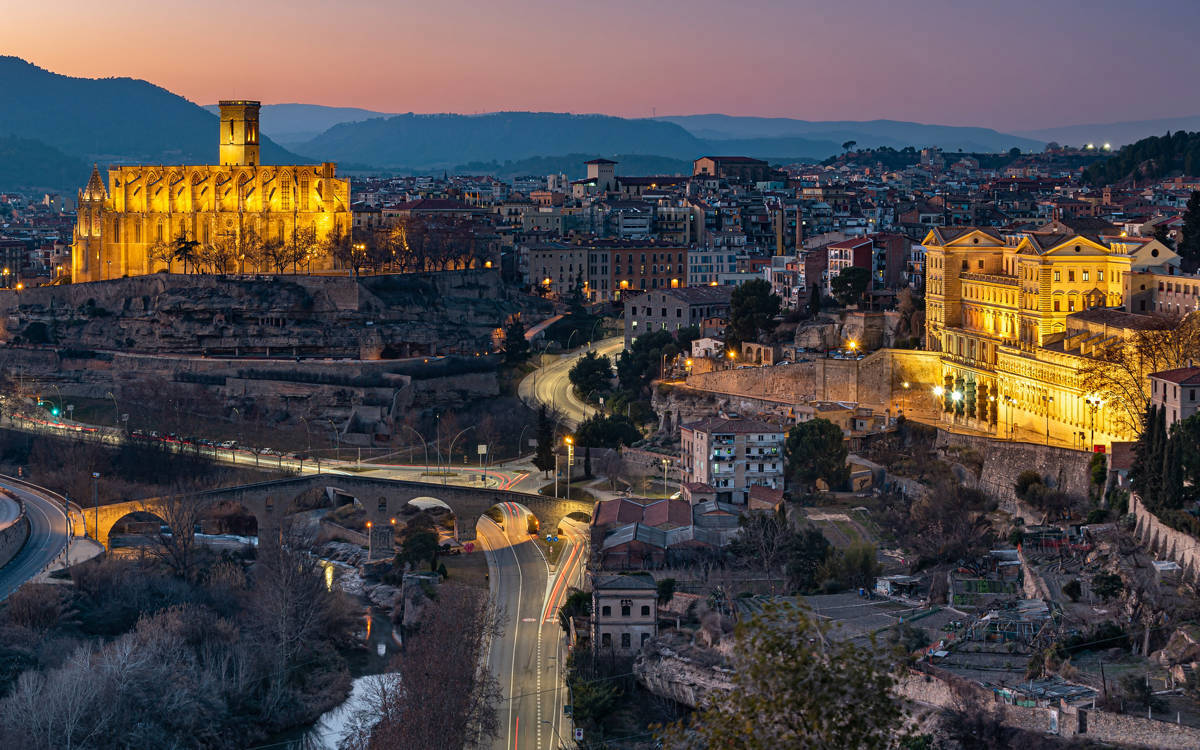
Steve drops us off in Manresa, 65 km outside Barcelona—an unplanned stop. The old brown stone architecture immediately draws our attention. I say, “Merdo, this is your city. Let it be called MardinCatalan.” With meaning added to place, we begin to slowly discover the town.
The first things we notice are Manresa’s narrow streets and its massive medieval castle that seems to transport us to another time. Amid the Catalan and Spanish we expected to hear, the frequent sound of Arabic also surprises us. As we wander the town surrounded by Arab, Spanish, and Catalan cultures in harmony, we eventually find a place to rest and catch our breath.
The next morning, a train takes us through Mediterranean hinterlands and finally brings us to Barcelona. I love the harmony of this city’s streets, how people touch one another, how laundry hangs from balcony to balcony—connected. There is even a musical rhythm to the streets. Yet, when I see the city overwhelmed by massive crowds, I feel as if it has been invaded.
Later that night, we are hosted by Ander, and that sense of harmony continues. Ander, whose path had once crossed with the Kurdish Freedom Movement, asks us questions with such enthusiasm that we feel our excitement mirrored in his. The next morning, as we prepare to explore the city, we go to leave our luggage with a storage service—only to discover, with great surprise, that both our bank cards have been suddenly blocked.
Starting point: the power of the collective
We find ourselves living the very reality of being completely broke and alone in a city. We perch on the garden walls of a chapel, trying to reevaluate our options. A comrade far away comes to mind—so I call Nur, who sends money via Western Union. After walking in the heat for some time, we finally reach the office. But there’s a problem with the system. While my passport had posed no issue for air travel, now it becomes an obstacle to withdrawing money from my Western Union account—because it has expired. The French word piège (trap) best describes our situation: we’ve fallen into a kind of trap. We are at the heart of a life where online systems have excluded us.
We throw ourselves onto a park bench—hungry, out of water, and under 34°C heat. We continue discussing the state of being on the street or of the street. I say: sometimes being on the street is a choice, but sometimes—like in our case—it’s about being thrown outside the system. I go to a market with my last two euros to get something to eat. A bad choice. The sweet-tasting product I bought is hardly edible... We’re stuck. Then my phone rings—it’s Andok, one of our internationalist comrades: “Heval, where are you? I’m coming to get you.” A wave of warmth and optimism spreads across our faces and into our hearts. A comrade’s hand reaches into our exiled reality and pulls us out.
After a long road, we find ourselves in a small complex nestled within pine forests. It’s the home of a Catalan trade unionist comrade, opened up as a one-month commune for people from different languages and cultures whose paths have crossed with the Kurdish Freedom Movement—and become even more internationalized through Rojava. Each of them came from different political quests but found resonance in the Democratic Modernity paradigm: democratic, ecological, and gender-liberated. Conversations flow in Kurdish, with joy and solidarity. I’m struck by how many people from such diverse linguistic backgrounds speak Kurdish so confidently—so fluently. Even though I was born into a Kurdish life, their command of the language amazes me.
Alongside the language, I notice the collective spirit flowing into everyday life—the shared behaviors, the way responsibilities are distributed. A culture, discourse, and practice grounded in political belonging gives one strength. After the friend on kitchen duty serves us a meal, we play a game of volleyball. Later, a call brings us to a circle on the garden soil where comrades sit. They explain the ceremony planned for the night—three friends have been preparing for it.
June 21 holds a special place in Catalan culture. A Catalan friend explains in English that it’s somewhat the opposite of Newroz—the new year celebration in Kurdish and other Middle Eastern and Asian cultures. Yet fire, as in Newroz, remains the shared symbol. San Juan marks the summer solstice—the shortest night and the longest exposure to the sun.
Though the solstice falls on June 21, the festival is celebrated on the night of June 23–24, coinciding with the feast day of the saint. We form a circle around a pile of dry tree branches lit with glowing lights on the earthen ground. Music plays. We each write our wishes and hang them on the branches. Then, led by the Catalan friend, we learn a traditional Catalan dance—and begin to dance around the fire.
Once again, I say: capitalist life—in all its forms and derivatives—has wrapped our daily existence in a model of consumption and disposability. At the slightest stumble, it tries to leave us without options. But again, the presence of a safe space wraps us in its embrace. Our sense of comradeship, our organized and collective being—this is our greatest value, capable of holding and protecting us in every street, every town in the world.
Our essential starting point is to multiply this value: to build more organization, more collectivity. Another life, another world, is only possible this way. That night, under the warmth and friendship of comrades, our eyes drift into the direction of the clear moon above, and we surrender ourselves to the dream world of this safe space.
This is how we are strong. This is how we are beautiful. (EJA/VK)