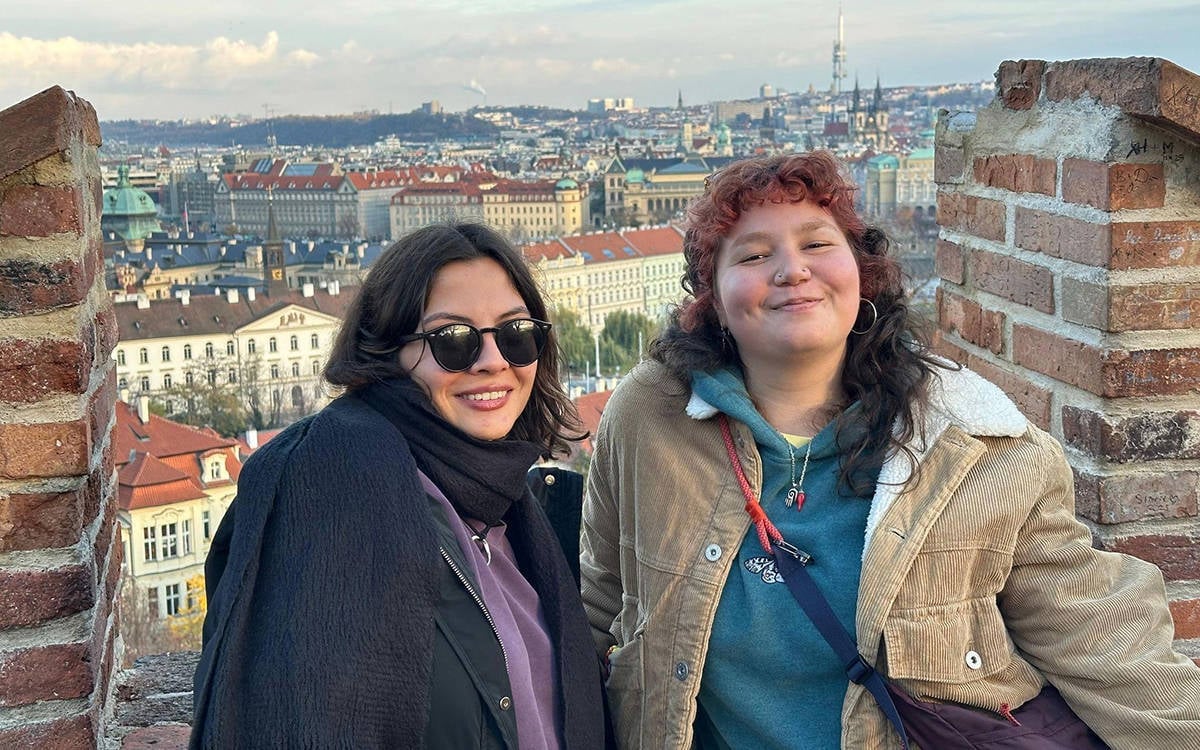






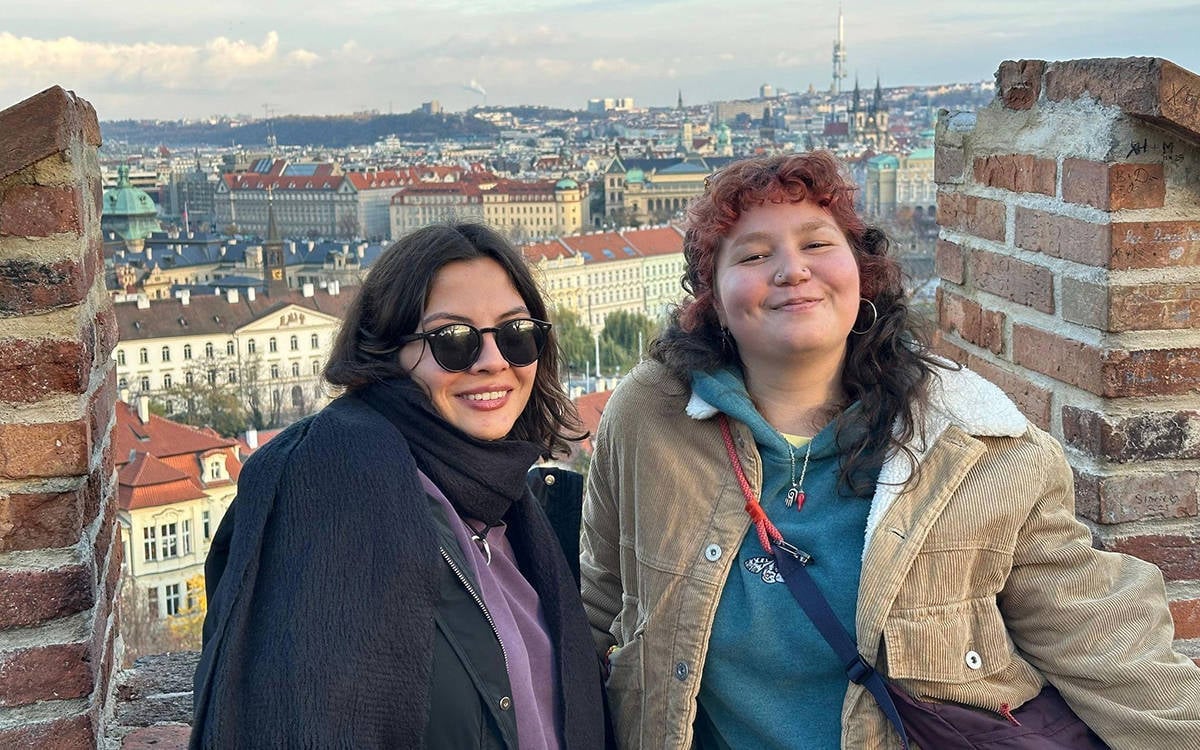



As part of the Media Literacy and Activism Academy for Young Leaders under the Our Media (Bizim Medyamız) project, in which the IPS Communication Foundation/bianet is a stakeholder, we carried out a study visit to Prague, the capital of the Czech Republic, from Nov 11 to 13.
Over two days of intensive programming, a core team composed of representatives from the IPS Communication Foundation/bianet, the Press Council of Kosovo, and the Montenegro Media Institute visited Transitions (TOL), the Central European Digital Media Observatory (CEDMO), Europeum (Institute for European Policy), and Radio Free Europe.
First day
Our first stop in Prague was the office of Transitions, an independent media organization dedicated to fostering quality journalism across Central, Eastern, and Southeastern Europe. The office is located in the heart of Prague’s Old Town, in the historic Dům U Minuty building. Dating back to the Late Renaissance period, this building, located right next to the Prague Astronomical Clock, once housed Franz Kafka and his parents between 1889 and 1896. Today, the building hosts several civil society organizations, including Transitions and Europeum.
The historical texture of the Old Town stayed with us as we stepped inside Dům U Minuty. With its nationalized status and enchanting courtyard, the building gave little sense of the 21st century, until we were greeted by the Transitions team, bringing us back to reality.
During the presentation by Transitions, an organization that seeks to strengthen media literacy, professional standards, and the resilience of independent media through publications, training, and projects, several key insights stood out.
One point in particular resonated deeply with our experience in Turkey: the recognition that independent media institutions are among the first to be targeted during government transitions. This observation strongly reflected the ongoing and everyday reality in Turkey, reinforcing our position among colleagues as journalists working under an authoritarian regime.
One word that caught our attention during the presentation was "debunking." In Turkish, we might translate this as “revealing lies.” The organization approaches debunking by softening messages in the public sphere and involving older audiences through media literacy efforts.
One of their key focuses is age-oriented programming, organizing intergenerational workshops to counter misinformation and encourage peer learning. Under the motto of "social journalism," they bring together journalists from different generations, creating space for them to voice concerns and share stories.
The organization also promotes a solution-oriented approach to journalism, transforming topics perceived as "toxic" or divisive into empowering and constructive narratives. In doing so, they focus directly on narrative framing to reflect the public’s perspective. Their strategy rests on three pillars: “listen, reflect, and go deeper.” With this triad, they aim to build resilient communities and foster cross-border communication.
Later in the day, after leaving the Transitions office in the Old Town Square, we visited CEDMO, the digital media observatory based at Charles University.
Focusing on problems like disinformation and misinformation, CEDMO is an independent, impartial, and centralized platform that examines and prioritizes the root causes of these issues across Central Europe, especially in the Czech Republic, Slovakia, and Poland. It develops short- and long-term action plans and policy recommendations to address trust issues among civil society, public institutions, and the private sector, and to counter the effects of false and misleading information.
CEDMO’s work is divided into four main areas: research, fact-checking, artificial intelligence solutions, and media literacy. Its primary goal is to foster digital transformation in these fields, while promoting self-reflection in the media, enhancing public awareness, and strengthening freedom of expression. Treating podcasts as cognitive tools, CEDMO seeks to provide fundamental knowledge about how the media operates. Through communication and dissemination practices, it aims to educate the public on media through what it calls a “coordination beyond communication” approach.
Second day
On the second day of the program, we headed to Europeum, which we learned shares an office in the same building as Transitions.
At Europeum, a civil society organization focused on European integration and policy development, we were welcomed by Oszkár Roginer-Hofmeister, coordinator of the Global Europe program. He introduced us to the institution’s main areas of work and its flagship projects titled Green Europe, Global Europe, and Just Europe. After explaining their events held as part of their mission to promote European Union (EU) integration and describing the political climate in the Czech Republic, Roginer-Hofmeister answered participants’ questions. He noted that Europeum also operates in EU enlargement regions, mentioning the current atmosphere in Georgia. In this context, he added that they would soon launch a new public opinion survey on perceptions of the EU in Armenia.
Our visit to Radio Free Europe, which took place under tight security measures, began with a briefing by Jakub Tesar, who spoke about the station’s Cold War-era origins and its operations in the countries where it has historically broadcast. Tesar described how the station, which now broadcasts in 27 languages to 23 countries, has adapted its methods over time. He also shared that during the Trump administration, there had been an attempt to cut financial support for the institution, but noted that the resulting legal process was ultimately resolved in their favor. The visit to Radio Free Europe concluded with a tour of the newsroom and control room.
A recurring theme we observed across all institutions was the concern over changes in government, first mentioned during our Transitions visit. While each institution used different terms to describe an incoming government, the shared label was “populist,” and common concerns were expressed regarding increasing media pressure.
As journalists from Turkey, it was a valuable experience for us to hear perspectives from press organizations in the Czech Republic on the threat of authoritarianism. While sharing our experiences, we sensed that our European colleagues understood our stories as representing “the consequences of authoritarianism” or “the end of democracy.” In response to the solidarity shown by our colleagues, we emphasized that our presence here today as journalists from Turkey is itself proof of our ongoing struggle for a free press.
During our three days in Prague, we were enchanted by the city’s historical legacy while also experiencing what it means to be a journalist from Turkey in Europe. We strove to carry the voices of our colleagues who have been imprisoned or denied the right to travel due to bans, and we shared our experience in Turkey with European institutions. We left Prague with the hope that our visit would serve as a transformative encounter not only for our group, coming from the very reality our European counterparts fear becoming, but also for them.
Our Media
IPS Communication Foundation/bianet is among the partners of the Our Media project, financed by the European Union (EU) and covering the years 2023-2025.
The project's initial focus will be to help civil society organizations (CSOs), media professionals, young activists, and the public in the Balkans and Turkey build capacity regarding media freedom, as well as trends and challenges in the development and sustainability of the media. The project partners are:
- South East European Network for Professionalization of Media (SEENPM)
- Albanian Media Institute (Tirana)
- Mediacentar Foundation (Sarajevo)
- Kosovo Press Council
- Montenegro Media Institute (Podgorica)
- Macedonian Media Institute (Skopje)
- Novi Sad School of Journalism (Novi Sad)
- Peace Institute (Ljubljana)
- bianet (Turkey)
On behalf of IPS Communication Foundation/bianet, the researcher for the Our Media project is Sinem Aydınlı, the foundation’s research coordinator.
Scope of the project
The project begins with research aimed at identifying key trends, risks, and opportunities related to media sustainability, and at supporting media freedom and media and information literacy (MIL). The research will map best practices in media activism efforts. The findings will be used to strengthen the capacity of CSOs and other stakeholders in the media field to address challenges in the media.
Within the scope of Our Media, advocacy activities will be carried out to understand the capacity of journalists, media outlets, and media institutions. Local and national media, along with other actors, will be encouraged to engage in media activism efforts aimed at addressing gender inequalities in the media.
The project will also empower young leaders to stand against discrimination and sexist stereotypes, and to support gender equality through various activities.
Through financial support provided to CSOs in urban and rural areas, the project will reach out to local communities to enhance citizens' MIL skills, support media freedom and integrity, and counter polarization caused by propaganda, hate speech, and disinformation.
(IE/NK/VK)


.jpg)
.jpg)