










What we lose along with the lives lost in Gaza is our humanity.
Jonathan Swift is one of the greatest writers in English literature. Known as a master of satire, he is most recognized for Gulliver’s Travels, but his greatest satirical work is A Modest Proposal. First published in 1729, this short piece tackles the issues of hunger and poverty in Ireland with a level of irony that tightens the heart and challenges the mind.
The colonial policies pursued by England and the poverty caused by settlers led to a wide range of problems in Ireland for centuries, including hunger and destitution. In the face of the poverty he observed in 18th-century Ireland, Swift employed the technique of irony in a striking way to make a proposal to those who remained silent.
The unnamed narrator in Swift’s piece proposes selling poor Irish children to the rich as food to end poverty. The narrator presents this ironic suggestion in such a calm tone and backs it up with statistics that he ultimately claims no one will oppose him. Of course, the true aim behind Swift’s irrational, absurd proposal is to provoke thought about the poverty in Ireland and its underlying causes.
‘The Palestinian’ Jonathan Swift
In 2002, during the days of the Second Intifada in Palestine, I read Swift’s A Modest Proposal in an English short stories class. As I reread it now for the sake of this article, I couldn’t help but think: “Jonathan Swift is a Palestinian.” However, if Swift were alive today, he might not be able to write such a piece; because what is happening in Gaza would challenge even his powerful pen.
Food and water turned into weapons
Food provides the energy necessary for us to survive. We need food and water to perform bodily functions. As is well known, one can survive only a few weeks without food and just a few days without water.
The first step toward halting the genocide in Gaza through starvation is for Israeli officials to acknowledge the existence of the problem. Yet war-supporting leaders, most notably Benjamin Netanyahu, continue to ignore it.
Netanyahu’s statement, “There is no hunger in Gaza. There is no policy of starvation in Gaza,” must be a form of irony. Unfortunately, it’s not.
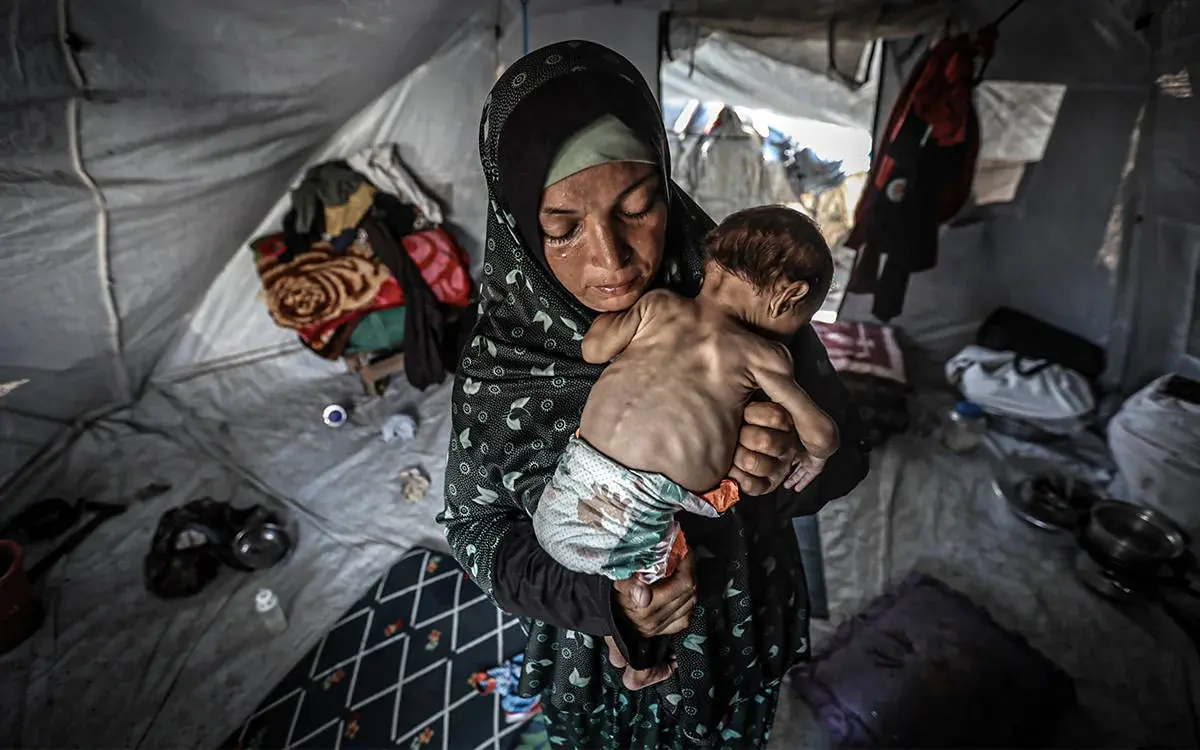
Although Netanyahu tries to distort this blatantly obvious reality, there is no clean water in Gaza. Babies have no milk, and adults have no food. According to Al Jazeera, at least 181 people in Gaza have died of hunger, 94 of whom were children and infants.
Mothers unable to breastfeed their babies
While World Breastfeeding Week is being marked between August 1–7, mothers in Gaza who are unable to breastfeed are trying to make their voices heard around the world. Breast milk is vital for infants. It is a miraculous source of nutrition essential for a baby’s development.
Save the Children, an organization working in the field of children’s rights, stated in a press release on August 4 regarding its activities in Gaza that 4 out of 10 pregnant and breastfeeding women are severely malnourished. Of the 747 women screened during the first half of July, 323 were recorded as being too malnourished to properly care for their newborns. It’s worth noting that this figure has tripled since Israel imposed a full blockade on Gaza in March. Additionally, Save the Children highlights that mothers without breast milk are giving their babies water or diluted tahini, which increases the risk of malnutrition.
Gaza did not suddenly face starvation
Irish Prime Minister Simon Harris had issued a warning on this matter in a speech on May 19, 2024. Speaking on the anniversary of the Great Famine that Ireland endured between 1845 and 1849, Harris drew attention to what is happening in Gaza with the following words:
“Witnessing famine being used as a weapon of war in Gaza is particularly disturbing to our \[Irish] psyche. Israel must step back and ensure the unhindered passage of humanitarian aid. This is the clear demand of Ireland, the international community, and international law.”
That demand has still not been met, even after a full year has passed.
The worst-case scenario is happening
The Integrated Food Security Phase Classification (IPC) stated, “The worst famine scenario is unfolding in the Gaza Strip. Conflict and displacement have intensified, and access to food, other essential goods, and services has dropped to an unprecedented level.”
The four dimensions of the right to food—availability, accessibility, adequacy, and sustainability—are clearly being violated in Gaza.
Blocking aid is a war crime
In recent weeks, the United Nations (UN) and various human rights organizations have issued statements to highlight the unbearable level of hunger in Gaza.
On August 4, UN High Commissioner for Human Rights Volker Türk emphasized that Israel is still severely obstructing humanitarian aid, that the level of aid reaching Gaza falls far short of meeting the scale of the crisis, and that Israel must immediately allow the passage of aid. The Commissioner also stressed that obstructing civilians’ access to food constitutes a war crime and potentially a crime against humanity.
Remaining silent
Luc Triangle, General Secretary of the International Trade Union Confederation (ITUC), which represents 191 million workers through 340 member organizations in 169 countries, wrote an open letter on July 31 about the hunger in Gaza.
In his letter, Triangle stated that the political indifference to the atrocities in Gaza is no different from condoning the crime. He argued that the silence of political leaders in the face of what is happening in Gaza cannot be explained by diplomacy or neutrality; rather, it amounts to complicity in the crime.
Severe violations, slow and insufficient reactions
The policies pursued by Israel in Gaza are causing grave human rights violations. Unfortunately, it is clear that the international community still fails to raise a strong enough voice for Gaza and has not taken effective steps to halt Israel’s genocide.
A miracle is not needed to stop the genocide in Gaza so that babies can drink the miracle that is breast milk. For a start, it is enough for the international community to act in accordance with human rights principles to stop Israel. Afterwards, a human rights-based program should be implemented for the reconstruction of Gaza.
Let me repeat what is already obvious: we should have acted long ago in response to what is happening in Gaza.
Let us not forget: while people in Gaza cannot find food to consume, our silence consumes our own humanity across the rest of the world. (Oİ/VC/VK)