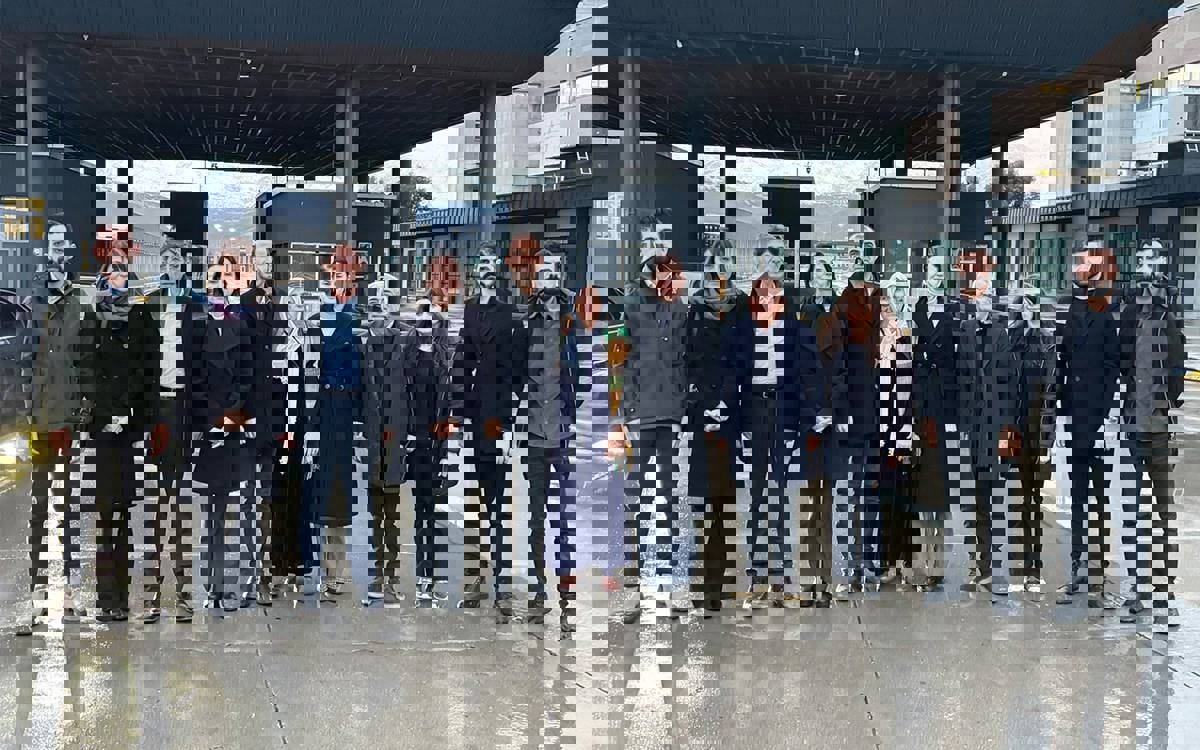








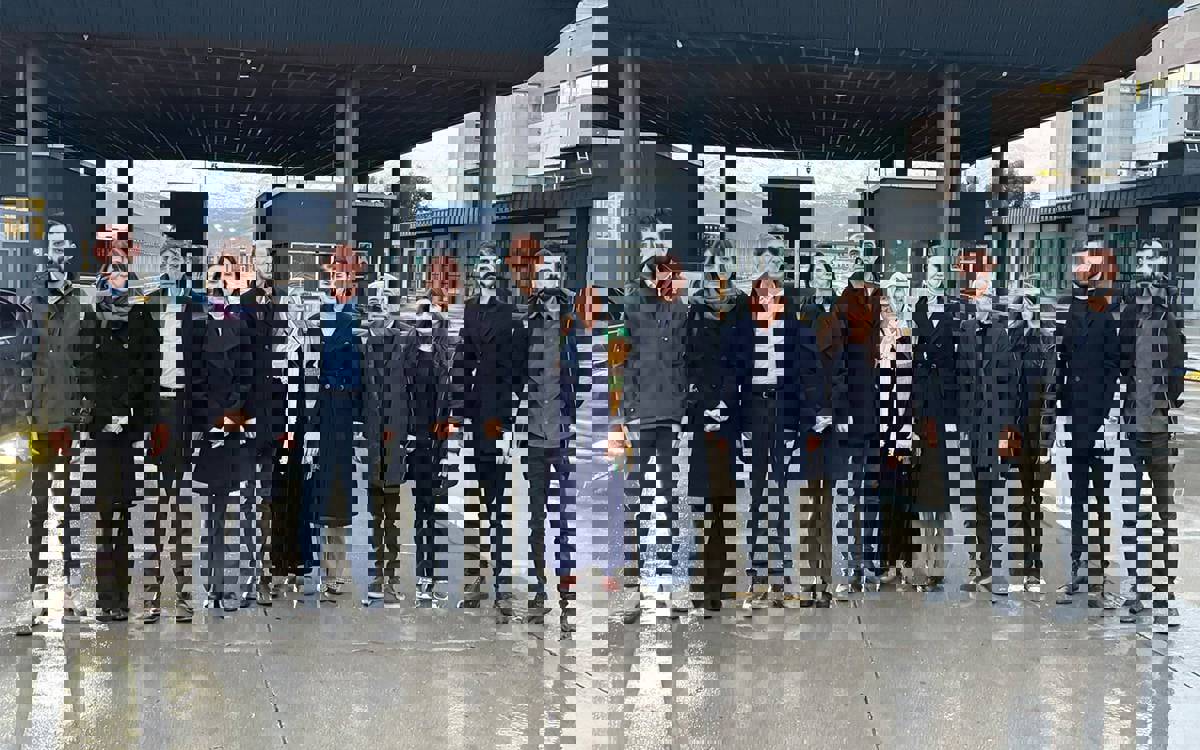



There was a bridge over the Tigris. On one side was Habur, on the other, Semelka. On one side were we, on the other, they. But in fact, we were all on the same side—the side of life.
When we set out on the morning of Jan 21, we didn’t know what would happen. The only thing we knew was this: On the other side of the border, thousands of people were being injured, hundreds were dying, and hundreds of thousands were being uprooted from their homes and lands. We were going. We would be together.
The road was long. It was jarring. Each kilometer grew heavier within us. Because we had been on the road for days to reach a place that, just yesterday, we could have walked to from Nusaybin. This is what borders drawn by states do. They turn a ten-minute journey into days. They separate siblings. Then they call it “security.”
Two rooms of a house
Maps lie sometimes. They make Nusaybin and Qamishlo seem far apart. But the truth is, these places are like two rooms in the same house. Siblings do not close the door on each other. But states do. And they punish.
While on the road, one question was always on our minds: why is the Middle East always a region where tensions and unrest are reproduced? There was no need to look far for an answer. While one can travel from one European country to another with ease, here, traveling from one Kurdish city to another means being subjected to every kind of oppressive control.
That is not all… Walls stretching for kilometers are being erected between the homes of first cousins. In history, journeys were accompanied by curiosity, attentiveness, joy, the search for life; here, they are accompanied by ugly walls built along borders. So ugly that they even prevent you from dreaming while looking out the car window…
Between walls, checkpoints, and separations designed to scatter our consciousness, we arrived in Qamishlo and were met with the clarity born of a struggle for life, a sorrow etched into eyes, and the resilience given by the belief in victory.
The streets of Qamishlo…
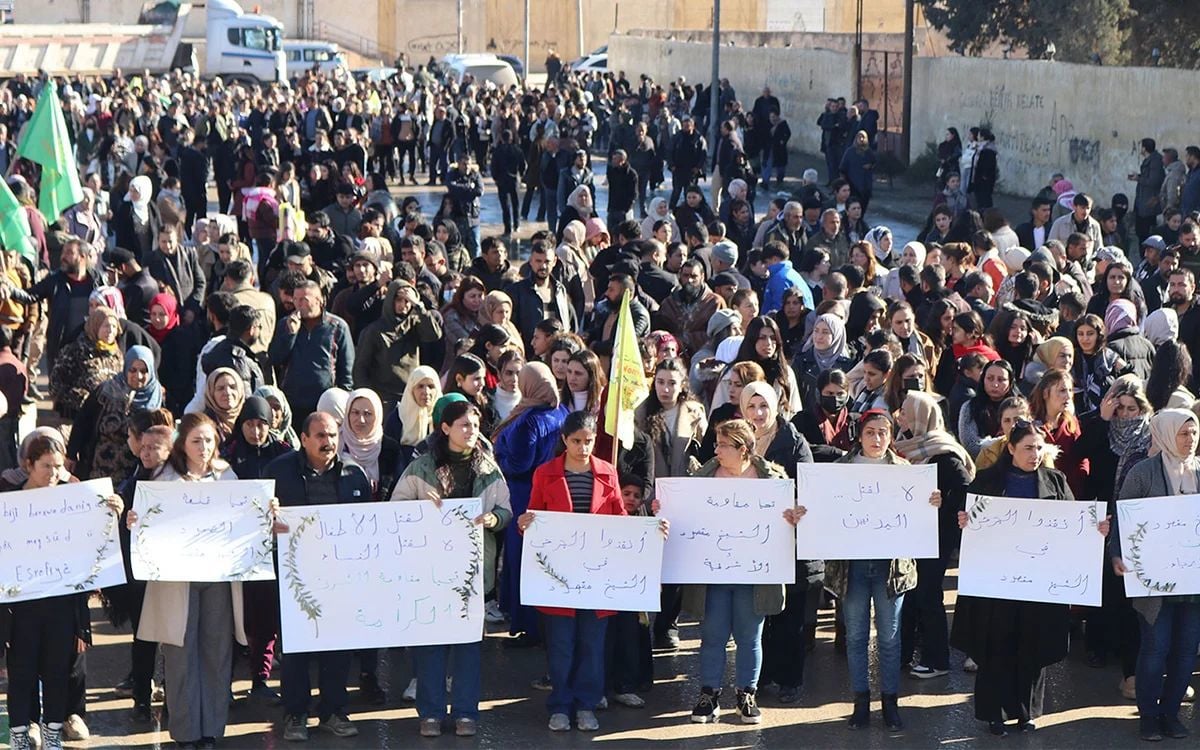
It was already dark when we arrived in Qamishlo. But there was movement in the streets, there was life. People were flowing into the square. Life was flowing into the square. Banners in their hands, Kurdish slogans on their tongues…
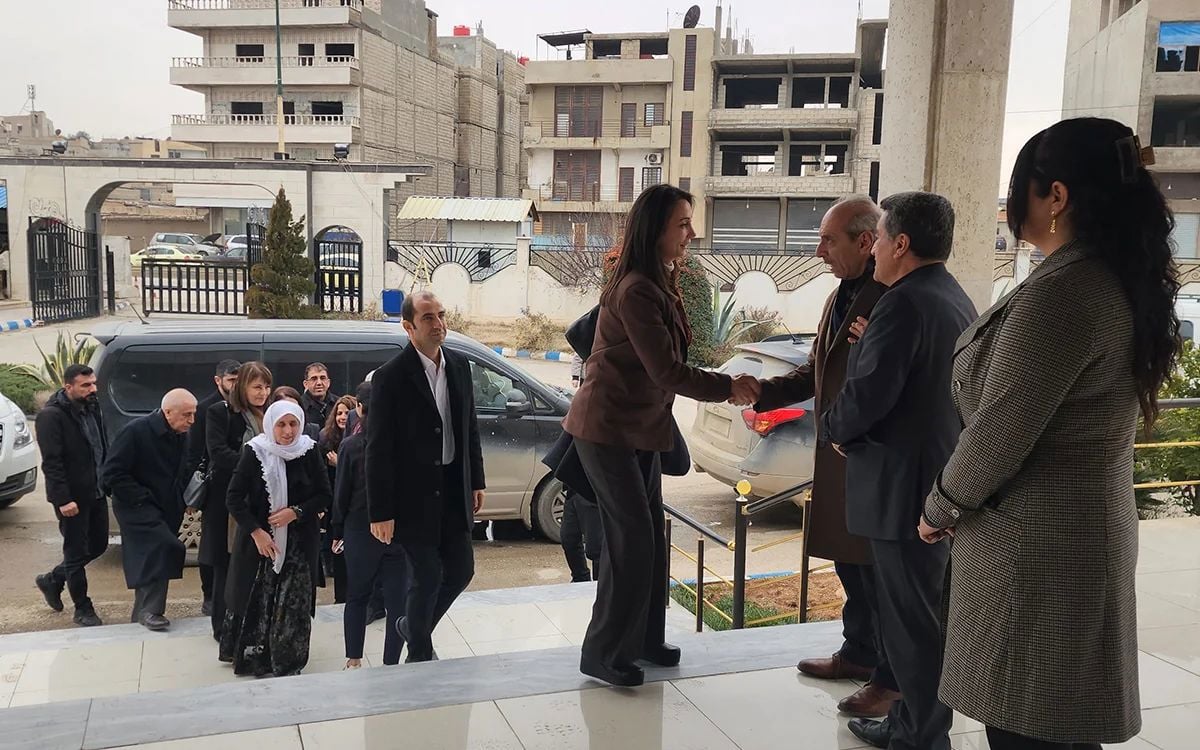
At the Rojava border, we were first welcomed by the Co-Chairs and administration of the Democratic Union Party (PYD). You’d think they weren’t the ones subjected to some of the most brutal attacks of the 21st century. They were so spirited, so determined… We encountered the self-confidence that comes with being in the right.
In Qamishlo, the people were living a political line of resistance that required mobilization to survive. With a spirit of total mobilization, from age 7 to 70, they were out in the streets. No one was troubled by lack of sleep. They said that the joint struggle of Kurds, their friends, revolutionaries, and democrats from all over the world against the attacks of HTS and its derivatives gave them great morale. They spoke with confidence that they would defend the streets of Qamishlo with a rare solidarity among the people.
On the morning of Jan 21, we met with the PYD Co-Chairs and administration. Then with umbrella organizations of the Rojava women’s movement… After that, with the components of the Apr 26 Conference co-spokes by the Kurdish National Council (ENKS) and the PYD… The components of this conference include all Kurdish parties and Kurdish institutions in Syria. Subsequently, we met with the Foreign Relations Representation of North and East Syria.
Both the politicians of Rojava and the people participating in the mobilization were in agreement about the political background of the attacks. According to them, the attacks beginning in Jan 2026 are part of an international conspiracy. The aim of this conspiracy is a Kurdish-Arab war. Since the Syrian Democratic Forces (SDF) did not want to be dragged into such a war, they withdrew from Raqqa and Deir ez-Zor. They said that, just as in the past, they do not want a Kurdish-Arab war in Syria going forward. They also emphasized that guarantor countries, especially the US and France, must fulfill their duties and responsibilities in establishing peace.
I consider it a historical responsibility to share the words of Rojava’s politicians directly with the public in Turkey:
“The whole world should know that not a single stone has been thrown from North and East Syria toward neighboring country Turkey. We never pose a security threat to Turkey. On the contrary, a Turkey that contributes to peace in Syria would be even more secure with us as neighbors. We have conveyed this to Turkey many times. A Syria that has secured its peace would, strategically, be a guarantee for Turkey’s peace.”
I hope these words hold meaning both for those who stir up enmity with mop handles in their hands and for those who make decisions in the name of state reason…
Who left the table?
On the other hand, they say they have complied with the Mar 10 Agreement and held talks with the Damascus administration, but that steps persistently remain in limbo due to the inaction of the interim administration. They reported that an agreement had been reached during the Jan 4 meeting between the SDF and the Damascus administration in Damascus, and that signatures would be finalized a few days later. But what happened? Without any further meeting, on Jan 6, an attack took place targeting Kurds living in the Eşrefiye and Şêx Maqsoud neighborhoods of Aleppo.
Based on these events, a natural conclusion has emerged: “The Damascus administration and the powers behind it want war. They want to eliminate all Kurds through violence and death. They want to erase Kurds from Syria.”
They said they have built defense lines in areas where the Kurdish population is dense and that they will not withdraw from these areas. There is a persistent, renewed sense of strong will in their belief that Kurds are an ancient people of Syria and this region, and that it is not possible to uproot an ancient people from their land.
These words deserve to be recorded in history: “Just as we are against a Kurdish-Arab war, we are also against a Turkish-Kurdish conflict.”
In other words, they do not want to derive their happiness from someone else’s suffering.
The siege of Kobanî
In the 21st century, genocide has updated the methods of previous centuries and changed its images. The repertoire of genocide in this era is carried out by besieging, depriving of electricity, water, and hope, and leaving people to die. For the powers that be, the testing ground for this was Gaza yesterday. Today, it is Kobanî. Those who suffocated Gaza yesterday are now plunging Kobanî into darkness.
In Kobanî, electricity, water, and internet have been cut off and the city has been placed under siege. Turkey and the interim Damascus administration are pointed to as partners in this siege. In all our meetings, every political representative we spoke to said the same thing: “This siege is the joint work of both sides.” On one side, Turkey; on the other, the Damascus administration… Together, they are condemning Kobanî to darkness, thirst, and desperation.
In 2014, Kobanî had become a symbol of humanity’s liberation, women’s freedom, and the equality of peoples. That symbol still holds the same meaning and value today. Due to its symbolic significance, the ideological relatives of ISIS, which was defeated then, are now cutting off Kobanî’s water and electricity. This act of vengeance has turned into genocidal hatred and has caused five babies in Kobanî to freeze to death.
Today, Kobanî is under a severe siege. We learned that schools, hospitals, and public institutions in Kobanî are unable to function.
People are tired of war
Pay no attention to those who go on TV channels in Turkey waving the sticks of war, beating the drums, with furrowed brows and displays of mediocre masculinity…
Pay no attention to those who cling to the term “Arab tribes” to project geopolitical weight…
Pay no attention to those who celebrate when a Kurd is struck…
Pay no attention to many Gulf and Arab media representatives who mislead the world with manipulations…
Pay no attention to those who reveal their utter lack of humanity when a Kurdish woman’s body is thrown from a building and five Kurdish children freeze to death…
There is a war-weary Syria, where half the population has been displaced, institutions are not functioning, and even the most basic humanitarian needs cannot be met.
People in Syria do not want more war. Syria’s institutional structure and psychological thresholds can no longer bear further conflict.
The most beneficial course of action for Syria is not to listen to those who, from their comfortable positions in Turkey, call for war, but rather to do things that will ease life for every citizen in Syria.
People in Syria must be able to return to normal life. Above all, hospitals, health centers, schools, and all public institutions must be rapidly rebuilt. Roads must be constructed, access to electricity and internet must be ensured, and drinking water and food must be made available. In short, Syria must be able to return to a normal life.
A prosperous Syria will not be built by waging war against Kurds, but by reaching an agreement with them. Peace in Syria will not be achieved through massacres of Alawites and Druze, but by building a country where different peoples and beliefs live together. Allowing these diverse groups to live as equal citizens in Syria will fully open the path to a democratic country.
As we continued our contacts in Rojava, we came across the women’s square. There was a statue of a woman. In that moment, we understood once again that the struggle for women’s freedom spreading from Rojava across the Middle East ensures Syria’s social peace. It contributes to stability, equality, and freedom in the Middle East. As long as these attacks target women’s achievements, they are in fact also attempting to sabotage Syria’s free future. We know that what most disturbs groups like ISIS and HTS is the existence, struggle, and freedom of women.
Solidarity with Rojava is a humanitarian responsibility
We have bad news for those rubbing their hands, waiting for the ceasefire to end and for Kurds to be killed: the Autonomous Administration of North and East Syria has stated that it will make every effort to implement the ceasefire and ensure democratic integration. They continue to stand by this decision. They do not want the war to continue. They want to build peace and live in a democratic order.
It is our historical responsibility to raise awareness across the world, especially in Turkey, to help Rojava escape the grip of annihilation and to support Syria’s democratic future.
Rest assured, we can increase awareness and solidarity right from our doorstep. A growing democratic solidarity and sensitivity in Turkey will spread everywhere. The salvation of babies, children, women, and young people in Rojava is only possible through this democratic solidarity. That is why we call on all democratic forces in Turkey, women’s movements, human rights defenders, environmental activists, the devout, and everyone who is anti-war to show democratic solidarity and awareness with Rojava.
Rojava at the intersection of emotional solidarity and emotional rupture
In the 21st century, borders were drawn between Kurds. Rojava became the force that rendered these borders meaningless and united Kurds in a shared emotion and spirit. But at the same time, Rojava also caused an emotional rupture that is hard to repair in Turkish-Kurdish relations.
For days, a flood of hate speech against Kurds has been flowing on social media. Politicians seeking victory from suffering, newspaper commentators, and the divisive policies of the government have deepened this. We saw people applauding as the body of a Kurdish woman was thrown from a building. We saw those who ignored the death of five babies who froze to death. We saw that hatred in people’s eyes.
This is a danger alarm. And this alarm tells us many things.
The language of hate is not only on social media—it is at the heart of politics, at the center of the media. Such great insensitivity, such deep loss of humanity in the face of a people’s suffering… This does not only target Kurds. It targets the future of the country, its peace, and the culture of coexistence.
To politicians and media figures banging war drums like a marching band: you are doing great harm to this country. You are opening wounds in the soul of society that are very hard, maybe impossible, to heal.
Imagine you are a mother. What would you feel when you heard that five babies froze to death? Wouldn’t you writhe in pain? Or would you shout cries of victory?
Imagine you are a father. What would you do when you learned that your child’s school had no electricity or water, and that they were shivering in the dark? Would you applaud?
Imagine you are a human being. Just a human being… When you saw the lifeless body of a woman thrown from a building across the border, or another woman killed, her braided hair cut and shared on social media, could you remain silent? Or worse, would you defend it?
At a time when we are trying to heal the deep wounds and bleeding relationship between Turks and Kurds left from the 20th century, stop reopening those wounds and deepening the pain.
Return to reason. Return to humanity. Return to conscience.
Because every seed of hate you plant today will grow into poison on these lands tomorrow. And that poison will poison us all.
A piece of our heart was left there…
In the vehicle we were in, Ahmet Kaya’s song, Edip Cansever’s verses came to mind: “Brother Ahmet, my beauty, why does a handkerchief bleed? It’s not a tooth, not a nail, why does a handkerchief bleed…”
We know the answer. In this region, handkerchiefs bleed because they can’t keep up with dressing the wounds.
When we left Rojava, a piece of our heart was left there. With the people resisting in the streets of Qamishlo, with the families in Kobanî holding each other to stay warm in the dark, beside the statue in the women’s square…
But we made a promise before leaving… We will continue to defend the political, cultural, and democratic rights and demands of Rojava. This is not just a duty of solidarity, but a debt of humanity. To defend the right to life, to stand against genocide, to support the struggle for equality and freedom… These are responsibilities we cannot give up.
We will breathe together with Rojava. Because Rojava’s struggle is not just that of the Kurds, but of all the oppressed, of all people seeking freedom.
A call to the ruling power
The administration and people of North and East Syria are extending a hand of peace to Turkey. Whether to take that hand or not is up to you.
If you take it, you will take a historic step toward ensuring stability in the Middle East. You will be a source of hope for the region’s future.
If you do not, you will bear primary responsibility for every pain, every death, every act of cruelty in Rojava. Every baby who dies from the cold, every person who dies under siege, every child who dies in the dark… All of it, in both merit and sin, will be recorded in the pages of history under your name.
The choice is yours. History will take note. (TH/VC/VK)