










Today’s [Sep 17] issue of the Official Gazette published a Constitutional Court ruling regarding decisions to ban the seizure, printing, reproduction, distribution, and sale of various books, magazines, newspapers, and brochures.
The High Court ruled that the freedoms of expression and the press of Hasan Cemal, Tuğçe Tatari, Rojvin Perişan, and Yavuz Ekinci—who were subjected to censorship on charges of inciting the public to hatred and hostility and propagating a terrorist organization—as well as the publications Aram, Gelenek, İmera, Payiz, Avesta, and the political parties CHP and HDP, had been violated.
One of the European Court of Human Rights (ECtHR) precedents cited by the Constitutional Court in its ruling is particularly noteworthy today: Kaos GL/Turkey.
This is because, nearly 10 years after the ECtHR’s Nov 22, 2016, ruling regarding the seizure of Kaos GL’s magazine, the organization once again finds itself at the center of a vague investigation—this time on grounds of “obscenity.” Moreover, it is not just Kaos GL; all LGBTI+ individuals, activists, human rights defenders, civil society, and those protesting the events are targets of judicial and police harassment.
At least 81 people have been arrested so far in operations across Turkey. Seven of them are members of Kaos GL’s executive or supervisory board. One is a journalist who reported on Kaos GL.
The charges include “obscenity” as defined in Article 226 of the Turkish Penal Code and violations of the Associations Law. The prosecution alleges that the association’s social media posts are of a nature that “violates general moral standards” and “may offend the public’s sense of decency and modesty.”
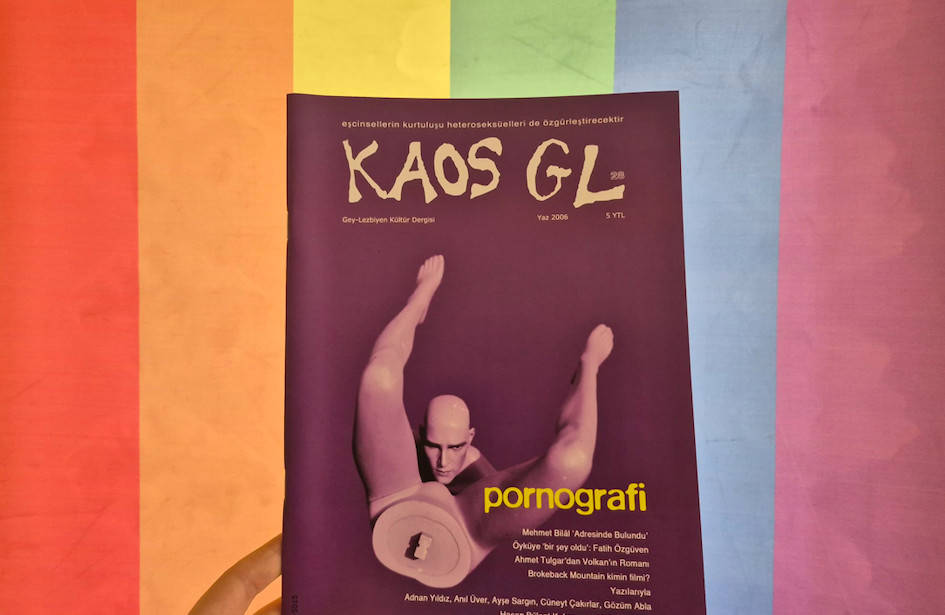
Magazine issue seized in 2006
These allegations are not new. Kaos GL has long been battling judicial and police pressure. The story behind the ECtHR ruling cited by the Constitutional Court also dates back to 2006.
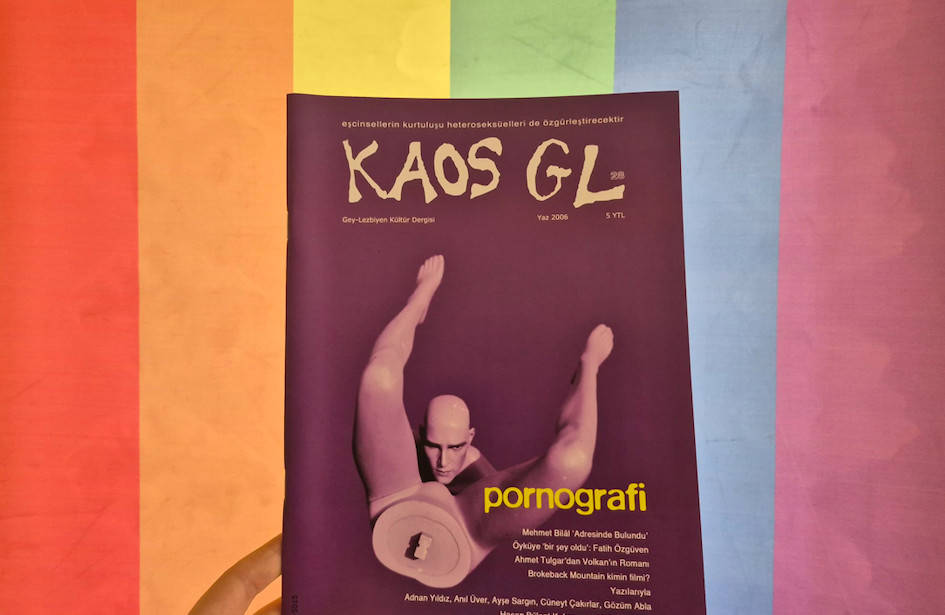
At that time, the 28th issue of Kaos GL’s magazine—which contained a special section titled “The Visuality of Sexuality, the Sexuality of Visuality: Pornography”—was seized by the Ankara Public Prosecutor’s Office for review before it could be published.
The Ankara Penal Court of First Instance ruled that certain articles and images in the issue were “contrary to the principle of protecting public morality” and ordered the seizure of all copies of the magazine. A total of 375 copies were confiscated.
During the same process, a case was filed against Umut Güner, President of the Kaos GL Association and the magazine’s editor-in-chief, under Article 226 of the Turkish Penal Code, which remains in effect today. The prosecutor’s office alleged that an image in the magazine was “obscene and pornographic.”
Güner stood trial and was acquitted in February 2007. The court also ruled that the seized issues must be returned once the decision became final. The acquittal was not upheld by the Court of Cassation until February 2012.
Kaos GL, meanwhile, filed a complaint with the ECtHR over the fact that all issues of the magazine had been held for years. The ruling was issued 10 years ago.
ECtHR: Which content, and why, was contrary to 'public morality'?
The strongest link between the ECtHR’s 2016 ruling and today’s debate lies in its assessment of how the “public morality” justification was applied.
The Strasbourg Court first examined the reasoning of the lower courts.
It found that the seizure order did not specify which article or image in the magazine was harmful to public morality. It noted that there was no evidence that the court that issued the initial ruling had examined the magazine’s content in detail, nor did the court that rejected the appeal provide any details or justification regarding this matter.
According to the ECtHR, in this case, the general and unsubstantiated invocation of the “protection of public morals” was insufficient to justify the seizure of all issues of the magazine for a period exceeding five years.
In its decision published today, the Constitutional Court of Turkey summarized the Kaos GL v. Turkey ruling precisely on this point.
Magazine seizure 'not proportionate'
The ECtHR did not consider restricting children’s access to sexual content to be inherently unlawful.
The Court acknowledged that the magazine contained some images with explicit sexual content and noted that measures to prevent minors from accessing them could respond to a “compelling social need.”
However, the review did not end there. The Court questioned why it was necessary to block the entire public’s access to the publication in order to protect children.
It pointed out that the authorities had not attempted less restrictive measures instead of seizing all copies. Banning the sale of the magazine to those under 18, requiring it to be sold in special packaging with a warning, or restricting its sale to newsstands were among the alternatives listed by the ECtHR.
Ultimately, the Court did not find the 5-year, 7-month ban on the magazine’s publication to be proportionate to the intended purpose.
The ECtHR unanimously ruled that Turkey had violated Article 10 of the European Convention on Human Rights, which guarantees Kaos GL’s freedom of expression.
From magazine seizure to arrests
Nearly 10 years have passed.
This time, Kaos GL is under investigation on the same charges—not because of a single issue of a print magazine, but due to content published on its website and social media accounts.
Police raided the association’s headquarters and arrested its members and leaders. They even imprisoned those who reported on Kaos GL.
The police are raiding the association’s headquarters and arresting its members and executives. They are even imprisoning those who report on Kaos GL.
The measures taken against Kaos GL leaders directly infringe on personal freedom.
In 2006, it was the freedom of a magazine that was at stake; today, people’s freedoms are being restricted using the same arguments.
Being LGBTI+ is not a crime. Organizing for LGBTI+ rights, publishing on this issue, or making same-sex relationships visible is also not a crime. Moreover, Kaos GL is an association that continues its activities within the legal framework.
Nevertheless, the fundamental question underlying this story, which stretches from 2006 to the present, remains the same: Is the charge based on a specific act, or is it the very existence and visibility of LGBTI+ people? (HA/VK)