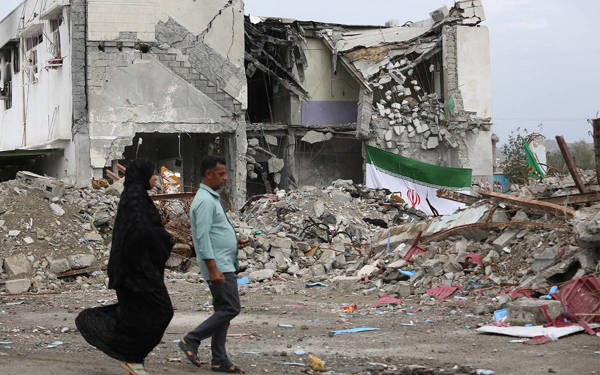








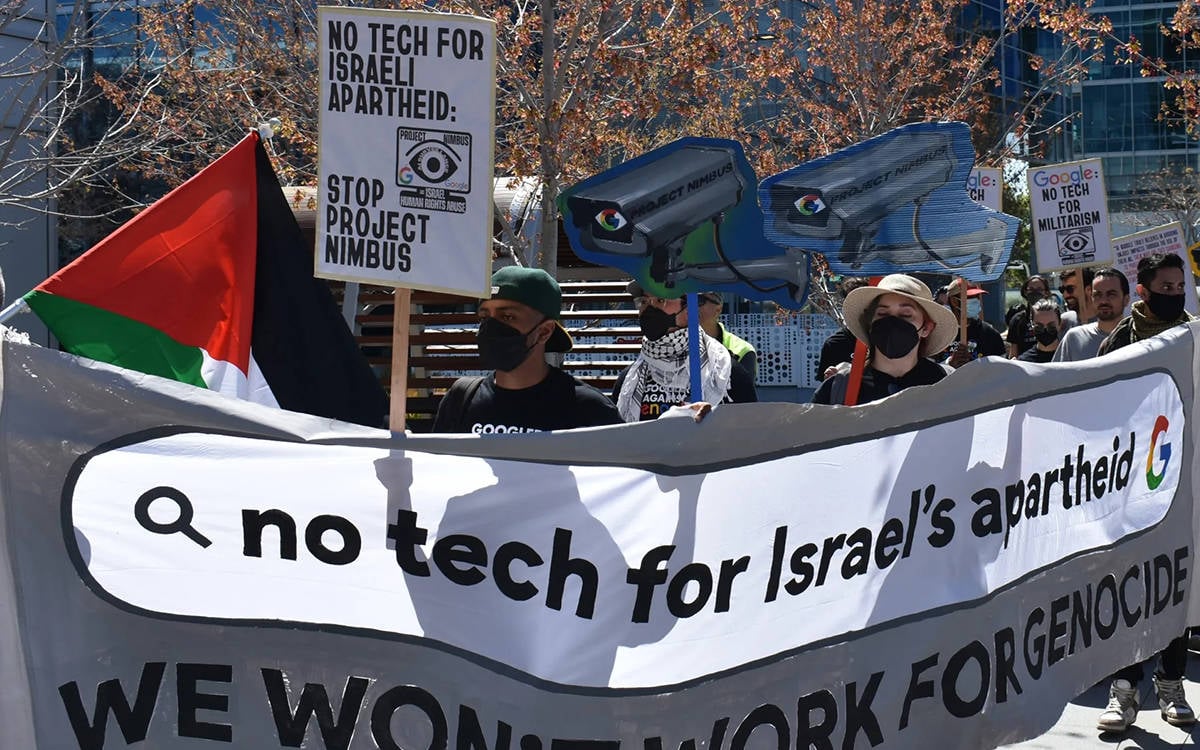



For over a century, settler colonialism and apparatuses of violence in Palestine have evolved, and in recent years they have fused with digital technologies to form a new regime of destruction. Israel and its military, in partnership with state actors—chiefly the United States—and global tech corporations, have combined drones, cloud infrastructure, biometric surveillance, and signal intelligence to build an extensive digital network that monitors, controls, and targets millions of Palestinians. This network ensures the continuity of settler colonial domination, but since October 2023 it has taken on a deadlier form: “artificial intelligence,” “big data,” and automated systems have become direct tools of genocide.
In The German Ideology, Karl Marx and Friedrich Engels stress that productive forces carry a historical potential for emancipation, yet when they clash with existing relations of production they can be turned into instruments of domination and destruction.[1] Productive forces are not only technical tools; they also encompass knowledge, communication, and forms of organization. When articulated to private property and state violence, they cease to serve social needs and are redeployed to govern, suppress, and annihilate. As Ernest Mandel shows in Late Capitalism, the capitalist regime of accumulation accelerates this conversion: as productivity and knowledge grow, ecological ruin, mass unemployment, and the war industry deepen.[2]
What we see in Palestine is the concrete and extreme manifestation of this very dialectic: productive forces that inherently carry emancipatory potential—such as digital networks, algorithms, and data-driven planning—have been subordinated to the needs of settler colonialism and transformed into destructive forces, deployed for the automation of surveillance, displacement, and mass annihilation. Thus, as technological development advances, it expands not the possibilities of liberation but the mechanisms of colonial domination. The concept of “digital colonialism” provides a powerful framework for understanding this process—the transformation of productive forces into destructive ones within capitalist and colonial relations.
Digital colonialism in Palestine and its three layers
Digital colonialism, as defined by Michael Kwet, is a form of domination through which U.S.-based technology giants make the Global South economically, politically, and culturally dependent by monopolizing software, hardware, and network infrastructures. According to Kwet, the transport networks of classical colonialism—railways and ports—have today been replaced by closed platforms, cloud services, and data flows; data has become the raw material of the new era, while platform code serves as its new “law.” In this way, user data are collected and processed in centralized hubs, then recirculated in the form of information and algorithms—bringing together market rent, surveillance capacity, and discursive power within the same architecture.[3]
Kwet emphasizes that this structure represents not only an economic but also a political and cultural form of domination: the rules of the digital world are no longer determined by democratic institutions but by the code of these platforms. It is the algorithms of these largely U.S.-based companies that decide which information becomes visible, who gets to speak, and which content remains in circulation. Thus, data—much like the mines or ports of the past—has once again become a colonial raw material. As Kwet’s example from South Africa demonstrates, Google and Facebook’s monopolization of the advertising market or Uber’s destruction of local transport systems exposes the new colonial logic of the digital economy. Countries in the Global South, unable to develop their own digital industries, become structurally dependent on these closed platforms. For this reason, digital colonialism emerges as a form of domination that fuses data extraction with economic rent while centralizing knowledge production and cultural representation.
Palestine represents the most extreme form of this global digital colonialism: here, technology not only produces economic dependency but also transforms into a mechanism that automates the physical annihilation and genocide central to settler colonialism. Israel has extended its territorial control into digital networks, colonizing the realms of communication, data flow, and narrative production. Since the Oslo Accords, Israel has maintained control over all communication infrastructures used by Palestinians—including telephone lines, mobile networks, and internet systems.[4] Thus, the occupation has expanded beyond the physical domain into the digital sphere; just as the movement of bodies is restricted, the flow of information is also subjected to colonial control.
This form of control is not limited to surveillance or censorship. It also functions as a structural mechanism that ensures the technological and economic underdevelopment of Palestinian society, systematically binding it to Israel’s infrastructure. The process that Sara Roy calls de-development reveals that the Palestinian economy’s condition is not one of natural backwardness but the result of deliberate colonial engineering. According to Roy, Israel has systematically dismantled productive relations, social organization, and economic institutions, thereby reversing development itself.[5] Today, this process is being reproduced at the level of communication infrastructure and information technologies: digital networks—once expected to serve as productive forces—have instead become instruments of destruction, stifling growth and isolating society from the outside world. In this sense, digital colonialism is not merely about control over information and infrastructure, but constitutes a “digital regime of de-development” that makes social reconstruction impossible. This regime is not merely an economic policy but a form of domination that mortgages Palestine’s future through the systematic control of infrastructure, data, and technological production.
The fact that this structure has evolved from a local colonial economy into an internationally institutionalized order is clearly demonstrated in the 2025 report of UN Special Rapporteur Francesca Albanese.[6] Albanese argues that Israel’s economy of occupation has transformed into an economy of genocide, and that this transformation is sustained not only by states but also by global technology corporations. The report highlights how companies providing cloud infrastructure, artificial intelligence systems, and data analytics to the Israeli military and intelligence services have become integral components of policies of displacement and destruction. In this sense, the process of de-development described by Sara Roy has, in today’s digital age, turned into a colonial digital–military complex sustained by the active participation of global corporations—revealing that digital colonialism functions not as a merely technical or economic phenomenon, but as an internationally legitimized form of domination.
Israel’s digital colonial order over Palestine is built upon three fundamental layers: infrastructure, surveillance, and narrative.
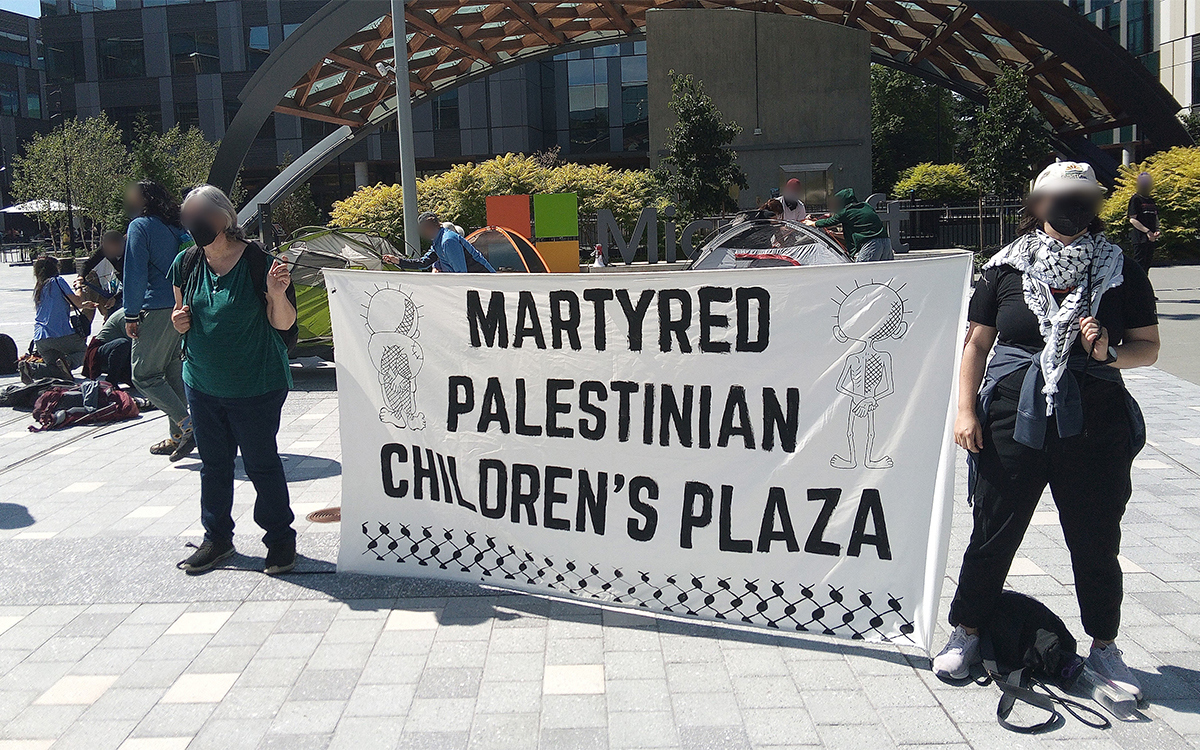
First layer: Communications infrastructure
The first layer of digital colonialism in Palestine lies in Israel’s tight control over digital communication infrastructure and the radio frequency spectrum. After 1967, all communication networks in the occupied territories — from telephone lines to what would later become the internet backbone — effectively came under Israeli control. Although the Oslo Accords of the 1990s theoretically granted the Palestinian Authority the right to establish an independent telecommunications infrastructure, Israel never allowed this to materialize.[7] Fundamental areas such as radio frequency allocation, bandwidth permissions, and the import of telecommunications equipment have all been subject to Israeli approval — a mechanism that has stifled Palestine’s digital development and rendered it structurally dependent on Israel.
The effects of these restrictions were felt tangibly in everyday life. For years, Palestinians were confined to outdated 2G mobile communication technologies. By 2016, Palestine was one of the few regions in the world without access to 3G or 4G networks. In the West Bank, 3G service was introduced only in January 2018 — and even then, in a limited capacity — while Gaza remained entirely deprived of it.[8] Israel granted permission for 3G frequencies to Palestine only after issuing 4G licenses to its own companies, following years of negotiations. In areas where local GSM networks were unavailable, Palestinians were forced to use Israeli SIM cards. As a result, Israeli companies profited by providing 4G service to illegal settlements in the West Bank, while Palestinians in their own cities were left with 2G connections.[9] Moreover, Israeli authorities obstructed the operation of Palestine’s second GSM provider, Wataniya (now Ooredoo Palestine), in Gaza for years, repeatedly delaying the entry of essential infrastructure equipment under the pretext of “security concerns.”[10]
Israel’s control over infrastructure extends far beyond mobile networks. Palestine’s internet traffic operates within a fragmented and fragile system that remains largely dependent on Israel’s backbone networks. In the 2010s, nearly all data flows were routed through gateways under Israeli control. This dependency persists today; however, ongoing attacks on infrastructure, communication blackouts, and network damage have rendered the system more vulnerable than ever. Israel continues to monopolize the main internet backbone lines, monitoring traffic and obstructing the entry of information and communication technology equipment into Palestine under the pretext of “security.”[11] This digital control functions as the virtual counterpart to the physical checkpoints and permit systems in the West Bank, restricting the flow of information and creating both visible and invisible barriers that disrupt economic activity and public life.[12]

Second layer: Surveillance technologies
The second layer of digital colonialism operates through surveillance technologies and algorithmic intelligence. Israel has long used AI-assisted mass surveillance and automated targeting systems that go far beyond traditional monitoring methods to control Palestinian society. One of the most visible examples is the Israeli army’s “Wolf” network of facial recognition and data integration systems. The “Blue Wolf” application allows soldiers to photograph Palestinians with their smartphones and instantly match the images to a central military database, displaying each person’s identity and “risk score.”[13] This database—known within the army as “Wolf Pack”—contains detailed personal information, family ties, addresses, and profiling notes for nearly every Palestinian in the area.[14] Another component, “Red Wolf,” operates as a fixed facial recognition system in Al-Khalil, scanning the faces of all those passing through checkpoints and denying passage to anyone not already registered, while automatically adding new faces to its archives.[15] In effect, this creates a constantly expanding biometric profiling infrastructure.[16] Amnesty International has described this system as “Automated Apartheid,” emphasizing how Israel uses artificial intelligence to systematically restrict Palestinians’ freedom of movement.[17]
Surveillance is not limited to cameras. The Pegasus spyware, developed by the Israel-based NSO Group, has been used against targets in Palestine as it has been across the world. In 2021, it was revealed that the phones of six Palestinian human rights defenders had been hacked using Pegasus, documenting that these individuals were systematically monitored through the software during the 2020–2021 period.[18] Although more than 85 international organizations issued statements condemning its use, Israel’s digital surveillance capabilities continue to expand.[19]
The most recent and contested dimension of the surveillance regime is AI-powered military targeting. Since 2023, Israel has made intensive use of AI technologies in the destruction and genocide carried out in Gaza. According to press reports, systems such as “The Gospel” automatically generate lists of targets through big-data analyses, while another system called “Lavender” reportedly computes a “suspicion score” from phone calls and social-media posts to decide whether an individual should be placed on a kill list.[20] Although Israeli officials describe Lavender as a “cross-referencing intelligence database,” in practice it appears to function as a semi-automated death-list generator.[21] Digital rights group Access Now has warned that Lavender and Gospel amount to the “automation of mass killings” in Gaza.[22] Another program reportedly developed by the Israeli military, known as “Where’s Daddy?,” identifies moments when a target is at home with children and times attacks accordingly—thereby exposing children and other civilians to direct danger under the guise of “collateral damage.”[23]
As Antony Loewenstein and other researchers have highlighted, Palestine has long functioned as a laboratory for Israel’s high-tech ecosystem. Surveillance and weapons technologies are tested there before being marketed globally under the label “battle-tested,” while Palestinians pay for these experiments with their lives. The drones, spyware, and AI-driven targeting algorithms that Israel refines on the Palestinian population are later sold on the international market, generating both economic profit and strategic leverage.[24][25]
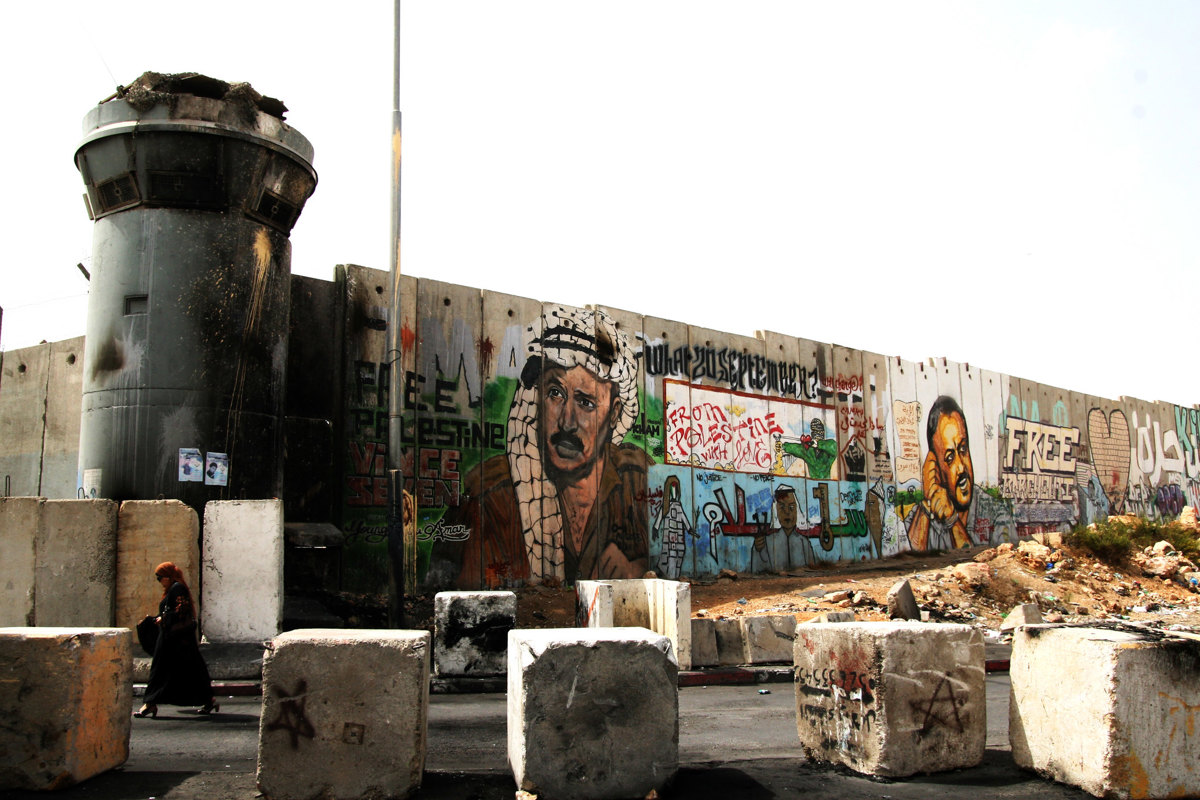
Third layer: Censorship and repression in the digital sphere
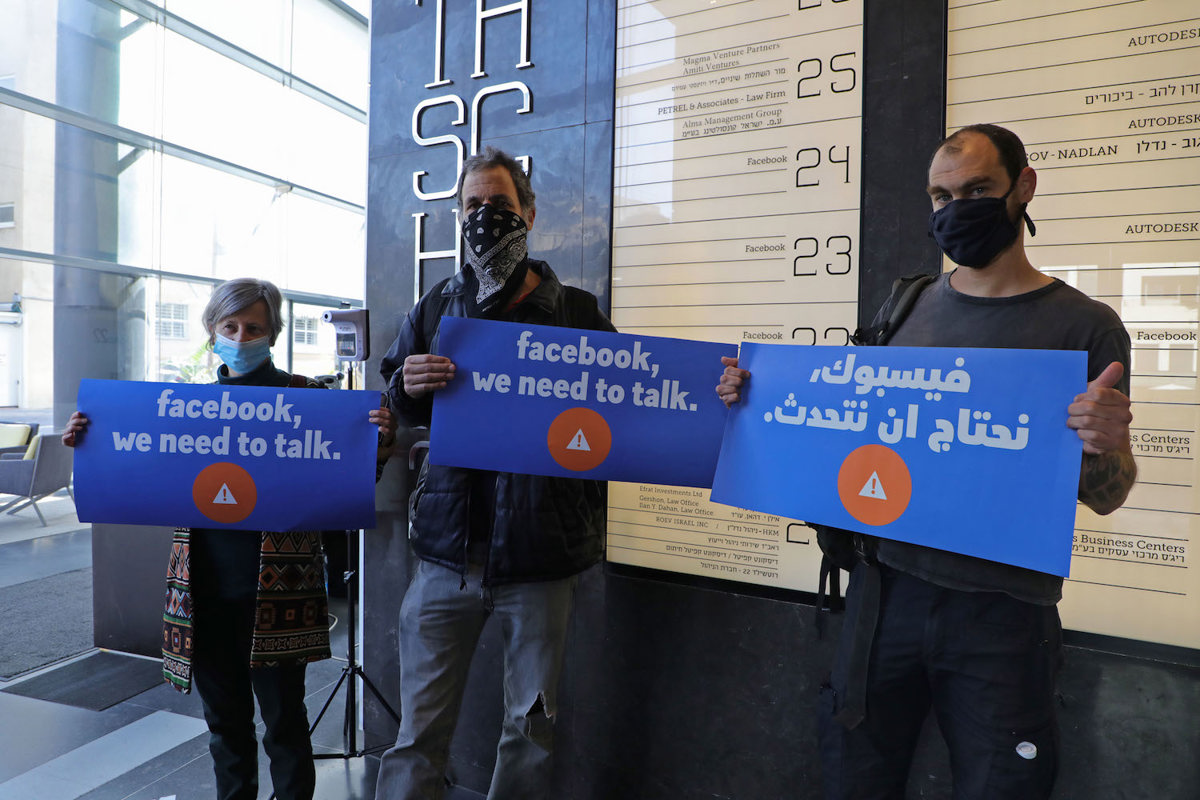
The third layer of digital colonialism concerns Israel’s control over narratives and discourse. For decades, Israel has sought to impose its official narrative across global media while marginalizing Palestinian voices. With the rise of social media and online platforms, this dominance has expanded into the digital realm. Platforms such as Facebook, Instagram, and X (formerly Twitter) — ostensibly public spaces — have in practice become “digital occupation zones” for Palestinians, where posts are deleted, accounts suspended, and collective memory systematically targeted.
Since 2015, Israel has systematically turned social media activity into a tool of criminalization and punishment. Hundreds of Palestinian journalists, students, and activists have been arrested on charges of “incitement” or “supporting terrorism,” with Facebook posts and WhatsApp messages used as evidence in court. Between 2015 and 2018, at least 470 people were imprisoned on such grounds.[26] A single Facebook post could lead to months in prison, while even private WhatsApp conversations were exploited by Israeli intelligence for blackmail and coercion.[27]
Israeli authorities did not stop there; they went on to establish formal mechanisms of cooperation with social media companies. The Ministry of Justice’s “Cyber Unit” began submitting content removal requests to platforms such as Facebook, Twitter, and YouTube. In 2020, these platforms complied with 81% of the unit’s official requests.[28] That same year, under pressure from the Israeli government, Facebook reportedly deleted hundreds of pro-Palestinian posts. For instance, during the Sheikh Jarrah protests in May 2021, Instagram and Twitter collectively removed posts criticizing the forced expulsions in East Jerusalem, citing a technical “error.” Within just a few days, 7amleh documented more than 200 complaints related to these removals.[29] Although the companies later apologized and attributed the incident to an “algorithmic glitch,” the episode revealed their willingness to silence Palestinian voices. Meanwhile, Israeli far-right groups openly used Telegram to call for pogroms without facing any moderation. In this way, a double standard became institutionalized in the digital public sphere: Palestinian expressions of resistance were suppressed, while hate speech from Israeli sources was freely circulated.[30]
The institutional dimension of these biased censorship practices is equally alarming. Facebook’s Director of Public Policy for Israel and the Jewish Diaspora, Jordana Cutler, previously served as an adviser to Prime Minister Benjamin Netanyahu.[31] Cutler plays a key role in coordinating content moderation between Facebook and the Israeli government. In early 2021, internal discussions leaked revealing that Facebook was considering classifying the word “Zionist” as a form of hate speech. Once this proposal became public, widespread backlash followed, with many individuals and organizations warning that such a move would equate legitimate criticism of Israel with antisemitism.[32] A global campaign led by Jewish Voice for Peace gathered more than 50,000 signatures, arguing that banning the term “Zionist” would effectively silence Palestinians from expressing the oppression they face. In response to the public outcry, Facebook backtracked and announced that it had suspended the proposed policy.[33]
Palestinian digital rights organizations continue to document and expose these violations to the world. For example, the group Sada Social reported nearly 1,000 cases of content removal and account suspension targeting Palestinians on social media throughout 2019, while 7amleh revealed that in 2020, online platforms complied with over 80% of Israel’s official content removal requests.[34][35] Censorship intensified further during 2023–2024: in the first year of the destruction that began in Gaza in October 2023, Palestinian digital rights organizations documented at least 5,100 cases of censorship, including the suspension of journalists’ social media accounts, restrictions on information sharing by NGOs, and the deliberate suppression of pro-Palestinian content in search engine results.[36] Moreover, in 2022, online archives hosting historical records of Palestinian refugees from 1948 were subjected to cyberattacks, rendering some permanently inaccessible. This represents the digital embodiment of what Mario Pansera calls epistemicide—the systematic destruction of knowledge—where the colonial power seeks not only to silence present voices but also to erase the memory of the past within digital spaces. The historical records and digital memory of Palestinians are under assault, completing the narrative dimension of digital colonialism.
Expanding the Palestinian struggle: Reclaiming the productive force
When read together, the layers of infrastructure, surveillance, and narrative reveal the alliance at the heart of digital colonialism in Palestine: the partnership between Israel and global technology corporations. The nodes of telecommunication and spectrum, the chains of AI-assisted surveillance and targeting, and the visibility/exposure regimes of digital platforms all function in concert — monopolizing the flow of information, maintaining control over the Palestinian population, and undermining political agency. This reality exposes how the recently popularized discourses of “ethics” and “responsible innovation” quickly become tools of concealment when confronted with colonial power relations, masking rather than challenging the structures of domination that technology helps sustain.
The dialectic that Marx and Engels identified is laid bare here: once the productive forces become integrated into dominant relations of production, they cease to be emancipatory and instead acquire a destructive character. In Palestine, telecommunications networks, cloud services, big data, and algorithmic systems have been transformed from instruments meant to serve social needs into technologies of occupation management. The expanding digital capacity, celebrated in the name of “progress,” in practice generates restriction of movement, deepened surveillance, and suppression of narrative.
Therefore, the issue is not merely about how technology is used, but who produces it, who controls it, and for what purpose it is directed. Reclaiming the productive forces requires the repoliticization of spectrum, infrastructure, and data for public and collective benefit; the democratization of platform governance; and the organization of institutional disengagement—through boycotts, exposure, and contract termination—by academia, unions, and tech workers from colonial projects. Otherwise, even the most radiant ethical frameworks ultimately become instruments of domination.
What Palestine tells us today is crystal clear: the productive forces will either remain destructive forces in the service of colonial violence, or they will be redirected through an anti-colonial politics to become social instruments working in favor of the oppressed. The struggle unfolding in Palestine is the sharpest stage of this crossroads; the question is not “the future of technology,” but whose future technology will serve.
Footnotes:
[1] “In the development of productive forces there comes a stage when productive forces and means of intercourse are brought into being, which, under the existing relationships, only cause mischief, and are no longer productive but destructive forces (machinery and money); and connected with this a class is called forth, which has to bear all the burdens of society without enjoying its advantages, which, ousted from society, is forced into the most decided antagonism to all other classes…” Karl Marx, Friedrich Engels, The German Ideology, Progress Publishers, 1968 (Marx/Engels Internet Archive)
[2] “The inherent inability of late capitalism to generalize the vast possibilities of the third technological revolution or of automation constitutes as potent an expression of this tendency as its squandering of forces of production by turning them into forces of destruction: permanent arms build-up, hungerin the semi-colonies (whose average labour productivity has been restricted to a level entirely unrelated to what is technically and scientifically feasible today), contamination of the atmosphere and waters, disruption of the ecological equilibrium, and so on — the features of imperialism or late capitalism traditionally most denounced by socialists.” Ernest Mandel, Late Capitalism, NLB, 1975, p. 214.
[3] Michael Kwet, “Digital Colonialism: US Empire and the New Imperialism in the Global South,” Race & Class, 60(4), 2019. Michael Kwet, “Digital Colonialism is Threatening the Global South,” Al Jazeera, March 13, 2019.
[4] Helga Tawil-Souri, “Digital Occupation: Gaza’s High-Tech Enclosure,” Journal of Palestine Studies, vol. 41, no. 2 (2012), pp. 27–43.
[5] Sara Roy, “The Gaza Strip: The Political Economy of De-development,” Journal of Palestine Studies, vol. 17, no. 1 (1997), pp. 56–88.
[6] Francesca Albanese, “From Economy of Occupation to Economy of Genocide: Report of the Special Rapporteur on the Situation of Human Rights in the Palestinian Territories Occupied Since 1967,” United Nations Human Rights Council, A/HRC/59/23, July 2, 2025.
[7] Helga Tawil-Souri, “Digital Occupation: Gaza’s High-Tech Enclosure,” Journal of Palestine Studies, vol. 41, no. 2 (2012), pp. 27–43.
[8] Associated Press, “Palestinians to Get 3G in West Bank, After Israel Lifts Ban,” January 15, 2018.
[9] Ibid.
[10] Palestine’s first mobile communications operator, Jawwal, was established in 1999 under the Palestine Telecommunications Company (Paltel Group).
[11] Anwar Mhajne, “Israeli Colonialism Goes Digital,” +972 Magazine, May 25, 2021.
[12] Ibid.
[13] “Israel/OPT: Israeli Authorities Are Using Facial Recognition Technology to Entrench Apartheid,” Amnesty International, May 2, 2023.
[14] Ibid.
[15] Amnesty International, “Automated Apartheid – How Facial Recognition Fragments Palestinian Life,” (2023).
[16] Ibid.
[17] Ibid.
[18] Amnesty International, “Devices of Palestinian Human Rights Defenders Hacked with NSO Group’s Pegasus Spyware,” November 8, 2021.
[19] Human Rights Watch, “Spyware Used to Hack Palestinian Rights Defenders,” November 8, 2021.
[20] Human Rights Watch, “Q&A: Israeli Military’s Use of Digital Tools in Gaza,” September 10, 2024. This HRW document explains, in a question-and-answer format, how AI-assisted systems such as The Gospel, Lavender, and Where’s Daddy? operate and the risks they pose to civilians.
[21] Ibid.
[22] Marwa Fatafta and Daniel Leufer, “Artificial Genocidal Intelligence: How Israel is Automating War Crimes,” May 9, 2024.
[23] Human Rights Watch, “Q&A: Israeli Military’s Use of Digital Tools in Gaza,” September 10, 2024.
[24] Marwa Fatafta and Daniel Leufer, “Artificial Genocidal Intelligence: How Israel is Automating War Crimes,” May 9, 2024.
[25] Antony Loewenstein, The Palestine Laboratory, Verso Books, 2023 (Turkish edition: Filistin Laboratuvarı, trans. Özlem Arpacı, Metis, 2024). Following the book’s publication in Turkey, we also conducted an interview with the author: “Loewenstein: Gazze’de yaptıklarına rağmen İsrail’e derin bir hayranlık var,” Technology for Palestine Series, Bianet, September 27, 2024.
[26] Noah Kulwin and Amel Guettatfi, “Israel Is Now Using Facebook Posts to Jail Palestinians,” VICE News, January 11, 2018.
[27] Ibid.
[28] Anwar Mhajne, “Israeli Colonialism Goes Digital,” +972 Magazine, May 25, 2021.
[29] Reuters/Al Jazeera, “Instagram, Twitter Blame Glitch for Deleted Sheikh Jarrah Posts,” May 11, 2021.
[30] Emanuel Maiberg, “‘Burn Their Homes: Israeli WhatsApp Groups Are Organizing Attacks on Arabs,” VICE Tech, April 5, 2022.
[31] Oren Ziv, “Is Facebook About to Crack Down on Criticism of Zionism?,” +972 Magazine, February 26, 2021.
[32] Ibid.
[33] Middle East Eye, “Facebook Reassurances on ‘Zionist’ Hate Speech Policy Met with Scepticism,” March 30, 2021.
[34] Anwar Mhajne, “Israeli Colonialism Goes Digital,” +972 Magazine, May 25, 2021.
[35] Ibid.
[36] 7amleh, “Palestinian Digital Rights in the Context of Genocide – One Year After the War on Gaza,” September 15, 2024.
(DS/VC)