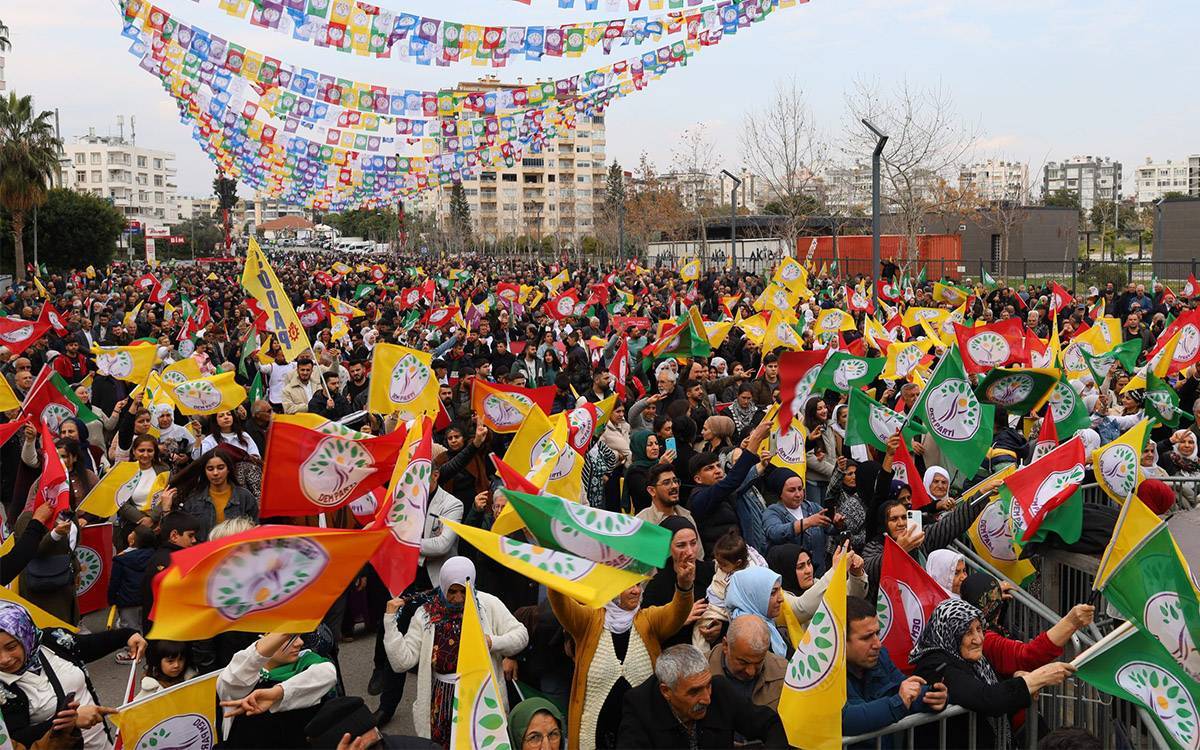




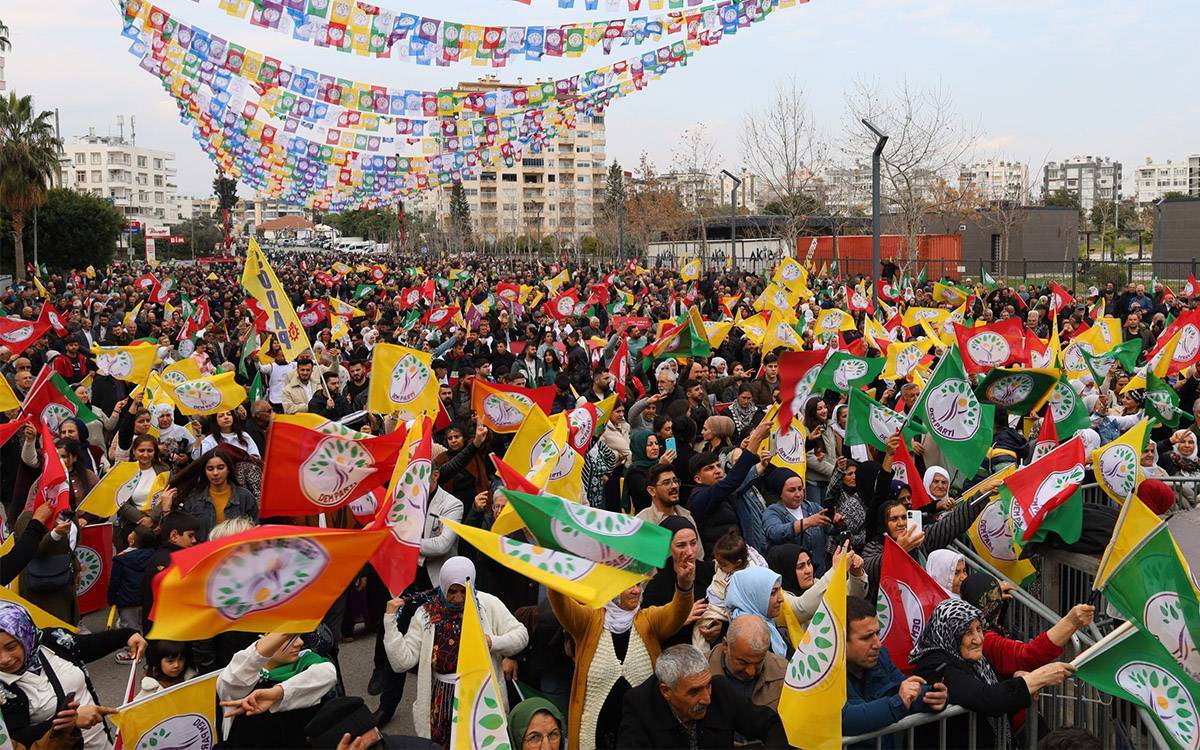



The process the government relaunched in Oct 2024 to resolve the Kurdish issue—partly driven by the regional risks posed by the increasingly violent war in the Middle East—reached a concrete stage with the passage of the Framework Law by the Parliament in August.
This development has left the DEM Party facing a complex strategic equation at a critical juncture where two key dynamics intersect. The DEM Party is compelled to remain at the negotiating table with the ruling bloc to ensure the Kurdish peace process gains a lasting legal foundation. On the other hand, it faces the responsibility of representing the broad segments of society demanding democracy, the rule of law, equality, and freedom.
This dual position—setting aside Turkish nationalist political forces that cannot even tolerate the DEM Party’s very existence—has made the party the target of harsh criticism from both the mainstream opposition and socialist groups that have not severed their ties with Kemalism.
The party’s fundamental strategic challenge is how to reconcile its claim to be part of Turkey’s democratic opposition with its role as an active actor in negotiations aimed at resolving the Kurdish issue. Striking a balance between the political caution required by the peace process and the critical stance of the democratic opposition will be one of the defining debates of the coming period.
Negotiations and the risk of instrumentalization
Among the main criticisms directed at the DEM Party is the concern that its contacts with the ruling party could weaken its capacity for democratic opposition. Among the primary indicators of authoritarianism in Turkey are the appointment of government-appointed trustees in place of elected mayors, the use of the judiciary as a tool to pressure opposition politicians, the failure to implement decisions by the Constitutional Court and the European Court of Human Rights, bans on strikes, and control over the media.
In such an atmosphere, dialogue with the ruling party fosters mistrust within the opposition. According to those who take a critical view of the process, the government is using the peace process not only to resolve the Kurdish issue but also to strengthen its political hegemony, shape the constitutional order according to its own needs, and divide the opposition. In this context, the DEM Party’s position in the negotiation process could, even unintentionally, become part of the government’s political calculations.
In contrast, there is also an approach that does not view the resolution of the Kurdish issue as separate from Turkey’s democratization. According to this perspective, reflected in the DEM Party’s congress and party council discussions, the end of the conflict could mark a significant milestone not only for the Kurds but also in terms of paving the way for democratic politics across Turkey. The elimination of one of the sources of legitimacy for security-oriented policies could make it more difficult to justify authoritarian practices ranging from the appointment of trustees to bans on public demonstrations.
From this perspective, remaining at the negotiating table does not mean supporting the government’s policies. However, assuming that the peace process will automatically lead to democratization is also risky. In a scenario where negotiations are not backed by legal safeguards, limiting the process—as the government’s approach does—solely to the goal of “eliminating terrorism” could lead to the continuation of authoritarian governance practices even after the conflict has ended. For the DEM Party, the fundamental challenge is to avoid being pushed into a position where, while contributing to peace, it might end up delaying demands for democratization.
The opposition's dilemma regarding the Kurdish issue
On the other side of this strategic tension lies the stance of the main opposition. It appears that the YENİ Party is struggling to develop an inclusive perspective on resolving the Kurdish issue that enjoys strong social legitimacy. Differing stances on the parliamentary committee’s work and on ensuring legal safeguards for the process, along with the decision to withdraw from the Monitoring Commission, indicate that a common democratic ground has not been established with the DEM Party. Approaches shaped by nationalist sensitivities tend to view the resolution of the Kurdish issue as part of the process led by the ruling party. One possible consequence of this distant stance could be that political initiative in the resolution process becomes largely concentrated in the hands of the ruling party. Consequently, while the DEM Party negotiates with the ruling party, it may face the risk of a widening gap between itself and a significant segment of the opposition.
However, if the democratic resolution of the Kurdish issue is reduced solely to a negotiation point between the government and the Kurdish political movement, it may remain limited in terms of social legitimacy. The participation of Parliament, opposition parties, labor unions, and various segments of society is crucial for the sustainability of the solution. For this reason, the main opposition’s distance from the process, as well as the DEM Party’s capacity to develop political relationships that can bridge this gap, constitute an important dimension of the discussion.
The groundwork for pluralism and democratic opposition
A theoretical framework regarding the tension between negotiation and opposition can be found in Ernesto Laclau and Chantal Mouffe’s approaches to radical democracy and pluralism. According to this approach, a democratic counter-hegemony can be established when diverse social struggles converge on a common political ground while preserving their distinct characteristics. Mouffe’s conception of agonistic pluralism also emphasizes the expression of social conflicts within democratic politics rather than their suppression.
From Turkey’s perspective, a key dimension of this approach is the relationship between identity-based rights struggles and class-based demands. While the Kurds’ demands for equal citizenship and collective rights, the Alevis’ struggle for freedom of belief, women’s quest for equality, the ecological movements’ defense of nature, and workers’ economic demands stem from different experiences, they converge in the face of authoritarianism and inequality. Deepening poverty, precarious work, unemployment, and income inequality hold the potential to create a common ground for struggle among different social groups. Class politics can be viewed not as a replacement for identity-based struggles, but rather as a space for solidarity that can strengthen the connections between them.
In this regard, the DEM Party’s structure—which brings together a legacy of social struggle and diverse socialist traditions—offers a significant opportunity. However, the political realization of this opportunity appears to depend on the nature of the relationship the party establishes not only with its own base but also with the expectations of Turkey’s various social segments regarding democracy, freedom, and economic justice.
Is a politics possible where the negotiating table and the opposition do not exclude one another?
The DEM Party’s strategic dilemma is not merely a matter of choosing between negotiation and opposition. The real issue is whether a political relationship can be established in which negotiation does not replace democratic opposition, nor does opposition rule out the possibility of peace. Restricting criticism of the government out of concern that the peace process might be harmed could weaken the party’s visibility within the democratic opposition and its ties to social struggles. Conversely, an understanding of opposition that evaluates negotiations solely through the lens of the relationship with the government could also narrow the historical window of opportunity for resolving the Kurdish issue. Both approaches carry political costs.
Therefore, just as the success of the peace process is important, so is the democratic foundation upon which it proceeds. Conducting negotiations in a manner that is open to the participation of social opposition, grounded in legal safeguards, and linked to a perspective of democratization could influence both the sustainability of peace and Turkey’s prospects for democratization. The challenge facing the DEM Party is to maintain a relationship between these two political spheres that does not exclude one another but rather reinforces each other. As long as peace and democracy, and negotiations and opposition, are viewed as alternatives to one another, this tension will persist. However, bringing together diverse social demands on a common democratic ground can enable these two spheres to reinforce one another. It is difficult for an approach that does not view the resolution of the Kurdish issue—one of Turkey’s fundamental problems since the founding of the Republic—as an integral part of democratization to produce lasting democratic transformation. The heavy price paid over the past four decades also demonstrates that these two issues cannot be considered separately.