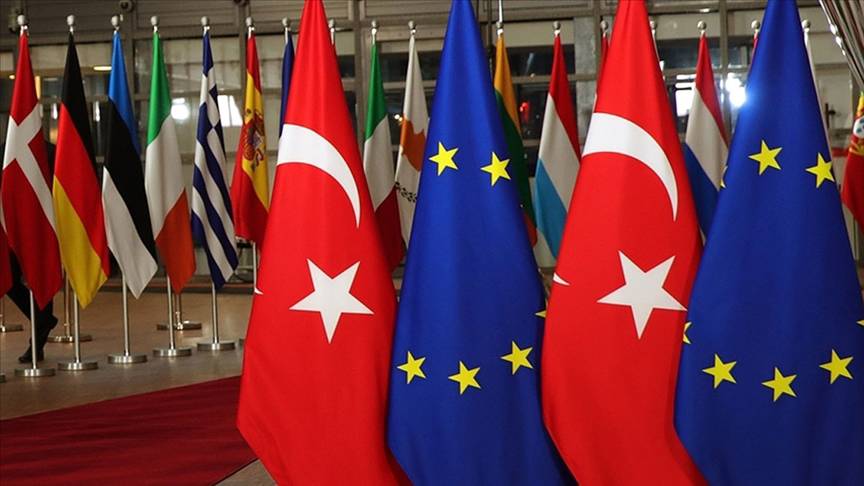











On Dec 7, 2025, I addressed the conference titled “Democracy, Solidarity, Peace: The Progressives’ Commitment to Deepening the EU–Turkey Relationship,” held at The Art İstanbul and hosted by the Group of Socialists and Democrats (S&D). The event was convened at a moment when Turkey’s rule of law, democratic institutions, and political freedoms face one of their most challenging periods in decades.
The conference featured contributions from Namik Tan, Vice President of the Republican People's Party (CHP); Kathleen Van Brempt, MEP and Vice President of the S&D Group; Nacho Sánchez Amor, the European Parliament’s Standing Rapporteur on Turkey; Ahmet Aras, Metropolitan Mayor of Muğla; Gökhan Zeybek, CHP Vice President for Local Authorities; Yunus Emre, Member of the Foreign Affairs Committee; Dario Nardella, MEP from the S&D Group; Joško Klisović, Vice-Chair of the PES Group in the European Committee of the Regions; Seren Korkmaz from the IstanPol Institute; and Luise Rürup of the Friedrich Ebert Stiftung.
The purpose of the conference was clear: to reaffirm the S&D Group’s solidarity with Turkey’s democratic forces—beginning with the CHP as the country’s strongest opposition party—and to voice firm support for all actors resisting authoritarian pressure. This commitment was particularly meaningful given the unlawful arrest and removal from office of Istanbul Metropolitan Municipality Mayor Ekrem İmamoğlu and the politically motivated attempt to remove CHP Chairman Özgür Özel. Against this troubling backdrop, the gathering aimed to articulate a progressive vision for reviving Turkey–EU relations based on mutual understanding, cultural exchange, and the fight against all forms of prejudice.
A stalled accession path
Turkey applied for EU membership in 1987 and remains, formally, a candidate country. Yet the promise of accession has long faded. Of the 35 negotiation chapters, only 16 have been opened and just one provisionally closed. Negotiations, launched in 2005, have been effectively frozen since 2018. Meanwhile, 16 other countries have joined the EU since Turkey’s initial application.
Over the years, the relationship drifted into a transactional pattern defined primarily by European priorities—most notably migration and security—rather than by a genuine accession perspective. Responsibility for this deterioration is shared. Successive Turkish governments have failed to implement key reforms, while the EU has not demonstrated the political resolve necessary to advance Turkey’s candidacy, despite describing Turkey as a “strategic partner.”
The 2016 migration framework and unkept commitments
Turkey’s central role during the 2015 migration crisis led to intensified diplomatic engagement, including three summits in four months. The 18 March 2016 Statement was instrumental in preventing humanitarian catastrophe along the Aegean route. Although 43.610 displaced persons were resettled from Turkey to the EU, the broader Voluntary Humanitarian Admission Scheme never became operational once irregular crossings declined.
Today, Turkey continues to host nearly three million Syrians under temporary protection—likely an undercount—bearing a heavy socio-economic burden even after €12 billion in EU assistance.
Another unfulfilled promise concerns visa liberalization. By 2016 Turkey had met 66 of the 72 benchmarks, yet visa-free travel never materialized. Difficulties in accessing Schengen visas have since intensified: appointment shortages, prolonged processing times, and high refusal rates disproportionately affect students, researchers, businesspeople, and transport professionals. Turkey remains the only EU candidate country without visa liberalization, an inequity that undermines the credibility of the accession framework.
Customs union modernization and economic cooperation
The modernization of the 1996 EU–Turkey Customs Union remains pending. Although the European Commission sought a mandate for negotiations in 2016, the Council has not granted it. Progress on high-level economic dialogue has also been insufficient, while pre-accession financial assistance to Turkey has significantly decreased—limiting collaboration on the green transition, digitalization, and competitiveness. Restoring the European Investment Bank’s full operations in Turkey is essential.
The Cyprus constraint
The unilateral accession of the Greek Cypriot Administration to the EU in 2004 continues to complicate Turkey’s path. In 2009, the Greek Cypriot side blocked six negotiation chapters, linking progress to the normalization of bilateral relations. Even when Turkey meets technical benchmarks, political blockage prevents chapters from opening. The EU must no longer allow Greece and the Greek Cypriot Administration to hold EU–Turkey relations hostage.
Greek Cypriot narratives often focus exclusively on post-1974 developments, overlooking the suffering experienced by the Turkish Cypriots prior to 1974. In EU platforms, this one-sided framing obstructs constructive dialogue. During the 2026 EU budget discussions, we objected to funding a monument dedicated solely to missing Greek Cypriots, arguing that any such initiative must include all missing persons on the island.
Meanwhile, the UN-supported Committee on Missing Persons continues to operate successfully under a cooperative model. We are confident that the CHP, under Tufan Erhürman’s leadership, will contribute meaningfully to a more balanced approach following its 2025 electoral victory in Northern Cyprus.
Security, defence, and geopolitical realities
Turkey’s growing significance for Europe in terms of connectivity and security is increasingly acknowledged; however, these factors alone are not considered sufficient to justify full EU membership. Turkey’s strategic location makes its participation in EU security and defence mechanisms—such as the Security Action for Europe, the Permanent Structured Cooperation, the European Defence Agency, and Black Sea initiatives—both necessary and mutually beneficial. If the EU expects Turkey to align its foreign policy accordingly, then critical decisions affecting Turkey should not be taken in its absence.
Democratic backsliding and the domestic dimension
Under current conditions, the EU expects adherence to the principle of the rule of law as a prerequisite for returning to full membership negotiations. As CHP, we fully acknowledge the concerns highlighted in the European Commission’s Turkey Reports over the past decade. As rapporteur Nacho Sánchez Amor has repeatedly noted, the failure to implement the Commission’s longstanding recommendations underscores the gravity of Turkey’s democratic erosion.
The authoritarian trajectory under the AKP government—characterised by the politicization of the judiciary, erosion of checks and balances, and targeted attacks on opposition figures—has severely damaged institutional trust. The indictment against Mayor Ekrem İmamoğlu exemplifies judicial capture. Arbitrary detentions, selective prosecutions, and the non-implementation of ECtHR judgments have further deepened the crisis.
In Parliament, CHP insists that issues concerning the rule of law, corruption, political ethics, and organized crime must be addressed transparently. Our members in the EU Harmonization Committee and the JPC consistently propose roadmaps, yet these efforts receive insufficient consideration from the government.
The AKP leadership benefits politically from a transactional relationship with the EU and employs foreign policy to serve domestic political survival. Restoring the credibility of Turkey–EU relations requires principled leadership on both sides—leadership of the kind exemplified by CHP Chairman Özgür Özel.
A call for democratic renewal and rekindled engagement
CHP stands ready to implement the reforms aligned with the Copenhagen Criteria, the EU acquis, and universal democratic values. Our aim is to build a transparent, accountable, and democratic Turkey—not only to revive our EU membership perspective but also because these reforms serve our national interest. With the amendment we made to our Party Program last month, we included the following statement: ‘For the CHP, accession to the European Union is one of the most important foreign policy objectives.
As the leading party in Turkey’s most recent elections, we seek the electorate’s mandate in the next general elections to advance this transformative agenda. While not all political groups in the European Parliament support Turkey’s accession, we extend our sincere appreciation to the S&D Group for its unwavering solidarity—both in defending Turkey’s membership prospects and in standing against politically motivated operations targeting CHP and our municipalities. I also thank Nacho Sánchez Amor for his steadfast advocacy and friendship.
Turkey’s democratic future is intertwined with the future of its relationship with Europe. It is time to rebuild this relationship—on the foundations of democracy, mutual trust, and shared prosperity. (JNS/VK)