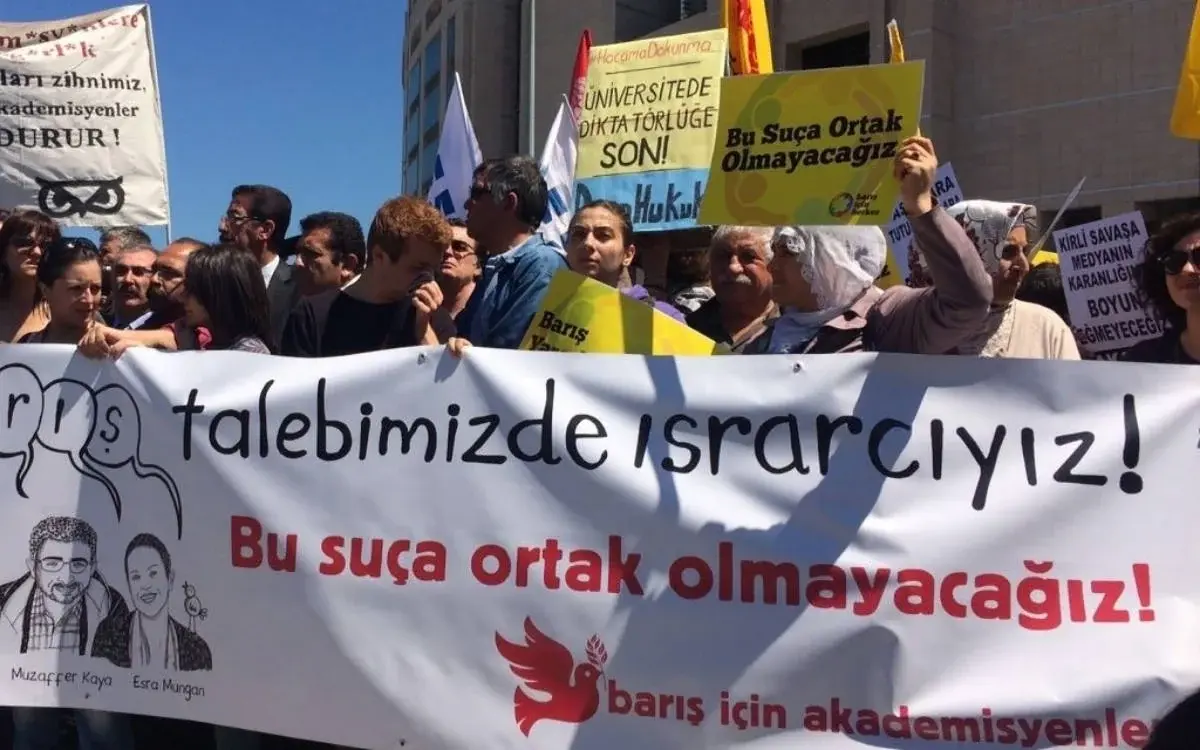

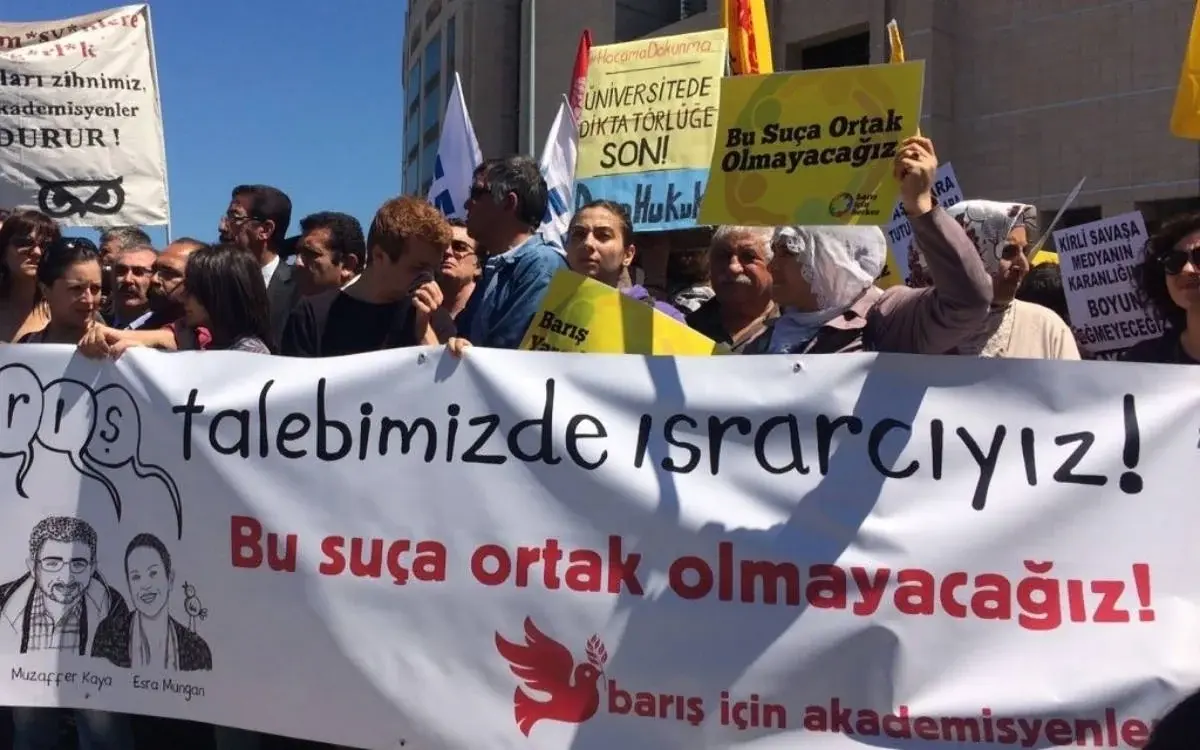



Let me tell you a Kafkaesque story. But this story is not merely a work of fiction; it is the very reality we are facing today. In a time when freedom of expression is restricted and academic freedom is nonexistent, this text has been written to stand in solidarity with the lives and dignity of the Academics for Peace, to remind that freedom of expression must be safeguarded, and to express that the denial of this freedom threatens not only individuals but also the future of society. This is not merely a reckoning with the past; it is also a call for fair and free universities and a just society in the future.
The practices during and after the state of emergency (OHAL) period in Turkey created a climate of pressure with grave consequences both on academic and expressive freedoms, as well as on the independence of the judiciary. The 10th anniversary of the declaration also marks the 10th year of the oppression and suffering experienced by a people isolated from the outside world and deprived of their rights through uninterrupted curfews imposed by their own state. The situation of the Academics for Peace, who were dismissed for signing the Peace Declaration during this period, must be seen not merely as individual rights violations but as the result of a security-oriented style of governance that undermines society’s capacity to produce knowledge, reason, and think critically.
Despite the Constitutional Court ruling that protected the freedom of expression of the Academics for Peace and emphasized the importance of a pluralistic and critical academic environment, the legal proceedings we could only initiate five years after our dismissals contain serious deficiencies, “excesses,” and inconsistencies in terms of enforceability and accountability.
In a state governed by the rule of law, the fact that the charge was identical and that the Constitutional Court found no criminal element in the declaration should have resulted in the reinstatement of all academics dismissed for signing the Peace Declaration after the AYM ruling. But this did not happen.
On the contrary, we found ourselves in an absurd, Kafkaesque labyrinth—worrisome, generating distrust, alienating, insecure, threatening, and lacking any rational anchor—over which we had no control. First, we waited for the decisions of the OHAL Commission, as if it were above the Constitutional Court. For nearly five years. Eventually, within a month or two, the files of hundreds of Academics for Peace were inexplicably reviewed at great speed, and almost all of us were issued rejection decisions. This meant the violation of our right to a fair trial within a reasonable time. Yet the OHAL Commission was not a judicial body, but a committee tasked with forming opinions. It had been established to assess and decide on applications regarding actions taken directly by decree laws, based on allegations of membership, affiliation, connection, or links with structures, formations, or groups determined by the National Security Council to be engaged in activities against the national security of the state or considered terrorist organizations under the state of emergency. As can be understood from this definition, the commission was assigned to erase from the public sphere the manifestations of alternative social, political, and ethical stances that the ruling power sought to exclude from its field of vision, by making a friend-enemy distinction within the boundaries defined by the government.
Following the rejection decisions by the commission, we had to file individual lawsuits at our institutions. Each of us was distributed to different “specially authorized” administrative courts. Both first-instance courts and Regional Administrative Courts (appeals) handed down widely differing decisions, as if each was applying the law of a different country.
Legal labyrinth
Some of us were reinstated by the first-instance courts, but rejected by the appeals courts (55 people); some were rejected by the first-instance courts, but reinstated by the appeals courts (39 people); some were reinstated by both courts (55 people); and some were rejected by both courts (44 people). A large majority (162 people) are still awaiting decisions from the appeals courts.[1]
The files of both those accepted and those rejected are now before the Council of State. As far as I can see, there is only one reason behind the unlawfulness we have endured over the past five years at the hands of administrative courts: they acted as criminal courts, stepping beyond their mandate and authority. However, according to Article 125 of the Constitution of the Republic of Turkey, “Judicial power shall be limited to the review of the legality of administrative acts and shall not be used in any way as a review of expediency.” The administrative courts that rejected reinstatement exceeded the boundaries set by the Constitution and acted like the OHAL Commission. The OHAL Commission, too, violated our right to defense and made decisions either based on its own opinion or the opinion of the institutions.
At the Council of State, the highest court of administrative justice in Turkey, which is supposed to review these decisions, the disturbing structure of the legal labyrinth has not changed much. Although the Council of State is the highest judicial body responsible for overseeing the legality of administrative actions and decisions, ensuring the final review of administrative rulings, and limited solely to examining the legality of decisions, it has acted like a criminal court, just like the administrative courts. In the files of three individuals so far, it upheld unfavorable decisions by citing absurd allegations of affiliation as evidence, without even allowing for the right to a defense. With these rulings, the Council of State also overstepped its constitutional boundaries.
Ultimately, although the Council of State is the upper judicial body where all cases should reach a final verdict, it did not act any differently from the administrative courts. Only five Academics for Peace have been definitively reinstated by a ruling of the Council of State. For the rest of us, the sword of affiliation continues to hang over our heads, and everything remains very uncertain…
Due to the absurdity created by the differences in court outcomes, I can clearly state that the multiple and severe rights violations against the Academics for Peace continue. These violations should concern not only us Academics for Peace but also all academics who care about university autonomy, academic freedom, and independent research. The impartial and independent application of the law is essential not only for the protection of individual rights but also for universities to fulfill their foundational mission of critical thinking and free inquiry.
The word 'affiliation'
First of all, the word “affiliation” (iltisak), used in the decree laws issued during the state of emergency declared after the “coup” attempt of Jul 15, 2016, is not just a term affecting the Academics for Peace. It has also obstructed the path to free and independent knowledge production in universities, academic freedom, society’s freedom of expression, the right to vote and to organize, and the principle of the rule of law in the judiciary. It is an empty signifier used hegemonically to measure the loyalty of citizens and institutions to the current government. Although it etymologically means “joining, merging, adhering, uniting,” it is not a concept recognized in the Turkish legal system. What may be attributed to this empty signifier and what will be considered as affiliation is entirely at the discretion of those in power. The fact that the term is often used alongside “connection” only serves to reinforce ominous implications, creating an atmosphere of uncertainty in which no one is safe. A case you were acquitted of years ago may be considered affiliation, disregarding the very concept of acquittal; so might a social media post, or membership in an association shut down by decree… When the presumption of innocence turns into the presumption of affiliation, no one is safe. This creates a vast space of criminalization that is not based on clearly defined criminal acts by law, but instead relies entirely on subjective judgments (which themselves stem from nothing other than the government’s strategy of creating enemies). Neither universities, nor institutions, nor ordinary citizens can remain immune to affiliation—especially when administrative courts abandon their legal oversight role and begin conducting inquiries of appropriateness.
Let me give you a couple of examples from this dark legal labyrinth: For instance, the 13th Regional Administrative Court says: “In the said application, the Constitutional Court ruled that those who signed the declaration cannot be sentenced to imprisonment, but did not establish a violation ruling indicating that these persons cannot be subjected to administrative sanctions for the same act.” The so-called administrative sanction is being dismissed from university and condemned to “civil death”; it is the nullification of academic accumulation, and thus of the labor of the academic, and even of their bodily existence! Beyond the fact that “freedom” is reduced to nothing more than not being in prison, it is disgraceful that judges—on whom we must rely for fair adjudication—cannot grasp that what is called an “administrative sanction” is in fact a penalty of deprivation of liberty that results in severe and multiple rights violations for every segment of society! When the Academics for Peace were dismissed and kept away from universities for 10 years under the hegemony of affiliation, was not the freedom of universities to think and research independently, the freedom of students to access expert knowledge and mentorship, the freedom of society to learn the truth, the freedom of courts to conduct fair trials, and the freedom of the press to democratize information all punished as if by imprisonment?
Let me give another example: I am one of the Academics for Peace whose reinstatement was approved by both administrative courts. However, my file has been pending at the Council of State since 2023. In an interim decision, the Council of State requested information, documents, or reports from the Council of Higher Education, the General Directorate of Security’s Anti-Smuggling and Organized Crime Department, the Financial Crimes Investigation Board (MASAK) of the Finance and Treasury Ministry, the Gendarmerie General Command, the General Directorate of Foundations, and the Civil Society Relations Directorate of the Interior Ministry, regarding whether I have any affiliations. My own institution, Ege University, submitted a few intelligence photos from 2012 and 2013 to the Council of State—photos it had not sent to either the first-instance court or the appeal court—accompanied by extremely false and malevolent comments such as “joined a march with a marginal left and separatist group; led students to march to the rectorate.” However, for the incidents in question, the university had neither launched a disciplinary investigation nor filed a criminal complaint against me. And yet, in their attempt to fabricate affiliation, they shamelessly distorted the context of these events with their own biased interpretations and submitted them as so-called evidence. If the Council of State takes these photos seriously and rejects my reinstatement without even allowing for a right of defense, then the process will move to a higher stage (the Constitutional Court and the European Court of Human Rights), and I and my fellow academics whose cases were rejected will have to endure this nightmare for who knows how many more years! Unfortunately, the situation is that grave.
For all the reasons mentioned, the fair and reasonable trial period in the 10-year struggle of the Academics for Peace has long been exceeded. The demand for the reinstatement of the Academics for Peace is closely related to the strengthening of the legal framework for ensuring the rule of law and protecting academic freedom.
The reinstatement of all Academics for Peace through a swift, fair, and transparent process can only be made possible by removing the existing barriers to the lawful functioning of the justice system and by taking concrete steps toward accountability and academic freedom. We continue our struggle; and even within this perilous labyrinth, we still manage to find our path and direction through solidarity. But in order to escape this legal absurdity, we need broader solidarity, the assurance that courts will not exceed their powers and responsibilities, and in short, the recognition of the rule of law! It does not seem possible for this to be achieved solely through our own efforts. (ZK/TY/VK)
Footnote
[1] The figures are from the table dated Dec 30, 2025, prepared by the Academics for Peace Post-Acquittal Working Group.