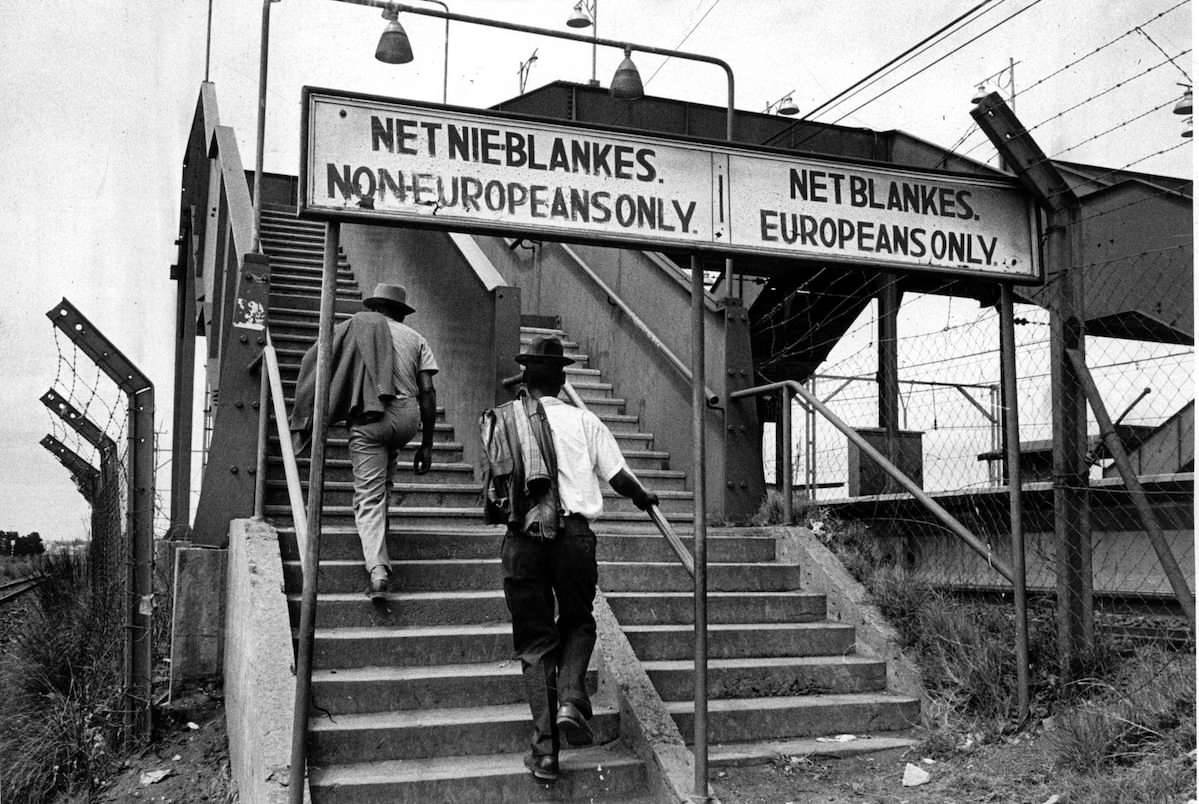











When the history of South Africa is mentioned, the first thing that comes to mind is "apartheid," a system of governance in which the white minority held a dominant, superior position and every aspect of political and social life was structured around racial segregation between Black and white people.
The discovery of gold in the Witwatersrand area near Johannesburg in 1886 and the transformation of Johannesburg into a major city within a decade led to a period of political polarization and division.
Alongside these developments, interregional disputes were resolved in 1910 and the Union of South Africa was established. This period marked the white minority gaining the power to control the flow of Black people into cities and confine them to specific residential areas outside urban centers.
On the other hand, a law passed in 1911 mandated that skilled positions be reserved for white people. The Land Act of 1913 is recognized as the legislation that first institutionalized racial segregation by designating specific living areas for Black people. This act defined the rural areas, or "reserves," where Black people were permitted to live. Furthermore, the act forbade Black people from farming independently or as tenant farmers, leaving them to work as wage laborers on white-owned farms.
While this legislation led to organized responses from Black people, white mine workers went on a general strike as they were losing their jobs to cheap Black labor. This strike led to a change in government and the formation of a hardline racist administration. A law enacted in 1923 empowered local authorities to designate specific zones for Black residence within cities. Another law regulated the employment of Black people in unskilled jobs at minimum wage.
The 1930s witnessed the rise of white nationalism among the "Afrikaners," predominantly people of Dutch descent who were the earliest white settlers in South Africa. These nationalist, racist whites viewed themselves both as the rightful owners of the country and as a unique people chosen by God, aiming to establish a well-structured "apartheid" system.
By the 1940s, a significant number of Black people, particularly women, were migrating not just as temporary workers but as permanent urban residents. In 1946, it was recorded for the first time that the Black population in cities outnumbered the white population. Coupled with economic difficulties, the growing number of Black people in urban areas led white populations to view them as an increasingly dangerous mass threatening their social gains.
The 1948 elections were won by the National Party, whose campaign was designed to meet the expectations of racist whites by introducing a regime for Black people called "apartheid."
Upon coming to power, the National Party began passing legislation designed to integrate racial segregation into every aspect of political, economic, and social life, keeping the movements and economic activities of Black people under strict control.
Citing a few of these laws provides insight into the implementation of apartheid. Acts No. 55 and 21, enacted in 1949, prohibited marriages and cohabitation between Black and white individuals. Some couples who were married or living together were forced to leave the country.
In addition to these laws, the population was registered according to racial classifications, and each racial group was compelled to live in specific areas. A law enacted in 1950 designated specific residential zones for Black and white people in urban areas. Thousands of Black people were forcibly moved from areas designated for whites, suffering significant social hardship and loss of property.
A new law passed in 1952 updated previous legislation regarding identification documents, making it mandatory for all Black men to carry these documents, a requirement extended to women in 1956.
In the course of these developments, the racist administration realized the potential of education as a crucial tool for strengthening the apartheid system. The Bantu Education Act of 1953 introduced mandatory regulations based on racial segregation within educational institutions. Dr. H.F. Verwoerd, the minister of education who later served as prime minister from 1958 to 1966 and is known as the architect of apartheid, advocated the view that education for Black children should teach them that they could never be equal to Europeans and could not reach a certain level of occupational capacity. In his view, there was no need to teach mathematics to a Black child, as they would have no opportunity to use it. Consequently, the budget allocated for the education of Black people was far smaller than that allocated for whites.
The Reservation of Separate Amenities Act of 1953 mandated the segregation and separate use of facilities and amenities in public spaces, such as post offices, buses, parking areas, and restrooms, based on race. Thus, the racist nature of the regime became visible in everyday life as well.
Between 1960 and 1994, forced displacement was recorded as one of the most painful and inhumane practices of the racist regime. Approximately 3.5 million Black people were removed from their homes and forced to live in newly established areas that lacked basic economic and social infrastructure. These movements also caused the deaths of many Black people due to starvation.
In the 1950s, nonviolent, broad-based protest campaigns and acts of civil disobedience against the racist regime began appearing in public spaces, mostly organized under the leadership of the South African Communist Party.
Meanwhile, the African National Congress (ANC) managed to gain broad support following the establishment of its Youth League in 1944 under the leadership of Anton Lembede, Nelson Mandela, Oliver Tambo, and Walter Sisulu. The Youth League developed a program including mass protests, boycotts, and passive resistance. However, this program had to wait until 1949 to be implemented.
As part of the civil disobedience campaign led by the ANC, large numbers of Black people entered white areas and parks, refused to carry their identity cards, and engaged in other acts of resistance. More than 8,000 Black people were arrested. These protests greatly increased the ANC's popularity, pushing its membership to 100,000. However, the response from the government was harsh, imposing many prison sentences and heavy fines.
In the 1950s, the government passed several laws to keep Black people under strict control. First, it banned the Communist Party by law, and the Public Safety Act of 1953 empowered the government to declare a state of emergency if needed.
The Freedom Charter
In the 1950s, leading organizations fighting against the racist regime joined together to form an alliance. This alliance was composed of the African National Congress (ANC), the South African Indian Congress, the Congress of Democrats (an organization of white anti-racists), the South African Coloured People's Organisation, and various trade unions.
Through nationwide efforts and several meetings, the alliance identified the public's demands and adopted the "Freedom Charter" in 1955, which listed the basic principles for the equality of Black people in the political and social spheres. These listed principles were designed to serve as the foundation for the constitution to be drafted in a future era of freedom.
The Sharpeville Massacre
On Mar 21, 1960, the Pan Africanist Congress organized a nonviolent march to protest identity cards. The goal was to march to the local police station, return their identity cards, and be arrested. A large crowd gathered outside the police station in Sharpeville; however, police opened fire, killing 69 Black people and injuring 180 others.
The Sharpeville Massacre marked a turning point in the struggle of Black people, drawing profound responses from local and international circles and sparking a rising wave of hatred against the racist regime.
With Resolution 134, passed on Apr 1, 1960, the United Nations condemned apartheid, declaring it a crime against humanity and calling upon the government to abandon its racist policies.
Start of armed struggle
Following increased Black demonstrations, the government declared a state of emergency and banned the ANC and the PAC. Upon these declarations, leaders of the ANC and the PAC decided that the time had come to launch an armed resistance.
Between 1961 and 1963, approximately 200 acts of sabotage were carried out in South Africa, mostly by the armed wing of the ANC. In 1963, after a police raid, the entire leadership cadre, including Mandela and his comrades, was captured, tried on charges of training for guerrilla warfare and sabotage, and sentenced to life imprisonment.
Mandela concluded his four-hour defense with these historic words: “I have dedicated my life to this struggle of the African people. I have fought against white domination, and I have fought against black domination. I have cherished the ideal of a democratic and free society in which all persons live together in harmony and with equal opportunities. It is an ideal which I hope to live for and to achieve. But if needs be, it is an ideal for which I am prepared to die.”
With Resolution 1881, dated Oct 11, 1963, the UN called on the South African government to unconditionally release Mandela and his comrades. However, the government disregarded UN resolutions despite calls for an arms embargo and exclusion from international organizations.
The 1970s – Youth Resistance – Steve Biko
By the 1970s, youth resistance had come to the forefront of the struggle. A student organization known as the "Black Consciousness Movement" was founded by Steve Biko in 1969. Biko wanted Black people to free themselves from perceiving themselves as inferior to whites. According to Biko, the education Black people received reinforced this sense of inferiority.
Over time, Biko emerged as a prominent leader whose protests and actions gained increasing national attention. The government viewed Biko as a dangerous activist, and in 1976 he was held in detention for several months without a court order. He was arrested again in 1977, thrown naked into a cell, and tortured to death within 18 days.
The Soweto Uprising of June 16, 1976
In 1975, a government directive mandated that Black students be taught in Afrikaans, triggering a student uprising. Students viewed education in Afrikaans as a racist and oppressive attempt to assert dominance and control over Black people.
After various attempts to overturn the instruction and small-scale protests, a massive protest march was launched on Jun 16, 1976, in Soweto, involving around 20,000 students. During the protest, police fired at the crowd, killing 13-year-old Hector Pieterson. This incident triggered violent resistance across the nation. Although the Soweto uprising was suppressed by the police, it marked a turning point in the struggle against racism, generating a renewed spirit of resistance among Black people nationwide.
From Apartheid to democracy
After the Soweto uprising, domestic resistance movements intensified, political pressure from the international community increased, and these developments seriously impacted the economy. The South African government found itself in political difficulties amid an increasing economic crisis, unable to cope with strikes and social unrest.
These events led to the unification of around 500 anti-apartheid political organizations active in the country under the name United Democratic Front (UDF), including trade unions, women's organizations, churches, and youth and student groups representing all races in South Africa.
However, faced with such broad-based opposition, the government once again resorted to harsh measures, banning anti-apartheid organizations and detaining their leaders. Many individuals were held in prison for extended periods without trial, subjected to torture, driven to suicide, or killed.
Throughout the 1980s, resistance movements against the government and its racist policies continued. On Sep 3, 1983, a new parliament was inaugurated, coinciding with a major uprising south of Johannesburg. In his 1985 New Year's address, ANC leader Oliver Tambo urged the people to make the country ungovernable.
The government’s response to this resistance was brutal, declaring a state of emergency across the country. The police were granted sweeping powers, and the army occupied settlements inhabited by Black people. The state’s employment of the police and army fueled public outrage and widespread unrest. By 1986, it was recorded that between 16,000 and 20,000 people had been imprisoned, and thousands had been killed by police or military forces.
The role of the churches
As they deemed the practices of the racist regime contrary to Christian principles and moral values, many churches supported resistance movements and became the voice of Black people. Desmond Tutu, a leading figure in this struggle, made a significant contribution as a globally recognized peace ambassador. Although harsh action against the church was unexpected, authorities imprisoned, dismissed, or imposed bans on certain clergy members serving in various church organizations.
International pressure
An economic embargo called for in the 1960s by the UN became effective in the 1970s as more countries joined. In the 1980s, boycotts expanded to cover sports, cultural activities, and academia. The most significant pressure came from the US, which imposed economic and financial sanctions in 1986. Due to the embargo, South Africa’s economy was severely shaken, and the National Party had to consider negotiating with the ANC. By the end of the 1980s, the government lacked the power to crush or eliminate resistance forces.
In 1989, F.W. de Klerk became leader of the National Party and president of South Africa. He faced immense pressure from domestic and international circles to make radical changes. This period also witnessed significant global transformation as the Soviet-led socialist bloc entered a process of disintegration. De Klerk decided to take radical steps, and on Feb 2, 1990, he lifted bans on political parties and organizations that had been outlawed due to their opposition to apartheid. Consequently, the ANC, the PAC, and the South African Communist Party were legalized, political prisoners were released, and exiles were permitted to return to the country. On Feb 11, 1990, Nelson Mandela was released after 27 years of imprisonment. Negotiations finally began with the ANC and other political parties, and the laws establishing the apartheid system were repealed.
A striking and tragic aspect of this period—during which new regulations were being enacted and negotiations were underway—was the continuation of violent clashes between Black citizens and government forces. Approximately 14,300 people lost their lives between 1990 and 1994.
In December 1991, an agreement was reached for an interim government to take charge until a new constitution could be drafted. Although negotiations faced various challenges and were occasionally interrupted, a consensus on the interim constitution was finally reached in November 1993. The first democratic elections were held on Apr 27, 1994. The ANC won the majority of the votes and formed a Government of National Unity, with Nelson Mandela as the first democratically elected president. F.W. de Klerk and Thabo Mbeki served as his deputies. (NT/VK)
References
K. Henrard, Post-Apartheid SA’s Democratic Transformation Process: Redress of the Past, Reconciliation and “Unity in Diversity” http://www.ethnopolitics.org/ethnopolitics/archive/volume_I/issue_3/henrard.pdf
Report of the South African Truth and Reconciliation Commission Volume 1 Chapter 1, 22
Alex Boraine, Hakikat ve Uzlaşma Komisyonu, Aram Yay. Ist, 2005, Çev: Aylin Kürkçü, Sh 80-81
Truth and Reconciliation Commission of South Africa http://www.trial-ch.org/en/resources/trut-commissions/africa/south-africa.html
Legal Information Institute http://www.law.cornell.edu/wex/south_african_truth_commission
http://www.khulumani.net/reparations/government/item/735-conference-report 4-6-Dec.2012/735
Varushka Jardine, The Truth and Reconciliation Commission : success and failure? upetd.up.ac.za/thesis/.../dissertation.pdf
http://www.ccr.uct.ac.za/archive/two/6_34/p24_winslow.html
James L. Gibson, “Truth, Justice, and Reconciliation” Washington University in St. Louis jameslgibson.wustl.edu/ajps2002.pdf
Survivors' Perceptions of the Truth and Reconciliation Commission http://www.csvr.org.za/papers/papkhul.htm
After Truth: The Truth and Reconciliation Commission, Media and Race Relations in Post-Apartheid South Africa http://digitalcommons.conncoll.edu/cgi/viewcontent.cgi?