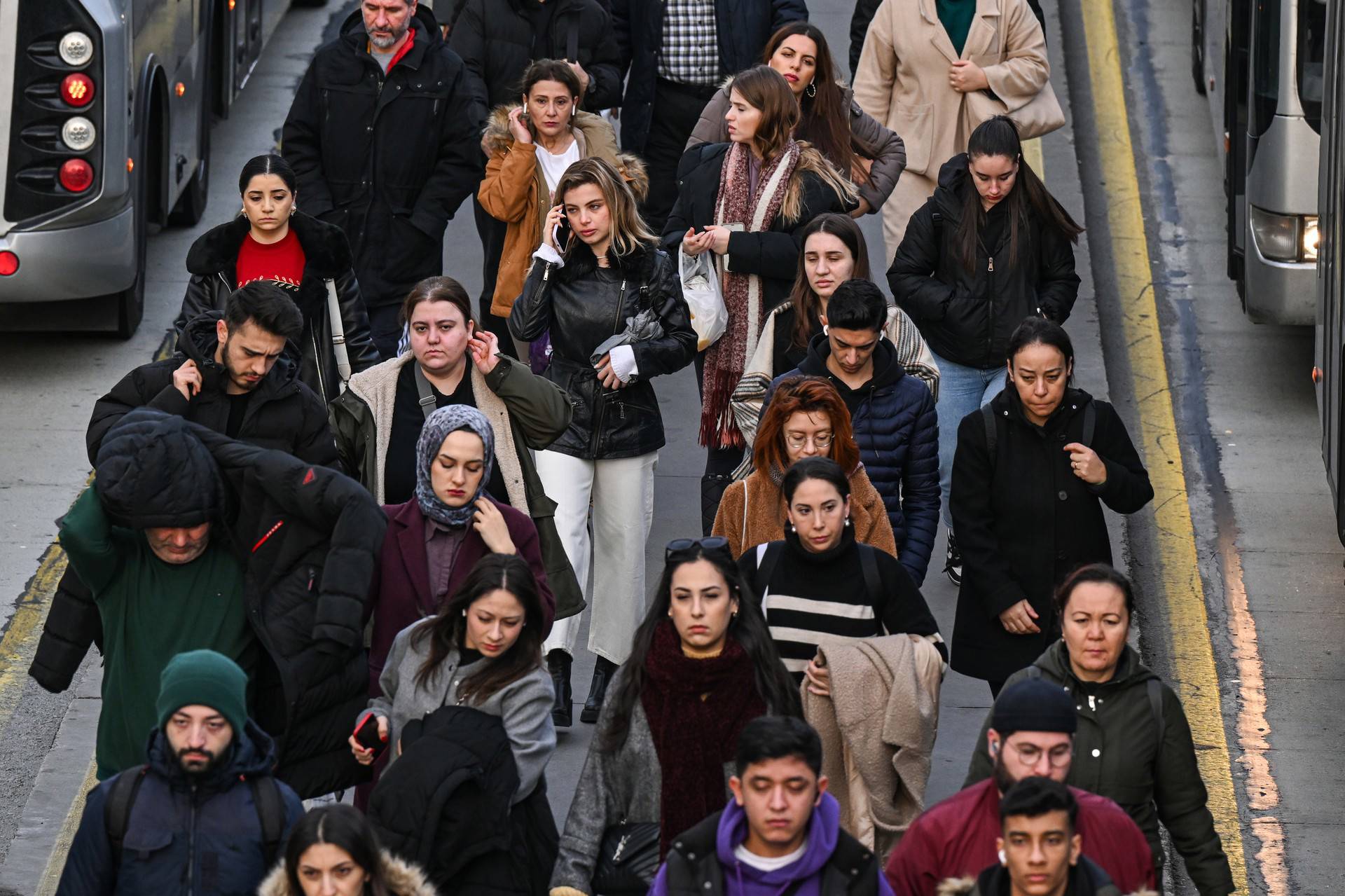










President Recep Tayyip Erdoğan earlier this month announced several steps aimed at increasing the participation of young people not in education, employment, or training (NEET) in the workforce.
With a program titled “Youth Production Era”, businesses will be required to hire interns. The project, which claims it will bring more than 3 million young people into employment within three years, has been allocated a budget of 445 billion liras (~102 million US dollars).
Is the problem of NEET youth solely economic? How well do we understand these young people? And does the announced employment package on its own offer a solution? We discussed the answers to these questions with Dr. Halil İbrahim Kılıç, senior analyst at KONDA Research.
'Seven out of 10 NEET youths are women'
It is reported that the number of young people in Turkey who are not in education or employment, referred to as housebound youth, has reached around 5 million. So, what kind of structure does this group of millions have, and can they be considered homogeneous?
It is difficult to say they are homogeneous, but they do share some similar demographic characteristics. We first addressed young people not in education or employment—those currently described as NEET youth—at the end of 2022 in the KONDA Barometer. What caught our attention then was that the NEET youth collectively contained the profile of the average person in Turkey. In other words, NEET youth are closer to the overall Turkish average than the average for all youth. For example, while youth in general tend to define themselves as more modern in terms of lifestyle compared to the Turkish average, NEET youth resemble the general Turkish population more closely in this regard. Although the proportion of those with a modern lifestyle is still high among them, they are more conservative compared to the overall youth population. Their level of religiosity is also higher than the average youth and again aligns more with the Turkish average.
Turkey’s NEET rate more than twice OECD average, report reveals
They come from economically lower classes, the proportion of Kurds among them is higher than the national average, they use social media more than the general population but less than the general youth population. Their tendency not to follow the news or to avoid TV news is higher than the national average, while their tendency to follow mainstream media news is nearly parallel to the general population. Their political preferences and voter behavior also resemble the Turkish average.
Demographically, one striking feature of NEET youth is that a quarter of them are Kurdish. When Zazas and Arabs are included, the rate exceeds 30 percent. Another important difference lies in the gender distribution. While the NEET rate among young men does not exceed 15 percent, it is close to 40 percent among young women. Seven out of every 10 NEET youths are women, while three are men. In this respect, Turkey differs significantly from EU countries. Turkey currently has the highest NEET youth rate in Europe, but in nearby Italy, for example, there is no such gender-based disparity. When we asked NEET youth about their working status, roughly half defined themselves as unemployed and the other half as housewives. That is, young women who have drifted away from both education and employment are approaching a point where they are almost giving up on the possibility of participating in the workforce.
Economic security and social capital
What do studies reveal about the trajectory of housebound youth in Turkey? Did this group not exist in the past and did we just recently discover them? And how aware are we of their expectations?
In fact, such a group has always existed. The rate has also always been high. In our 2008 Lifestyle study, we saw that the proportion of NEET youth was around 22 percent. Today this rate is around 25 percent. Before discussing their expectations, we can talk about our observations on their current situation. The most fundamental purpose of developing the definition of young people not in education or employment, which emerged in the 1980s, was to distinguish it from “classic unemployment” and “youth unemployment,” and to highlight that by being excluded from both education and employment, young people were at risk of being unable to develop their social capital. Today, above all, we consider NEET youth solely in terms of their non-participation in the labor force. But the main issue is that they are completely disconnected from opportunities that would allow them to build social capital and lose the chance to interact with the broader youth population.
NEET rate among people with higher education in Turkey exceeds 41 percent
NEET youth, due to their detachment from education and the labor market, largely live in a dependent relationship with their families and households. For this reason, although their primary expectation is the provision of economic security, what they actually need is to build social capital. Until recently, practices that could be seen as gaining social capital, from eating and drinking outside to traveling, have rapidly declined for all youth, and this has also confined NEET youth to their households, turning their condition into a crisis of isolation from social life.
Social support mechanisms
Based on your findings, could the 445 billion lira project, which claims to bring more than 3 million young people into employment within three years, be a method to employ housebound youth?
The NEET youth profile we are looking at is not only in an economic void but also trapped in a deep state of “housebound” stagnation, where they have lost interaction with the rest of society and the courage to participate in life. If the government’s announced program merely aims to improve statistics by creating temporary employment, it may not be a real solution to the chronic social disconnection of these young people.

Turkey's NEET rate drops as youth labor force participation increases
For the project to become a method of solution, it must establish nurseries or social support mechanisms that will bring women who have emotionally and structurally withdrawn from the workforce out of their homes. It must also offer young people not only a salary, but a social network that will help them regain their lost self-confidence and social environment.
Otherwise, for these young people—so similar to the Turkish average yet so distant from the public sphere—such projects may end up being an expensive band-aid that merely postpones unemployment by a few years, rather than initiating structural transformation.
'Lost energy isolated from social life'
What parameters need to be worked on to ensure that steps taken to include housebound youth in employment are sustainable? Ultimately, what kind of vision do the data suggest we should adopt on this issue?
The NEET problem is not just an economic crisis or an unemployment issue but a social disconnection. These young people should not be viewed merely as unemployed, but as lost energy isolated from social life.
Our vision should not be about managing statistics that improve numbers, but about a social integration strategy that brings young people out of their homes and includes them in public life and production. Among NEET youth, there are those who define themselves as housewives and those who have already married and moved on to another stage of life.
Rather than standard employment packages, we need steps that will liberate young people from dependence on their households and turn them into independent individuals. (NÖ/VK)