







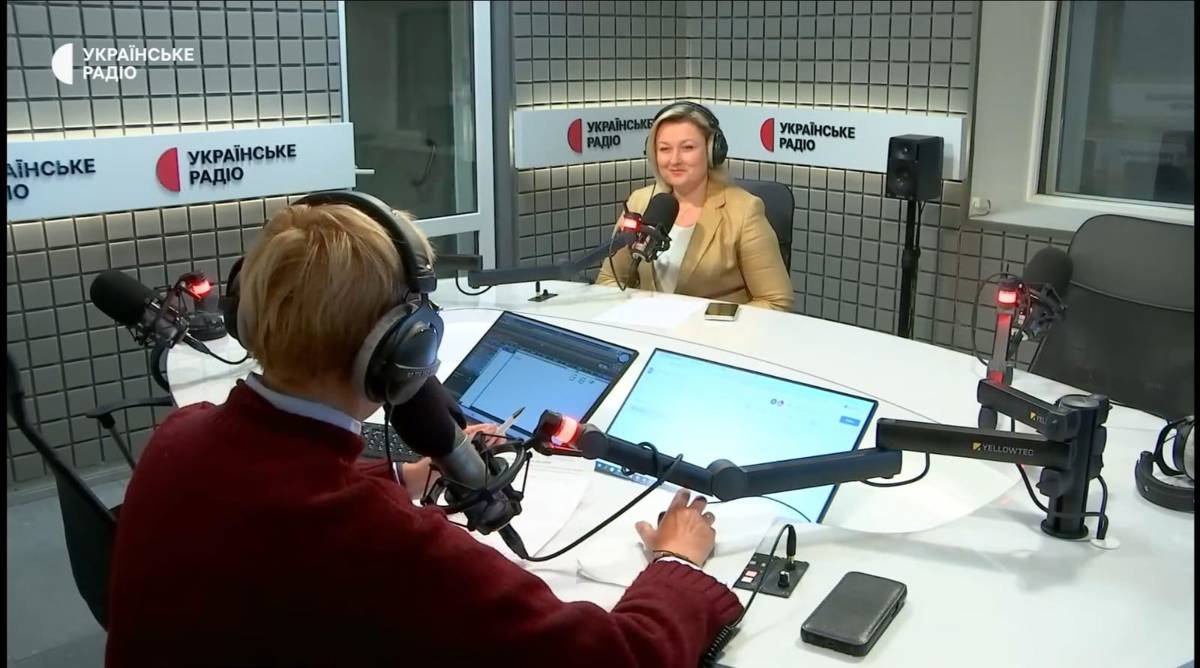



As Russia's full-scale invasion of Ukraine enters its third year, the role of journalism in wartime has become not just vital, but life-saving. In an interview with bianet.org Yuliya Sheludko, executive producer at Ukrainian Radio, the third oldest broadcaster in the world had written her responses from her phone, due to another power outage caused by drone attacks in the Kyiv suburbs.
"In times of war, people seek truthful information from reliable sources. As journalists, it is our responsibility to provide that," said Sheludko. "Public Broadcasting, to which Ukrainian Radio belongs, strictly adheres to journalistic standards and ethical codes. That is especially critical now."
Sheludko emphasized that propaganda and disinformation are powerful tools in modern warfare. Ukrainian Radio plays a vital role in combating these tactics.
'Weapons of the enemy'
"Disinformation and propaganda are also weapons of the enemy. Our mission is not only to stop the spread of fake news, but also to teach our audience how to think critically," Yulia said.
Despite the risks, Ukrainian Radio continues to broadcast even into Russian-occupied territories.
"People in those areas still manage to tune in, even though it’s dangerous. Listening gives them access to reliable news and helps them feel connected to Ukraine," she added.
Obtaining news from occupied areas has grown increasingly difficult.
"Russians inspect phones and gadgets to see if people are communicating with anyone in government-controlled areas. It's extremely dangerous for them to share any information. But firsthand accounts are essential, so we keep finding ways to maintain those connections," Sheludko explained.
When asked what keeps her going, Sheludko credited her family and colleagues.
'Always there for one another'
"I draw strength from the support of my family, and from my incredible team. My colleagues are always there for one another."
Some of the most difficult moments came during the initial days of the invasion.
"Our journalists from across Ukraine were evacuating their families while simultaneously going live on air, reporting on what was happening around them. It was deeply moving," she recalled.

'Green Corridor' information
During that time, Ukrainian Radio broadcast evacuation updates and "green corridor" informatio, safe passages through which civilians could flee.
"We received letters and calls later from people who told us they had no power, no internet, but they found old radios and tuned in to us. Thanks to that information, they were able to evacuate and save themselves and their families."
Terrifying personal story
Sheludko also shared a terrifying personal story about a journalist working in occupied Kherson.
"We had agreed she would report on a rally taking place in the city. Hours later, I heard Russian soldiers had opened fire on the crowd. I lost contact with her. I feared the worst."
"Thankfully, she called me hours later. She had hidden in a basement until it was safe. Her phone had been out of range. A few months later, she and her family managed to escape."
They moved the broadcasting
Sheludko also recalled the difficult decisions made in the earliest days of the full-scale invasion, and the extraordinary dedication of her colleagues.
"At the beginning of the full-scale invasion, we moved the broadcasting of Ukrainian Radio from Kyiv to another city. Thankfully, the management had a contingency plan that allowed us to continue broadcasting without interruption," she said.
She highlighted the efforts of Dmytro Khorkin, a member of the board of the Public Broadcasting Company, responsible for both radio and television.
"Dmytro did not sleep for many nights. He personally went on air for hours at a time. At the same time, his family was under occupation, and their lives were in danger. Yet he kept working. For me, this is a powerful example of resilience and dedication to the profession."
NOTE: According to a report published in February 2025 by Reporters Without Borders (RSF), since Russia launched a full-scale invasion of Ukraine on February 24, 2022, approximately 150 journalists have been victims of Russian abuses while performing their duties. Russian forces have killed 13 journalists, at least 47 journalists have been injured, 18 journalists have been arbitrarily detained by Russia, and one remains missing.
ABOUT UKRAINIAN RADIO
Ukrainian Radio (Ukrainske Radio) has been Ukraine's publicly funded radio broadcaster since 1924. Since 2017, the general producer of Ukrainian Radio channels has been Dmytro Khorkin.
Radio broadcasting in Ukraine (then part of the USSR) began on November 16, 1924, in Kharkiv, and a national radio network was established in 1928. (In the early years of the USSR, Kharkiv served as Ukraine's capital from December 1919 to January 1934.) Subsequently, the capital and Ukrainian Radio’s headquarters were relocated to Kyiv.
During World War II, Ukrainian Radio never ceased broadcasting. It was first moved to Kharkiv, then to Stalingrad, and later to Saratov, from where regular Ukrainian-language broadcasts were maintained.
During the Soviet era, broadcasts were managed by the Ukrainian SSR Television and Radio Broadcasting Committee. In the early 1990s, this committee was transformed into the Ukrainian State Broadcasting Company. In 1995, the Ukrainian National Radio Company was established as an independent state entity, separate from this structure.
After the Russian invasion, Radio's studios were relocated from Kyiv to an undisclosed location for security reasons.