





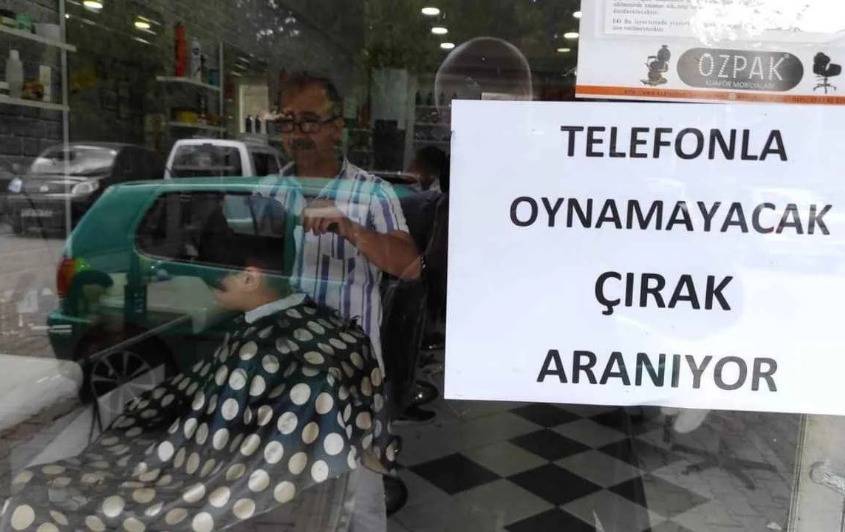


The name of the student interviewed for this has been changed to protect their privacy.
Vocational Education Centers (MESEM), which the Education Ministry describes as a system rooted in the Ahilik tradition of master-apprentice training, are intended to help young people learn a trade on the job. In practice, however, they are contributing to the spread of child labor. There are currently 553,728 students in the system, while 31,747 have suffered workplace accidents, according to the ministry’s responses to parliamentary questions. Questions remain over the frequency and effectiveness of workplace inspections, while unpaid wages have also raised another issue: Has the government ended its financial support for MESEMs?
One of the students caught up in this system is 16-year-old Metin Yıldız. Yıldız, who has been working at a barbershop in Gebze for two years through MESEM, says that instead of learning the trade, he mostly does cleaning and service work. He has not been paid for two months, was slapped for forgetting to serve tea to a customer, and says only one teacher from his school has visited his workplace during his two years there.
Metin Yıldız and Deniz Çayan, speaking on behalf of the Student Union’s MESEM Assemblies, spoke to bianet about MESEM students’ working conditions, wage problems and the lack of oversight.
Work that never ends
Yıldız, 16, starts work at 9 am five days a week. He spends most of his day cleaning and serving customers:
“I open the shop. I sweep the floors, mop them and make the tea. Then the master comes in, the apprentices arrive, and I clean the windows.”
He says that when he asks to practice cutting hair at the barbershop, where he started working to learn the trade, his boss does not allow him to.
He usually leaves work at around 10-10.30 pm. By the time he gets home, it is 11 pm, sometimes 11.30 pm. He says he enjoys playing computer games, watching videos and going out with friends, but most days he has no energy left when he gets home:
“When I get home, I’m really tired, so I go straight to bed. But normally I like playing computer games and things like that. I like spending time on social media.”
Yıldız says he can also be required to work on Saturdays. There have been times when he was unable to take time off because the shop was busy, and the leave he missed was not granted later.
He has also not received his wages for the past two months, September and October. Yıldız says he previously earned 8,000-9,000 liras a month, but no explanation has been given for why he has not been paid. He says he has heard similar complaints from other MESEM students in his class:
“I think this system needs to change. Because as long as it stays like this, everyone is unhappy with it. My friend, for example, is also complaining about this. You haven’t been paid for two months, so you can’t do anything. And at the shop my hands are tied anyway, they don’t let me do anything.”
Asked whether there is anyone at school he can talk to about what he has experienced, his answer is brief:
“No. The teachers don’t listen anyway.”
15-year-old vocational student allegedly abused for nine months during internship
‘I forgot to serve the customer tea and he slapped me’
Not being paid is not the only problem Yıldız has faced at work.
Yıldız says he is treated “very harshly” at the workplace and describes one incident:
“They treat you very harshly there. For example, a customer came in and I didn’t serve him tea. I forgot. He came over and hit me, slapped me. They get very angry there, they’re very harsh. And they don’t let me do anything either, it’s like my hands are tied.”
Yıldız has been at the same workplace for two years. During that time, he says, a teacher from his school has visited the shop only once. The teacher spoke to his employer, not to him:
“He talked to the boss. He probably asked whether I was working, how I was doing and things like that.”
Yıldız, who goes to the workplace five days a week, says no one asks why he is absent when he does not go to school:
“They never ask. They tell us to go to the shop.”

Survey: One in two vocational students suffer injuries while working
‘They don’t get paid unless the boss pays them’
Deniz Çayan, speaking on behalf of the MESEM Assemblies, says Yıldız’s experience is not an isolated case. They have received widespread complaints about unpaid wages, particularly from students working in barbershops:
“Right now, it varies across different sectors, from factory to factory and workplace to workplace. It’s basically a situation where half are getting paid and half aren’t. But none of the barbershop students are getting paid at the moment. They don’t get paid unless the boss pays them.”
Çayan says delayed and incomplete payments had also been a problem before, and that wage issues have become more serious alongside problems involving leave and working conditions:
“Even before this, there were many friends who weren’t getting paid. Some were paid less than they should have been, or were paid a month late. If this continues, these students will end up unable to take any time off either. We had been imagining a scenario where they would work seven days a week and still not get paid, and slowly, that’s where things are heading.”
According to Çayan, the problem lies less with vocational education itself than with the conditions under which it is provided:
“MESEM should not be shut down, but it needs to be an environment where students do not suffer workplace accidents, do not die in workplace accidents, receive their wages regularly and actually learn a trade. Vocational education is necessary. But the conditions under which it is provided matter.”
Vocational Education Centers: The reproduction of class inequality through education
‘They learn nothing about barbering’
Çayan says students in the barbering program often fail to learn the trade despite spending long hours at the workplace:
“These students get up in the morning, open the shop, clean the floors, and learn nothing about barbering. It really is exactly as Metin says, they don’t learn anything there.”
He says students are mostly assigned to washing hair, cleaning and other menial tasks:
“If the master is a good person, and I say ‘if’ because that matters, he’ll say, ‘Come and watch, see how I cut hair and observe what I’m doing.’ Otherwise, they’re either washing hair or doing other odd jobs. That’s basically what the students in the barbering program do.”
Çayan says students’ opportunities to gain practical experience often depend entirely on their employer’s attitude.
‘Bro, we go through this every day anyway’
Another issue Çayan highlights is how workplace accidents and dangerous working conditions are becoming increasingly normalized among students.
He recalls a conversation he had while working with MESEM students:
“I ask, ‘Have you ever had a workplace accident?’ They ask me, ‘What counts as a workplace accident?’ I give examples: ‘Maybe your arm was bleeding, maybe something happened to you, maybe you broke your arm.’ Then I get this answer: ‘Bro, we go through this every day anyway.’”
Çayan says that when students are not adequately informed about their rights and workplace safety, they can start to see these risks as “a natural part of the job”:
“These kinds of things start to feel normal to the children. Because they aren’t given any training, they accept it as normal. They think, ‘I guess this is how it’s supposed to be. I guess having a workplace accident is normal too.’”
Wages are part of the family budget
According to Çayan, economic conditions also play a major role in pushing students toward MESEM. Some contribute directly to their household budget with the wages they earn:
“I know a child who helps pay the rent with a MESEM wage. I also know students in Gaziantep whose MESEM wages go directly toward paying the rent.”
He says some families see having their children work as an economic alternative to keeping them in school:
“Their grades are bad. If this child isn’t going to continue studying anyway, they think, ‘At least let them go to MESEM and bring some money home.’”
Çayan says students need not only an income, but also support from adults who can help them make sense of the problems they face at work:
“These children are really looking for an adult. They’re looking for an older brother or an older sister. The children are already unhappy with this situation.”
For this reason, the MESEM Assemblies work with students around their rights to wages, leave, workplace safety and vocational training. Çayan says that as students learn more about their rights, they are less likely to see what they experience as “just part of the job” and become better able to articulate the problems they face. (NÖ/VK)

