







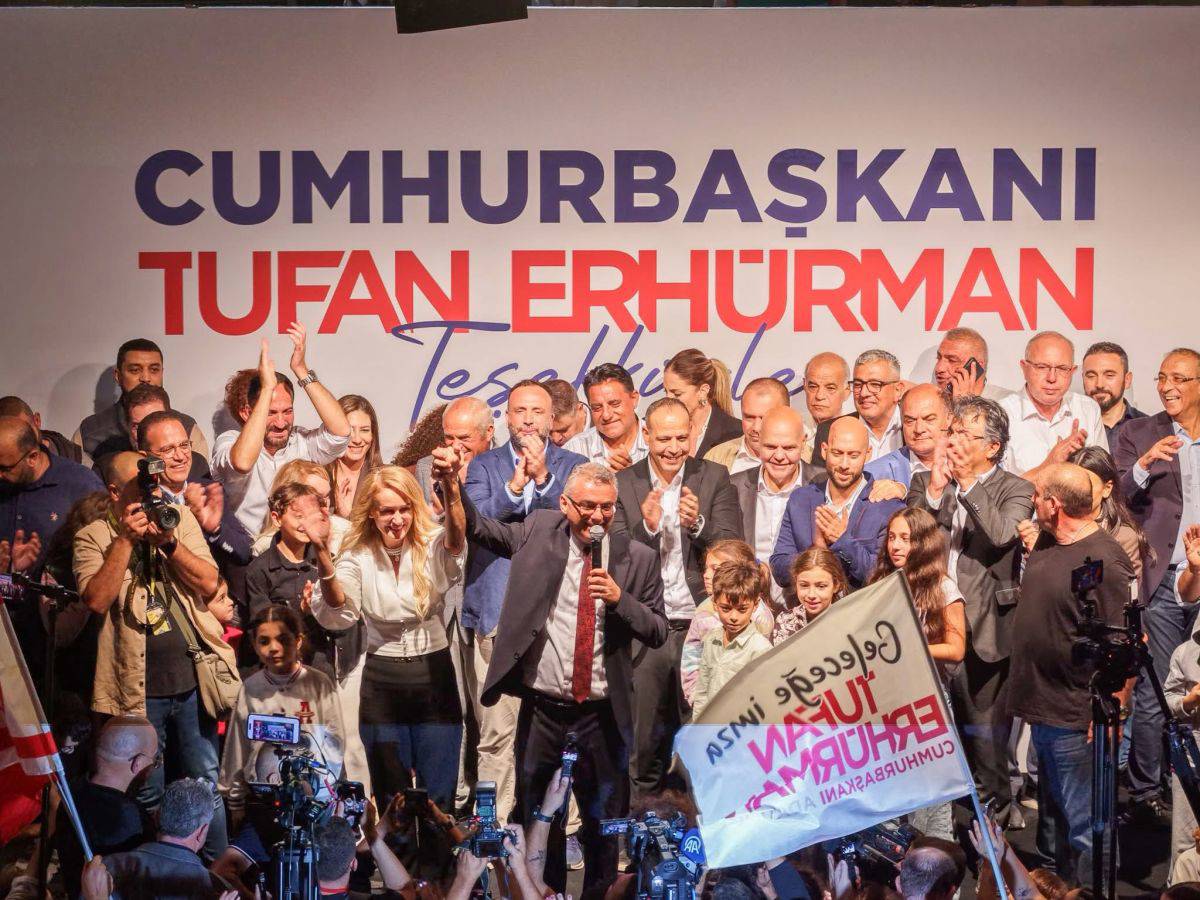



In the presidential election held in Northern Cyprus yesterday, unofficial results show that Republican Turkish Party (CTP) Chair Tufan Erhürman won with 62.76% of the vote. Incumbent President and independent candidate Ersin Tatar, despite receiving full backing from Turkey, secured only 35.81%.
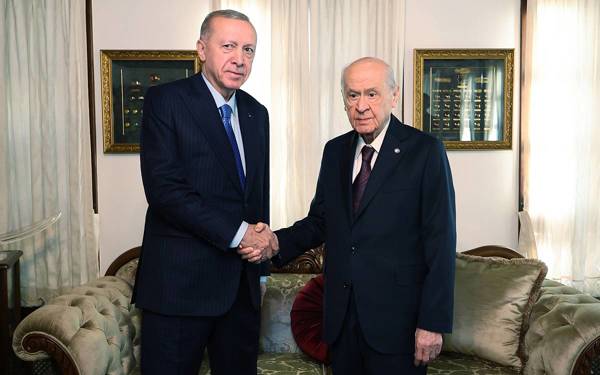
While President Recep Tayyip Erdoğan and main opposition Republican People’s Party (CHP) leader Özgür Özel congratulated Erhürman, Nationalist Movement Party (MHP) Chair Devlet Bahçeli, Erdoğan's main ally, said, “The TRNC parliament must convene immediately, reject the election results and the idea of returning to a federation, and declare its intention to join the Republic of Turkey.”
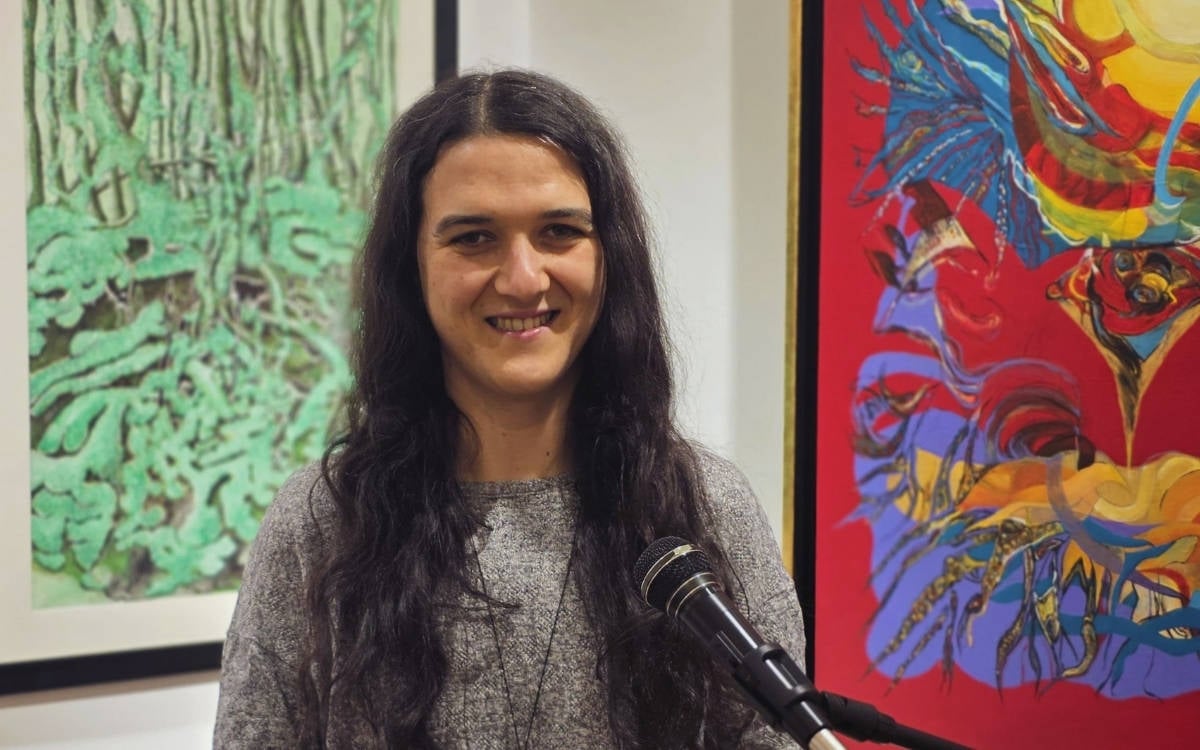
We spoke with academic and Cyprus Left Movement Foreign Affairs Secretary Dr. Abdullah Korkmazhan about the election results in Northern Cyprus and their significance in global politics.
Ersin Tatar’s defeat
How do you evaluate Tufan Erhürman’s victory? Why did Ersin Tatar, despite all of Turkey’s support, fail to win?
Tufan Erhürman ran as the CTP candidate and received support from around 60-65% of the broader opposition. Some voters who didn’t necessarily align with his politics also cast their ballots for him, simply because they wanted Tatar to lose. A key factor in Erhürman’s success was his ability to unite various opposition segments, including those with differing views, many of whom supported him as the “lesser of two evils.”
On the other hand, Tatar had been appointed as a trustee [to Northern Cyprus] five years ago, and his confrontational, arrogant, and controversial behavior during his term drew criticism even within his own party, the National Unity Party (UBP). Given all these factors, public opinion polls and field observations had already predicted that Erhürman would win with around 60% of the vote. There was also a general expectation that Turkey’s ruling bloc would not interfere. Although the AKP and MHP did not openly back Tatar during the campaign, they conveyed political messages indirectly. The “two-state solution” policy, based on two separate states on the island, featured prominently in their rhetoric. Tatar’s campaign also opposed a federal Cyprus and endorsed the two-state model, but this was ineffective in the face of the with the vast majority of Turkish Cypriots' preference of a federal solution.
Compared to the 2020 elections, when Mustafa Akıncı, Erhürman, and Tatar were all in the race, the level of Turkish interference was different. Still, it’s important not to equate Erhürman with Mustafa Akıncı.
Why not?
Mustafa Akıncı adopted a clear ideological and political stance against Turkey’s ruling power. He supported a federal solution to the Cyprus issue and opposed the AKP’s imposition of Islamist policies on Turkish Cypriots. As a result, during the 2020 elections, he faced threats from paramilitary groups, received death threats, and was labeled a “traitor” by both the AKP and MHP. Back then, armed groups reportedly went door to door across villages, pressuring voters in a highly intrusive campaign. Erhürman’s situation was different. The AKP and MHP anticipated that even if he won, it would not pose a major issue. That’s because Erhürman operates within a more conciliatory, non-confrontational political line that maintains dialogue and cooperation with Turkey.
In fact, when it comes to the social opposition’s struggle against religious impositions, Erhürman often took a more evasive stance. During the campaign, he never explicitly mentioned “federation.” Therefore, his approach should not be conflated with Akıncı’s ideological and political resistance. The political strategy here was to avoid antagonizing Turkey’s ruling bloc and to quietly gain its indirect support. However, the majority of those who voted for Erhürman were actually the same voters who had supported Akıncı, in other words, those who were uncomfortable with Turkey’s policies.
Turkey’s role
Was Turkey unable to interfere in this election?
From my own observations, especially after the [Sep 25] Trump-Erdoğan meeting in the US, the level of Turkish interference noticeably declined over the past three weeks. Just as Turkey softened its hardline stance in Syria following that meeting, taking a different view of agreements between the Syrian Democratic Forces (SDF) and the regime, it’s possible that post-Gaza peace efforts and expectations about Israel also influenced its Cyprus policy. During this period, Turkey’s ruling bloc appears to have backed away from its usual interventionist approach and let events take their course. As a result, they did not prevent Erhürman’s victory.
Of course, they could have blocked it if they wanted but that’s a debatable issue. There was already intense public opposition to Ersin Tatar, and it was clear he was widely unwelcome. But if the same level of intervention as in 2020 had occurred, similar to how the Turkish government acts in its own elections or appoints trustees, could something similar have happened here? Yes, it could have. After all, Northern Cyprus is effectively controlled by those in power in Turkey—by its government and state institutions. Claims that Turkish Cypriots govern themselves and enjoy democracy here are nothing more than illusions.
'Was the MHP left alone with Ersin Tatar?'
How do you interpret Nationalist Movement Party leader Devlet Bahçeli’s reaction to the election results?
From Bahçeli’s statements, I see a clear expression of intense anger. The visiting delegations were largely made up of MHP figures, people like Süleyman Soylu, Binali Yıldırım, and Ümit Özdağ, chair of the Victory Party, who regularly visited [Tatar] during the campaign. Bahçeli’s remarks seem to reflect a sense of panic and fury in response to an unexpected outcome. In contrast, statements from Erdoğan and Vice President Cevdet Yılmaz on behalf of the presidency emphasized congratulations to Erhürman, respect for the democratic will, and a commitment to aligning with the stance of the Cypriot people.
Looking at this picture, it’s hard not to wonder whether there was a kind of behind-the-scenes game between Erdoğan and the MHP. Could there have been a hidden balance or strategy within the ruling alliance when it comes to the Cyprus issue? Was Erhürman quietly allowed to win while the MHP was left alone to support Ersin Tatar on the ground? It’s a question worth asking, especially since, unlike in 2020, we didn’t see the AKP engaging in direct intervention on the ground—no house-to-house campaigning, no intelligence agents or MPs mobilized.
So, once it became clear that Erhürman was going to win, it seems the process was left to run its course. At this point, what I can say more generally is that a new round of negotiations on Cyprus is likely to begin. For the past five years, there have been no talks and no confidence-building steps. Ersin Tatar and his circle pursued an entirely hostile political line. In contrast, those supporting Erhürman and the CTP favor a bicommunal, federal, and unified Cyprus. That policy is likely to be revived, and the negotiation process will resume.
'Cyprus was used as a launchpad in wars'
How are the results being received by the Greek Cypriot side and Greece? In your view, what level of influence did the US and Israel have on the elections?
Developments in the Middle East, efforts to reshape the region, the rollback of Iran, and the genocide being committed against the people of Palestine and Gaza, all while Israel strengthens its role in the region in line with US interests, are directly impacting Cyprus. In this context, tensions between Turkey and Israel are also coming to the forefront, shifting from an Iran-Israel axis to a Turkey-Israel axis. Eastern Mediterranean and Cyprus politics are deeply influenced by these dynamics.
Greek Cypriot leader Nikos Anastasiadis has openly aligned himself with Israel, and Greece is taking a similar stance. Setting aside the roles of the UK and US, it’s worth noting that British bases have played a critical role in recent operations in the region. Dozens of warplanes have launched from Cyprus’s British bases for strikes on Gaza, Syria, and Iran, providing Israel with logistical and military support. In this context, Cyprus has served as a springboard for regional warfare.
Most recently, Israel deployed air defense systems to the Greek Cypriot side of the island. In response, Turkey has reinforced its military presence in Northern Cyprus. According to information we’ve received, though not officially confirmed, Turkey has sent around 10,000 to 15,000 troops to the area. Geçitkale Airport is now reportedly being used for drone operations. Turkish Armed Forces-controlled drones are closely monitoring the Eastern Mediterranean and Israel. Tensions between Israel and Turkey have long spilled over into Cyprus. However, as I mentioned earlier, the Trump-Erdoğan meeting has created a relatively softened atmosphere.
This raises important questions: Will the Eastern Mediterranean tensions give way to negotiations and diplomacy? Will Erhürman’s victory mark the beginning of renewed negotiations on the Cyprus issue? Because in the absence of a negotiation framework, Cyprus inevitably becomes a site of tension and potential conflict.
Turkey is the only country that recognizes the Turkish Republic of Northern Cyprus (TRNC), which unilaterally declared independence in 1983. Approximately 35,000 Turkish troops are stationed in the north.
Lawlessness on the island
How might Erhürman’s election affect this process?
The power struggle between Israel and Turkey is also reflected in Cyprus. Even if Turkey and Israel will never engage in open military conflict, it is clear that both seek to control zones of influence and assert dominance in the region. This geopolitical rivalry is manifesting on the island.
If Turkey’s ruling power insists on a two-state solution, negotiations on Cyprus will not begin. Erhürman’s next steps remain uncertain in this regard. Neither the United Nations (UN) nor the Greek Cypriot side is willing to negotiate based on a two-state model. UN Security Council resolutions are clear and they envision a federal Cyprus. Also negotiations are being conducted within that framework. Hopefully, Erhürman can fulfill the difficult task ahead. Because only if negotiations resume can Cyprus enter a peaceful new phase.
Beyond this high-stakes agenda, can the CTP also tackle ongoing issues like allegations of money laundering, criminal networks, and financial transparency that keep placing the island in the spotlight?
Due to Northern Cyprus’s unique legal and political status, oversight and transparency are seriously lacking. This makes the island an attractive hub for illegal financial transactions, virtually a base. There are serious concerns about illegal gambling, money laundering, and other unlawful economic activities. Cases like the murder of Halil Falyalı and revelations from figures like Sedat Peker have drawn intense scrutiny. Tackling these problems requires strong political will, legislative reform, international cooperation, and transparent oversight. Without these, a change in government alone will not eliminate financial misconduct.
Given the strong influence of the Turkish government, a permanent solution for Cyprus is needed to dismantle these structures completely. A federal Cyprus, operating under international law, would significantly reduce money laundering and similar crimes. Currently, the island has become a center for human trafficking, arms and drug smuggling, and money laundering. People here have lived in fear for a long time. Even while driving, you could be killed. And these aren’t just local problems, they’re criminal networks imported from Turkey. So Erhürman faces a daunting path ahead. But if we manage to organize social opposition, persistently and firmly push our demands, and insist on transparency, oversight, and legal reform, I believe these problems can be solved. (TY/VK)