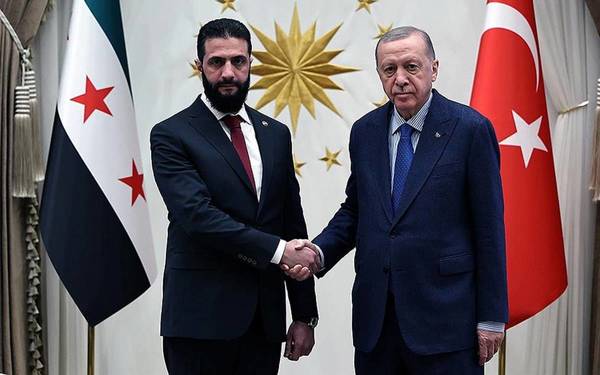

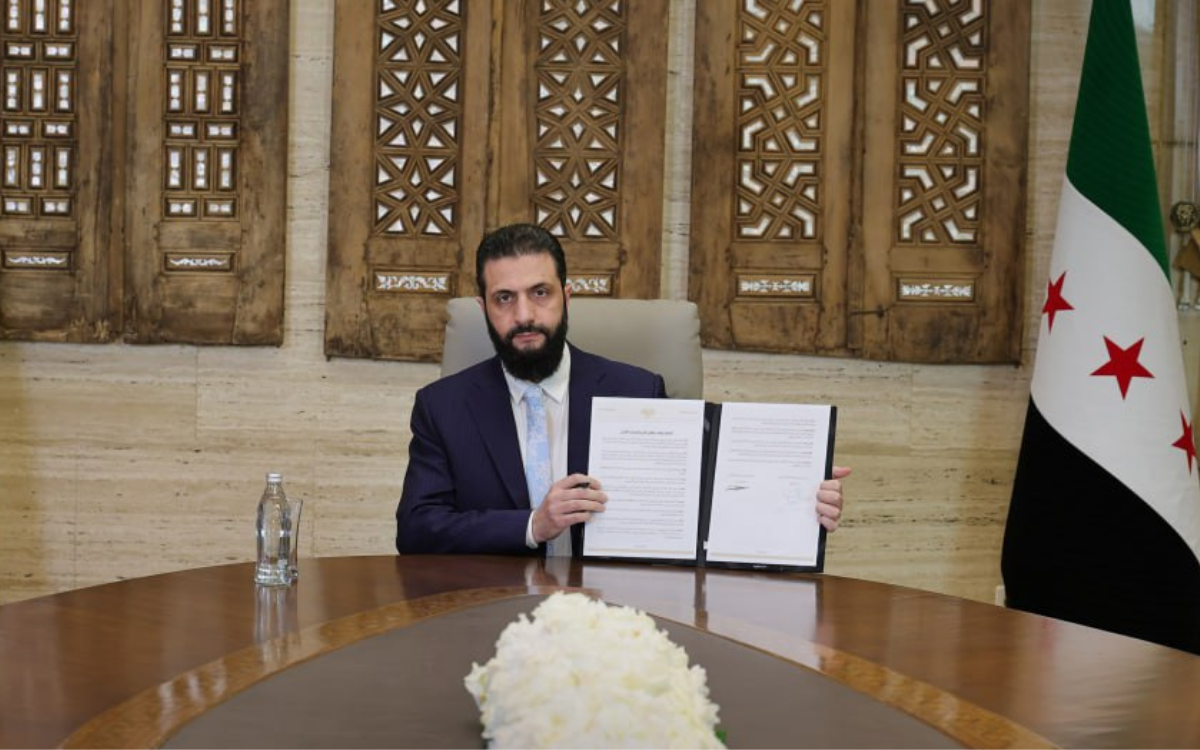


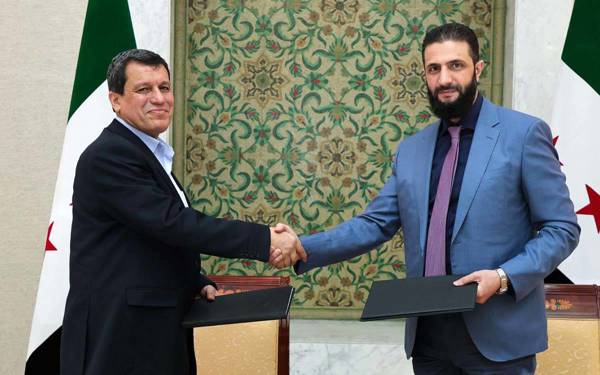
The Foreign Ministry expressed support for the integration agreement signed between the Damascus administration and the Kurdish-led Syrian Democratic Forces (SDF).
In a written statement released today, the ministry said it hopes the deal will "promptly and effectively advance efforts to establish stability and security in the country on the basis of Syria’s territorial integrity and unity.
"We hope that all groups and individuals in the country have fully understood, with the realization of the facts on the ground, that the future of Syria lies not in terrorism and discord, but in togetherness, unification, and integration.
"Turkey will continue to support the Syrian government’s counterterrorism efforts and reconstruction work, provided they are carried out with an inclusive and integrative approach based on public consent."
Details of agreement
The 14-point agreement followed recent advancements by the Syrian army into the Arab-majority provinces of Raqqa and Deir ez-Zor, which were previously under SDF control. Arab tribes in the region reportedly shifted their allegiance to the Damascus administration, prompting the SDF to withdraw. The handover places Syria's significant oil and gas resources back under the control of the central government.
Under the terms of the deal, the SDF will withdraw from Raqqa and Deir ez-Zor, and its members will be integrated into the Syrian army on an individual basis. While border crossings and energy fields will be transferred to Damascus, a "special status" will be established for the Kurdish-majority regions of Kobanî and Hasakah.
Interview: AKP’s Mehmet Metiner rejects war rhetoric, says ‘neither Kurds nor Syria should lose’
The move follows a previous integration attempt in March that failed to materialize. Recent steps by Syria’s interim president, Ahmed al-Sharaa, issued a decree on Jan 16 that recognized Kurdish as a national language, granted the right to education in the mother tongue, and declared Newroz an official holiday. The decree also restores citizenship to Kurds who were stripped of their identity by the previous Baath regime.
Formed in 2015 as an umbrella group led by the Kurdish People's Defense Units (YPG) and local Arab tribes with US support, the SDF had controlled roughly one-quarter of Syrian territory.
Abdi: The struggle will go on
SDF commander Mazloum Abdi said in a video message aired on Ronahi TV that they decided to withdraw from Raqqa and Deir ez-Zor to protect civilian lives in the face of multiple actors targeting the SDF.
He emphasized their commitment to defending what he described as the achievements of their people and maintaining the region’s special status, saying, “We have our forces, and we will continue our efforts. The struggle will go on with confidence in success,” he said.
Abdi added that they would pursue all available means to protect the gains of their "revolution" and the status of their regions. Further details would be shared with the public following tomorrow’s talks with Sharaa, he said.
Peace process in Turkey
The integration process in Syria is closely monitored in Turkey, where a Kurdish peace initiative was launched in Oct 2024. Ankara maintained that the call for disarmament made in February by the imprisoned leader of the Kurdistan Workers' Party (PKK), Abdullah Öcalan, also applies to the SDF. Turkey considers the SDF to be the Syrian wing of the PKK.
While the SDF had previously argued that Öcalan’s message did not concern them, today's deal marks a shift in the group's stance on disarmament and integration.
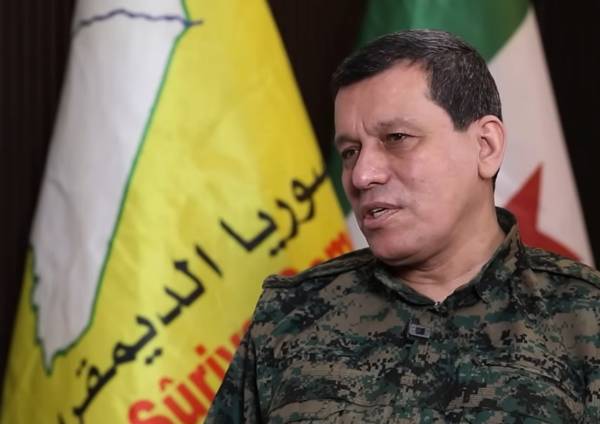
SDF commander says wants to visit Öcalan to support Turkey's peace process
Support from US
Tom Barrack, the US ambassador to Turkey and the US president's special envoy for Syria, also welcomed the agreement, saying that Washington commends the deal which "paves the way for renewed dialogue and cooperation toward a unified Syria."
"Two great Syrian leaders, driven by the shared vision of liberating their country and people from tyranny, have now come together to forge a brighter future for all Syrians. This agreement and ceasefire represent a pivotal inflection point, where former adversaries embrace partnership over division," he wrote.
In the middle of a big shakeout
"President al-Sharaa has affirmed that the Kurds are an integral part of Syria, and the United States looks forward to the seamless integration of our historic partner in the fight against ISIS with the Global Coalition’s newest member, as we press forward in the enduring battle against terrorism."
"An immediate and comprehensive ceasefire across all fronts and contact lines between the Syrian Government forces and the Syrian Democratic Forces (SDF) along the withdrawal of all SDF military formations to the east of the Euphrates River as a preliminary step for redeployment."
Full text of the agreement
- The full and immediate administrative and military handover of Deir ez-Zor and Raqqa governorates to the Syrian Government. This includes the transfer of all civil institutions and facilities, with the immediate issuance of decrees to permanentize current employees within the specialized ministries of the Syrian state.
- Integrating all civilian institutions in al-Hasakah Governorate into the institutions of the Syrian state and its administrative structures.
- The Syrian Government shall take control of all border crossings, oil fields, and gas fields in the region, with protection secured by regular forces to ensure the return of resources to the Syrian state, while considering the special case of Kurdish areas.
- The full integration of all SDF military and security personnel into the structures of the Syrian Ministries of Defense and Interior on an “individual” basis following necessary security vetting, granting them military ranks, financial entitlements, and logistical requirements accordingly.
- The leadership of the Syrian Democratic Forces (SDF) commits to refraining from incorporating remnants of the former regime into its ranks, and to providing lists of officers from the former regime’s remnants present in areas of northeastern Syria.
- The issuance of a presidential decree appointing a nominee to assume the position of Governor of al-Hasakah, as a guarantee of political participation and local representation.
- The removal of heavy military presence from the city of Ain al-Arab (Kobani), the formation of a security force drawn from the city’s residents, and the retention of a local police force that is administratively affiliated with the Syrian Ministry of Interior.
- The integration of the administration responsible for the file of ISIS prisoners and camps, as well as the forces responsible for securing these facilities, with the Syrian government, so that the Syrian government assumes full legal and security responsibility for them.
- The adoption of a list of candidates submitted by the SDF leadership to hold high-ranking military, security, and civil positions within the central state structure to ensure national partnership.
- Welcoming Presidential Decree No. 13 of 2026, which provides for the recognition of Kurdish cultural and linguistic rights and for addressing outstanding rights-based and civil issues—including those of unregistered/ stateless person and accumulated property-rights claims from previous decades.
- The SDF commits to the removal of all non-Syrian Kurdistan Workers’ Party (PKK) leaders and members outside the borders of the Syrian Arab Republic to ensure sovereignty and regional stability.
- The Syrian state commits to continuing the fight against terrorism (ISIS) as an active member of the International Coalition, in coordination with the United States, to ensure the security and stability of the region.
- Working toward understandings concerning the safe and dignified return of the residents of the Afrin and Sheikh Maqsoud areas to their homes.
(VK)