












Turkey has issued a warning to both Russia and Ukraine following the downing of an unidentified drone that entered its airspace from the Black Sea on Dec 15, the National Defense Ministry has announced.
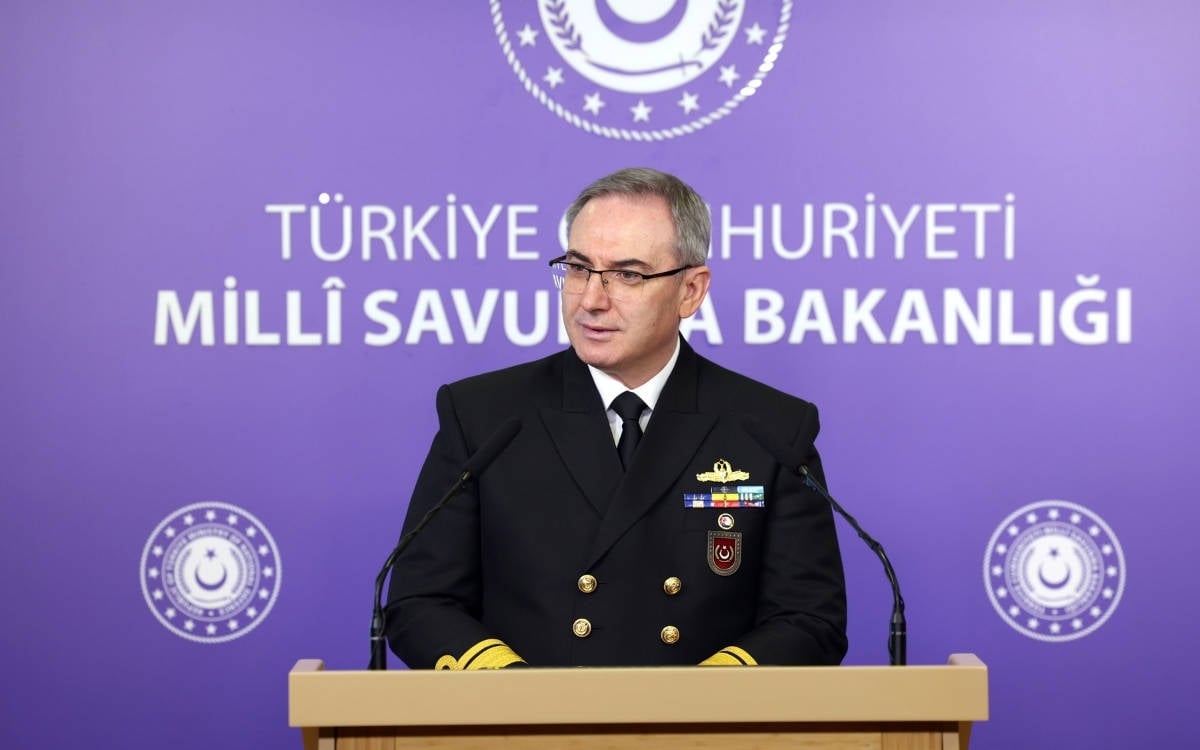
At a regular press briefing held today, Rear Admiral Zeki Aktürk, spokesperson for the ministry, provided details about the incident. “In response to the detection of a drone approaching from the direction of the Black Sea on Dec 15, a tracking and identification process was immediately launched by all relevant units,” he said.
The drone was difficult to identify due to its low radar signature and small size, said the read admiral. “The process was conducted using radar, electro-optical systems, electronic warfare, and early warning systems, with cross-verification of data from multiple sensors,” he explained.
Following these assessments, Turkish F-16 fighter jets tracked the drone, which was deemed to be out of control. It was brought down in a controlled manner at the most appropriate location to ensure public safety, Aktürk added.
'Managed successfully'
Aktürk did not disclose the exact location where the drone was downed. However, earlier reports indicated that it was brought down north of Ankara, the capital, and flights bound for the capital’s Esenboğa Airport were diverted to other airports during the incident.
In response to the public debate questioning the competence of Turkey's air defense systems, he rejected any vulnerabilities. “The incident was managed and concluded successfully. Our detection, identification, and response procedures are regularly reviewed and continuously improved."
Origin not determined
The origin of the drone has yet to be determined. Aktürk further noted that the drone disintegrated into small fragments upon impact, complicating the identification of debris.
Given the ongoing war between Russia and Ukraine, Aktürk said both parties had been cautioned about potential security risks in the Black Sea region. “We have urged both sides to exercise greater caution regarding such incidents,” he said.
'Asymmetric threats'
Meanwhile, retired Rear Admiral Yankı Bağcıoğlu, deputy chair of the main opposition Republican People’s Party (CHP) responsible for national defense policy, issued a written statement concerning the incident.
“In the coming period, unmanned systems will continue to pose asymmetric threats,” Bağcıoğlu said.
While he acknowledged the successful performance of existing defense systems in the drone incident, he stressed the need for continuous updates to defense strategies.
“The evolving and complex threat environment makes it essential to maintain a defense approach that is regularly updated," read the statement. "Strategic foresight, rapid decision-making, layered defense, and an integrated sensor-response architecture are vital for countering future threats that are likely to be more stealthy and complex."
He also emphasized that defense planning, force structuring, and investments in the defense industry should be guided by national security priorities and real threat analyses, rather than short-term political considerations. (TY/VK)

