
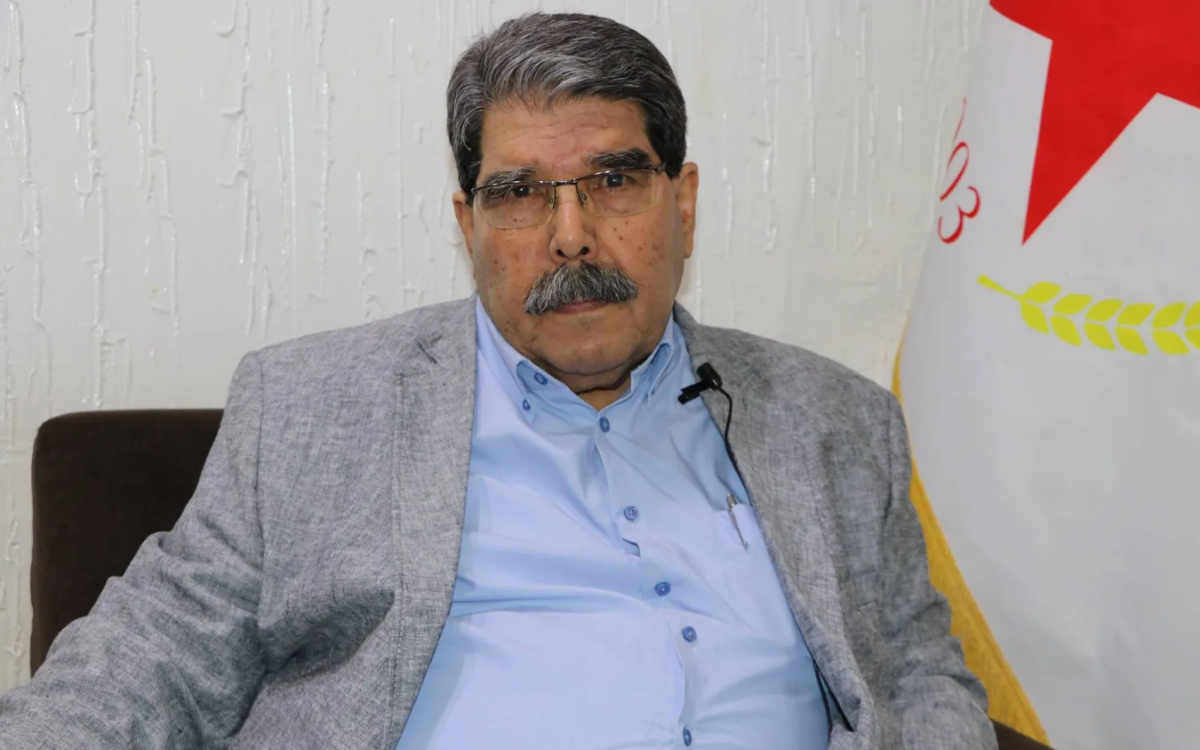



Salih Muslim, former co-chair and current member of the co-presidency council of the Democratic Union Party (PYD), the main Kurdish political movement in Syria, spoke to bianet recent developments in Syria and the ongoing peace process in Turkey.
Discussing the ongoing integration talks between the Kurdish-led Syrian Democratic Forces (SDF), which controls about 25 percent of Syrian territory, and the Turkey-backed Damascus government, Muslim reiterated the SDF’s position that a decentralized political system remains the most viable model for Syria.
Muslim noted that clashes erupted between Damascus and SDF forces after Turkey's foreign and defense ministers' recent visit to Syria, calling on Ankara to "use its influence on Damascus for a solution."
On Turkey's peace process, which Ankara views as directly related to the process in Syria due to the presumed ties between the SDF and the PKK, Muslim said while the Syrian Kurds support the process, the issues in Turkey and Syria should be handled separately. "The best thing Turkey could do in this regard would be to get its hands off from Syria," he said.
'Clashes erupted after visit to Syria'
What has changed in the region with the March 10 Agreement signed between Syrian Democratic Forces (SDF) General Commander Mazloum Abdi and Syria's Transitional President Ahmed al-Shara? How do you assess the recent visit from Turkey to Syria?
Turkey’s stance shifted immediately after the March 10 Agreement was signed. This agreement was made between the two parties under US supervision. Because Turkey was not part of the deal, it refused to accept it. It has done everything in its power to prevent such an agreement from taking place until now. From the beginning, it tried to sabotage it in line with its own policies.
Once it became clear that both parties were committed to the agreement, Turkey made some seemingly positive statements. However, as soon as the foreign and defense ministers visited Syria, incidents erupted in Şêx Maqsud and Eşrefiye. These events cannot be separated from each other. The continuation of the agreement is closely linked to Turkey withdrawing its influence from Syria and how far the Damascus government can distance itself from Turkey’s sway.
A decentralized system
Does the March 10 Agreement represent a temporary settlement? What are your long-term proposals for a lasting solution in Syria?
What we want is to sit down and draft a proper Constitution. It needs to be an inclusive solution for all groups, including ethnic and religious communities. The priority should have been to focus on this issue first, and only then to address military matters. But from the very beginning, they have been aiming to dismantle the SDF. Their goal is to leave the resistance here defenseless. What does it mean to abandon us without protection while massacres against Alawites and Druze continue? That would be extremely dangerous for us.
Of course, democratization is not something that happens overnight, but our priority is the Constitution. With a new Constitution, everyone can understand their role and obligations. Regarding governance, we are particularly demanding autonomy.
You had previously proposed a decentralized system. Do you still believe in this model?
A decentralized system could be the right model here. The discussions are as follows: Syria has provinces. Each province could function as its own decentralized unit. They could elect their own administrators and establish their own political institutions. After so much war, political decisions made in Damascus must be able to reflect the entirety of Syria.The main issue here is preventing the decision-making process from being monopolized by one person. The draft law they announced puts all powers into the hands of a single individual. It was done without consulting anyone, which is wrong. Full democracy may take years to achieve, but at the very least, we want to ensure a proper beginning. After that, progress can continue step by step.
‘ISIS members became police officers’
Does the threat of ISIS still exist in Syria?
Based on what we’ve learned, ISIS has declined since 2019 and now only operates through sleeper cells. They regained strength after the regime weakened, expanding their reach, especially in desert regions extending into the rural areas of Damascus and Homs. They are now capable of carrying out attacks in major cities.
Many individuals ideologically aligned with or sympathetic to ISIS have joined the security forces. Many are implementing their own practices. Previously, we also witnessed drone attacks on our positions across the Euphrates. These were launched from government security force positions. We have proven this. Their presence within government security forces today poses a serious threat.
SDF in communication with Ankara and Öcalan
Have you had any contact with Ankara since the process began in Turkey? Do you expect any developments soon regarding the opening of the borders?
Officials responsible for external relations within the SDF say channels with Ankara remain open. Of course, we don’t know the level of these contacts, but relations continue through the embassy in Damascus.
Opening the borders poses no real threat to Turkey. Not just today, but since the day we announced our formation, we have never harbored hostility toward Turkey. We have never taken any action against Turkey. Therefore, any border openings would benefit both sides. This could also lead to the establishment of a mutually agreed framework for border relations. It was the same in 2013. We never acted with hostility toward Turkey, and the actions of our forces here were never directed against it. That remains true today. Our goal is to reach an agreement with the Syrian government and help build a democratic Syria.
Instead of helping to resolve the issue, Turkey appears to be taking the opposite stance, likely due to its internal dynamics. We want to have good relations. Everyone knows the extent of Ankara’s influence over the Damascus government. We expect Turkey to use that influence in a positive way, for the benefit of the people.
You visited Turkey during the first peace process in the 2010s. Have you received any signals from Ankara that such visits might resume? Recently, former Education Minister Hüseyin Çelik said during an event that he personally invited you in 2011. How did that process unfold?
Of course, we would like to visit Turkey. But there shouldn’t even be a need for us to ask or make a request. We want to sit down peacefully and resolve our issues through dialogue. We’ve been saying this since 2013. When I visited Turkey, we were invited by the Foreign Ministry. At the time, Feridun Sinirlioğlu was in office. I also recall that the ambassador to Damascus, Ömer Önhon, played a role in facilitating it.
Back then, Turkey did not act honestly. They tried to lump us in with the opposition groups here. If they had acknowledged our democratic rights, perhaps we would have agreed but that didn’t happen. The opposition they wanted us to align with was not a group we could work with. That’s why we didn’t join.
It was previously revealed that contact had been established with Abdullah Öcalan during the process. Is that still ongoing?
We know that there is communication, particularly involving Mr. Mazloum Abdi and other SDF leaders. I believe this communication includes an exchange of information regarding the process in Turkey. Öcalan has said these two matters should be addressed separately. He does not view it as appropriate for the developments in Syria to negatively affect the process in Turkey.
How do you assess the ongoing Peace and Democratic Society Process in Turkey, where legal discussions are also taking place? Compared to the earlier process, is there a chance for a resolution this time?
Whether the process in Turkey succeeds or fails depends on its internal dynamics. We hope it will succeed. The best thing Turkey could do in this regard would be to keep its hands off from Syria.
‘Our own forces are sufficient for us’
Turkey has expressed concerns about PKK members who laid down arms joining the PYD.
This concern is unfounded, and we hope it will come to an end. We don’t need such support, our own forces are sufficient, and in fact, they are even growing. We do not need fighters from the PKK or from any other group in the region. The PKK fulfilled its role at one point. Guerrillas came and defended Kobanî. Together, we liberated Kobanî from ISIS. It wasn’t just the PKK, peshmerga forces also helped. That support lasted about three months. Once Kobanî was freed, everyone returned to their own positions. Our forces are enough. We don’t need anyone else.
‘The PKK will carry out its own democratic process’
If Turkey takes such a step, it would also help resolve its own internal issues. It would stop linking us to its own process. This wouldn’t just help solve the Kurdish question in Turkey, it would also bring us relief. Of course, this is something that the parties directly involved will decide. The PKK will pursue its own democratic process. We don’t need any participation or support from them.
Whatever positive developments occur in Rojava will ultimately benefit the people in Turkey as well. We want to establish good neighborly relations. That would benefit both sides. Some groups who don’t want peace are disturbed by this. They don’t want peace in either Turkey or Syria. Turkey needs to see this. We’re not seeking unrest, we want to build good relations and complement each other. There are Kurds on both sides of this border; the people are already ready for it. Hopefully, this will be approached with common sense and decisions will be made with that mindset. (AB/VK)