









Turkey is heading into the Muslim holy month of Ramadan, which will commence on Feb 19, amid one of the sharpest waves of pre-holiday food price hikes in recent years.
An analysis by bianet, based on data from the Turkish Statistical Institute (TurkStat) and microdata from the Central Bank, suggests that Ramadan has increasingly become a period of systematic inflationary pressure.
Yet the term "inflationary shock" should be used cautiously as Ramadan alone does not generate inflation. Instead, under Turkey’s ongoing high-inflation regime, the seasonal surge in demand accelerates existing price increases.
January: Calm gives way to storm
According to TurkStat, prices in the food and non-alcoholic beverages category rose by 6.59% in Jan 2026. This marks one of the highest increases in the "month before Ramadan" since the beginning of the Covid-19 pandemic in 2020.
A more dramatic 8.25% increase in Jan 2024 occurred during a period of much higher overall inflation of 64.86% compared to 30.65% last month. The 2026 increase coming in a relatively more stable environment suggests persistent pricing rigidity.
Data covering the 2014–2026 period shows a clear break beginning in 2019. Following the 2018 currency shock, pricing behavior in Turkey deteriorated. What were once temporary Ramadan price hikes became a permanent inflationary step.
In short, food prices start to rise before Ramadan and continue to climb during the month, settling into a new normal.
Central Bank analysis
Central Bank researchers Simin Bayraktar, Aslıhan Atabek Demirhan, and Muhammed Bahça explored the same trend in 2025.
Their study, published in the CBRT’s “Merkezin Güncesi” under the title “Ramadan and Food Inflation,” found that Ramadan had a direct impact of around 0.5 percentage points on headline inflation. However, this effect was unevenly distributed.
For instance, the impact was statistically significant in unprocessed food items like red meat, chicken, and legumes. In Feb and Mar 2025, unprocessed food inflation rose by 1.16 and 3.53 percentage points respectively due to Ramadan. Inflation in the overall food and non-alcoholic beverages category also climbed by 0.75 and 1.09 points in the same months.
The researchers warned that the rise in food prices during Ramadan carries the risk of becoming permanent. Their findings indicated that instead of retreating after the holiday, most price increases remained in place.
Over 200% price difference from field to shelf
The underlying crisis driving food inflation lies in the disconnect between production and retail.
According to the Union of Turkish Chambers of Agriculture (TZOB), at the start of 2025 the price gap between producers and retailers reached as high as 217% for dried beans. While producers sold the item for 33.29 liras, consumers paid 105.54 liras in stores. At the time, the TZOB chairperson reported price hikes in 36 out of 39 key food products monitored in markets.
While demand plays a role in these hikes, climate-related supply shocks such as frost events in the Mediterranean region also contribute. When these shocks coincide with the Ramadan demand surge, they can have a compounding effect.
The stark price gap between farm and shelf illustrates how intermediary costs and speculative markups amplify the impact of demand shocks during Ramadan.
Can government measures rein in inflation?
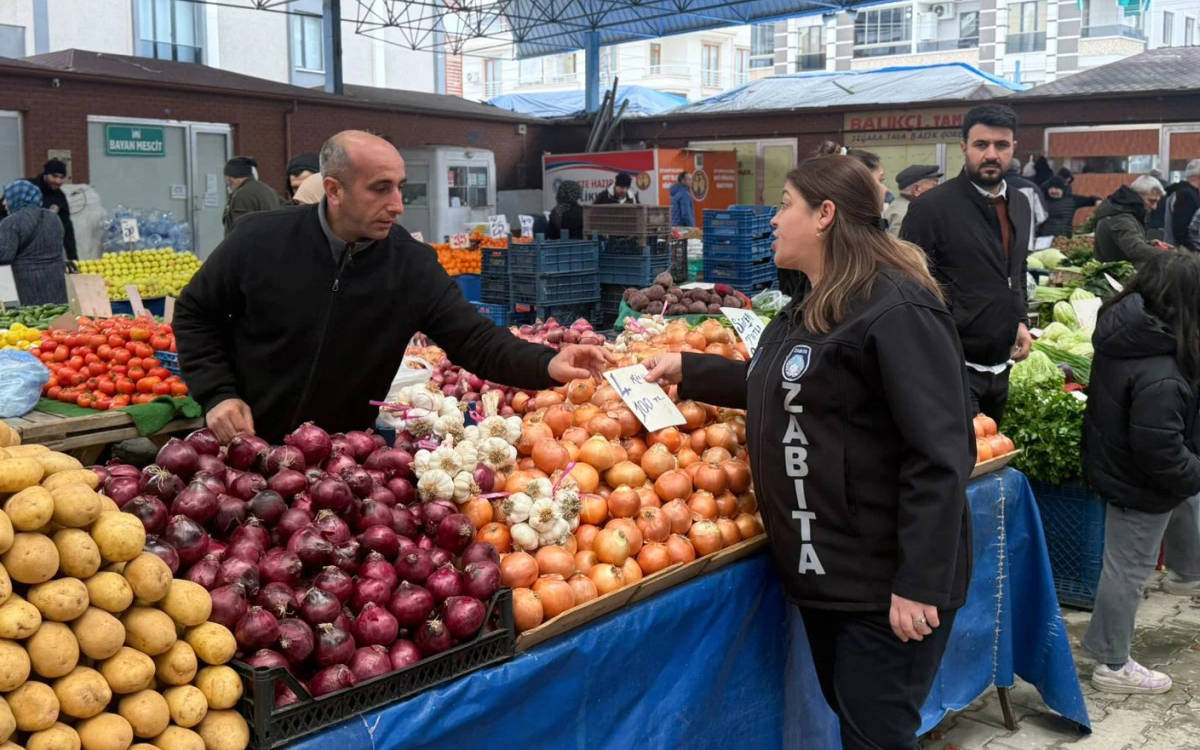
As in previous years, food prices began to rise again ahead of Ramadan. In Jan, TurkStat recorded 6.59% food inflation, compared to just 1.99 percent in Dec.
Poultry producers announced a 15% price hike ahead of Ramadan. In response, the Trade Ministry threatened to impose an export ban unless prices were rolled back—and ultimately followed through. The government’s aim was to redirect supply to the domestic market and lower prices through increased availability. Whether this strategy proves effective will become clearer in the coming months.
The government’s intervention is not limited to chicken exports. The Meat and Milk Board (ESK) fixed the price of ground beef at 485 liras and diced beef at 510 liras in İstanbul and Ankara. Agricultural Credit Cooperatives also set the price of 1 kg of frozen ground beef at 485 liras to stabilize the market. However, this is well below market prices, where ground beef is being sold for 800 to 1,000 liras.
In Turkey, food inflation is not merely seasonal. It reflects structural inefficiencies in the supply chain and high input costs, such as fuel, fertilizer, and animal feed.
Data from 2014 to 2026 shows that state-led price controls do not offer a long-term fix. In fact, prices tend to settle at new, higher levels after Ramadan ends.
The sharp 6.59 percent jump in Jan suggests that 2026 is likely to bring another financially challenging year for households. (HA/VK)