









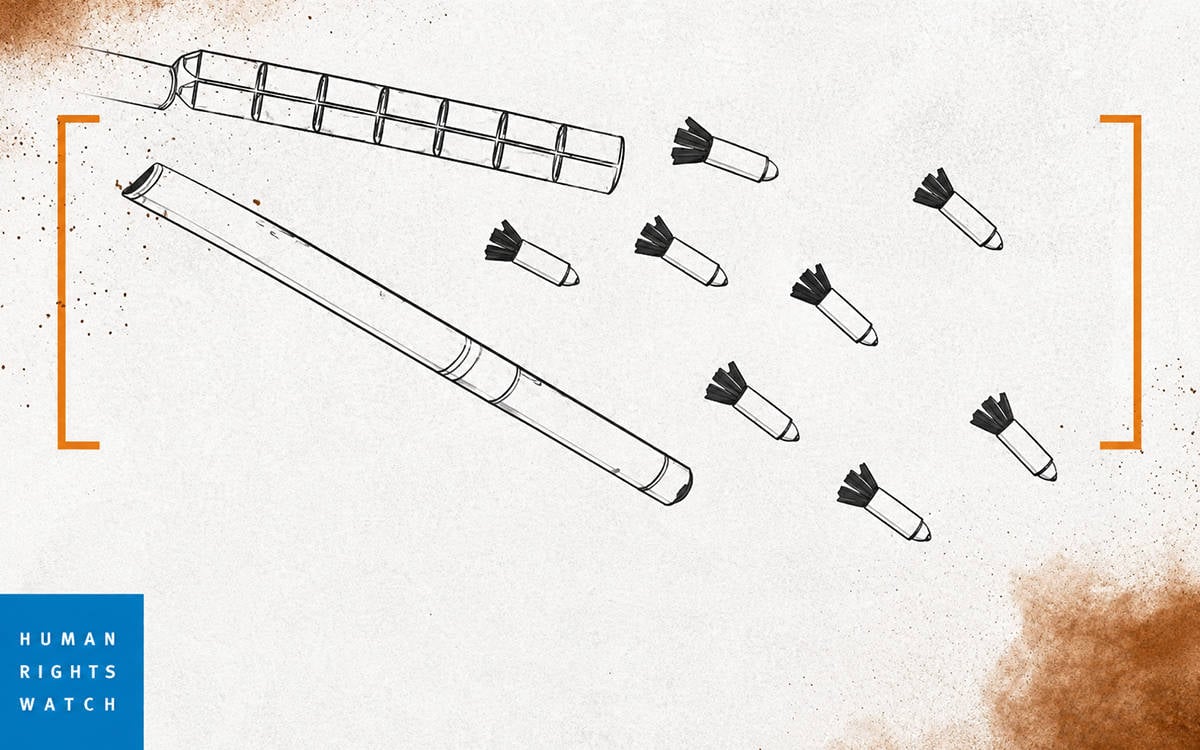



US congressional records and transfer documents show that Turkey wants to transfer 70 M39 ATACMS missiles, alongside rockets and artillery shells containing millions of explosive submunitions, to Ukraine. Turkey had long-standing declarations that it would not use or transfer cluster munitions.
In the face of this revelation, Russia warned that the potential transfer of US-made weapons and ammunition from Turkey's inventory to Ukraine would cause "serious damage" to Moscow's relations with both Ankara and Washington.
Russian Foreign Ministry Spokesperson Maria Zakharova said on Aug 15 that they requested explanations from Washington and Ankara regarding the transfer plan, TASS reported.
Zakharova asserted that the shipment would not significantly alter the course of the war, but would lead to more casualties and destruction.
Congressional records
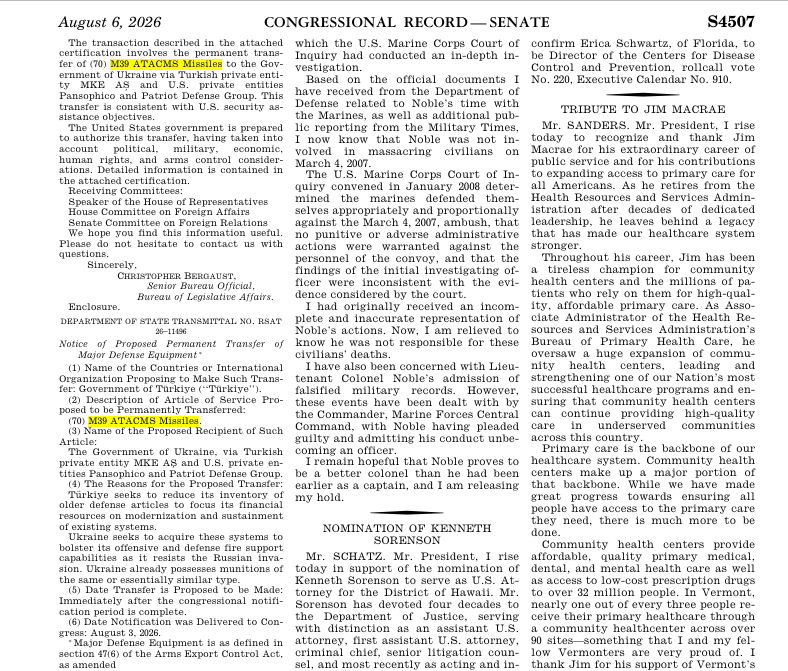
An official notification submitted by the US State Department to Congress on Aug 3 and published in the Congressional Record on Aug 6 states that Turkey proposed to permanently transfer 70 M39 ATACMS missiles to Ukraine. The US administration informed Congress that it is ready to authorize the transfer, taking into account political, military, economic, human rights, and arms control considerations.
The document lists Turkey as the proposing country and Ukraine as the recipient. The transfer is projected to be carried out through Turkey's state-owned weapons and munitions manufacturer Makine ve Kimya Endüstrisi (MKE), along with US-based companies Pansophico and Patriot Defense Group. Turkey's justification is to reduce its inventory of legacy defense materials and direct its financial resources toward the modernization and maintenance of existing systems. Ukraine intends to use these systems to strengthen its offensive and defensive fire support against the Russian invasion.
The document does not mean the transfer has occurred. Congress has the opportunity to review the process and decide against the transfer. HRW also called on Congress on Aug 11 to block the transfer.
What is ATACMS?
ATACMS is a US-made surface-to-surface tactical ballistic missile system. It can be launched from M270 and HIMARS systems.
The M39 model in Turkey's transfer list has a range of approximately 165 kilometers, and each missile disperses 950 M74 explosive submunitions over the target area. For this reason, the M39 is classified as a cluster munition.
The package is not limited to ATACMS
According to an analysis published by HRW on Aug 11, the 256 million US dollar package that Turkey wants to transfer includes 12 M270 multiple launch rocket systems, as well as three types of cluster munitions:
- 70 M39 ATACMS missiles: A total of 66,500 submunitions, with 950 M74 submunitions in each.
- 2,524 M26 rockets: A total of 1,625,456 submunitions, with 644 M77 submunitions in each.
- 47,000 M509A1 203 mm artillery shells: A total of 8,460,000 submunitions, with 180 M42 submunitions in each.
This brings the total number of explosive submunitions carried by the cluster munitions in the package to 10,151,956. HRW points out that the munitions are decades-old legacy systems, and submunitions that fail to explode on the ground could pose a long-term danger to civilians.
What is a cluster bomb?
Cluster munitions are based on the principle of dispersing a large number of small explosive submunitions over a wide area via missiles, rockets, artillery shells, or air-dropped bombs. Some submunitions may fail to explode upon impact, creating a landmine-like hazard years after a war ends.
The 2008 Convention on Cluster Munitions prohibits signatory states from using, producing, stockpiling, and transferring these weapons. Turkey, the US, Russia, and Ukraine are not parties to the convention. Therefore, the prohibition in the convention does not create a direct treaty obligation for these four countries.
Allegations against Turkey
A report published by HRW in Dec 1994 noted that there were allegations in the Turkish media indicating the Turkish Air Force used cluster bombs in some operations against the Kurdistan Workers' Party (PKK) militant group.
The report specifically highlights an air operation in Jan 1994 against the PKK's Zaleh camp in northern Iraq. According to a television news report cited by HRW, F-16 and F-4 fighter jets participated in the operation, and cluster bombs were among the total of 132 bombs dropped. HRW based this information on media reports.
The Landmine and Cluster Munition Monitor, which tracks use and policy developments regarding landmines and cluster munitions, reviews records indicating Turkey may have used cluster munitions in the past, but Turkey states it has not used these munitions since 2005.

Cluster Bomb Ban is in Effect, but Where is Turkey?
What did Turkey say before?
Turkey's Permanent Mission to the UN in Geneva reported at the 2023 meeting of the Convention on Cluster Munitions that Turkey has not used, produced, imported, or transferred cluster munitions since 2005, and has no intention of doing so in the future. Turkey declared the same stance again in Sep 2024.
Since Turkey is not a party to the convention, these statements do not constitute a legal obligation arising from the treaty. However, they reflect the official policy that Ankara has declared to the public and to the states parties to the convention for years.
How does it differ from the 2023 allegations?
The allegation that Turkey sent cluster munitions to Ukraine did not surface for the first time.
Foreign Policy wrote in Jan 2023, based on unnamed current and former US and European officials, that Turkey sent US-designed DPICM-type cluster munitions to Ukraine in late 2022. Turkey denied the allegation. Ukraine's Ambassador to Ankara, Vasyl Bodnar, also said the news was not accurate.
However, the issue continued to be discussed afterward. According to the Cluster Munition Monitor 2024, photographs showing Turkish-made M483A1 cluster munitions in the hands of Ukrainian forces were published in Aug 2023. Import records announced the same year contained data indicating Ukraine acquired Turkish-made ammunition, but the records listed Romtehnica, a trading company under the Romanian Defense Ministry, as the shipper instead of Turkey.
The fundamental difference between the current situation and the 2023 discussion is that the intent to transfer is no longer just the subject of a report based on anonymous sources. Turkey's plan to re-transfer US-origin weapons to Ukraine is now reflected in official US Congress records.
US also sent cluster munitions to Ukraine
According to the Cluster Munition Monitor, the Joe Biden administration announced at least seven cluster munition transfers to Ukraine between July 2023 and October 2024. The US did not share the total amount of munitions sent with the public.
According to HRW, US defense budgets have contained provisions limiting the export of certain cluster munitions since 2009. The Biden administration utilized a legal exception mechanism for the transfers made to Ukraine. HRW notes that it is not publicly known whether the Trump administration made a similar exception decision for the current Turkey-Ukraine transfer. (NÖ/VK)

