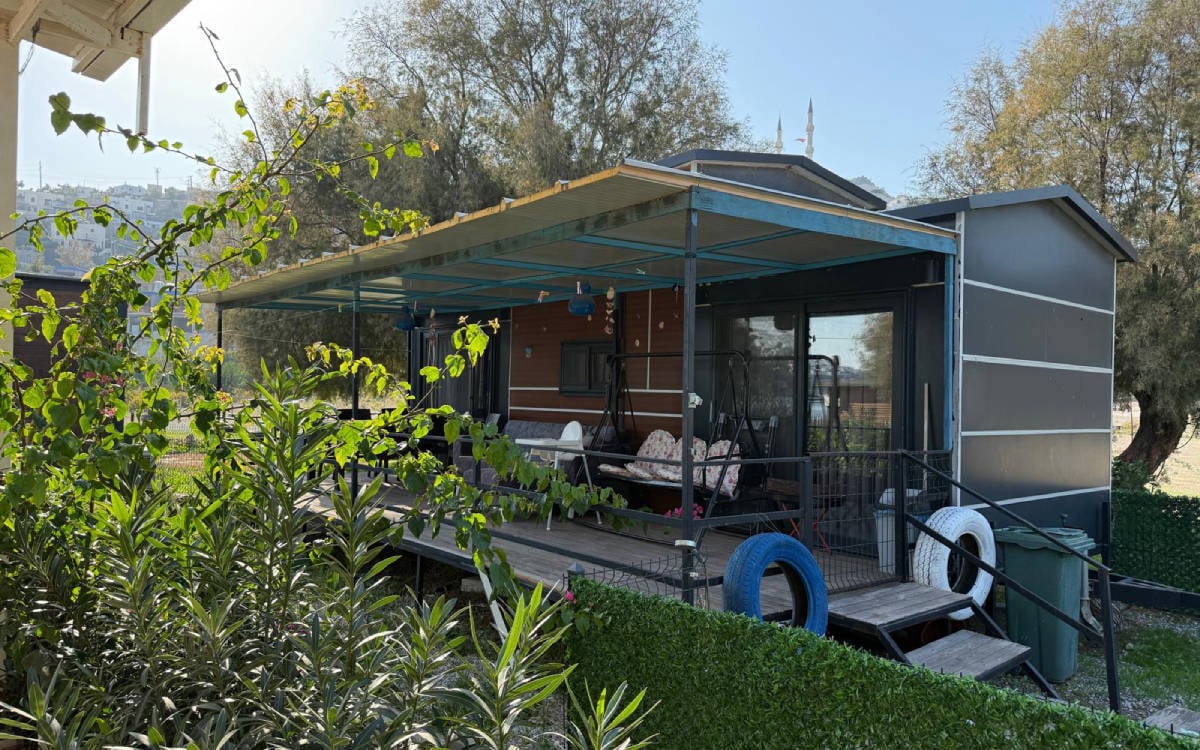








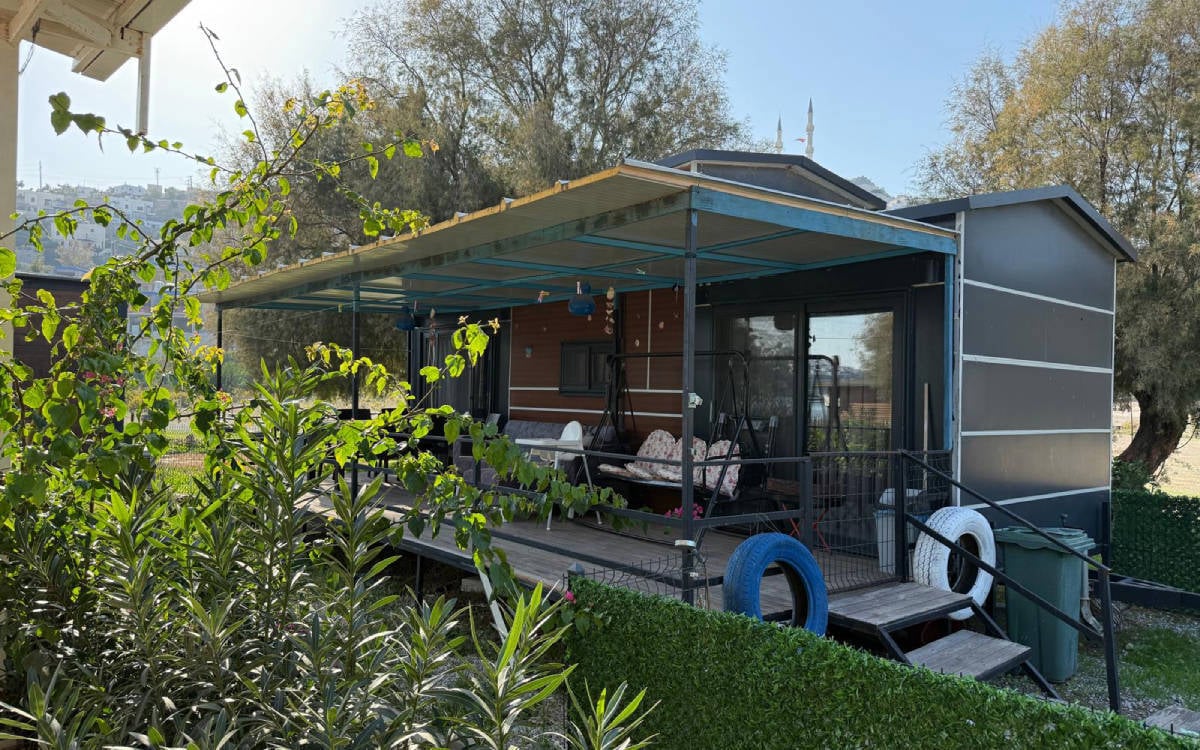



For some, it is the cornerstone of a minimalist life in nature; for others, a modern shanty. Following the pandemic-era desire to flee the city, coupled with the fear of earthquakes and the rapid rise in housing prices, there was a sudden boom in demand for "tiny houses" in Turkey.
Today, businesses selling tiny houses are lined up on the fringes of districts bordering cities or in the outskirts of seaside resorts. These structures, which offer a portable housing solution without licensing requirements, emerged as an alternative way of life and have transformed into a massive market.
Since legal regulations lag behind practice and oversight is weak, these houses are now seen on agricultural land instead of crops. They can even be placed in protected areas where any construction activity is prohibited.
Yet, there is already a significant risk of a food crisis due to the narrowing of agricultural lands. Experts warn that if this trend is not stopped, Turkey is heading toward an agricultural and environmental catastrophe, compounded by the problems brought on by climate change and drought.
The sector is unregistered, data is ambiguous
The tiny house sector is an area that is not officially measured. There is no publicly available data on net sales figures. Manufacturers operating in the sector estimate that approximately 10,000 to 12,000 tiny houses have been produced to date. Some analyses indicate that over 300 units are sold monthly, with demand increasing by about 80 percent in the last two years.
Different companies report having a production capacity ranging from a few hundred to a few thousand units per year. However, because this growth is coupled with unregistered production and unauthorized settlements on agricultural lands, measuring the true volume of the sector is nearly impossible today.
One of the manufacturing companies is MODSİS Modular Building Systems. The company exports to both Europe and the Middle East, primarily producing for tourism businesses rather than individual customers. The firm’s tiny house prices range between 30,000 and 100,000 euros. Prices vary based on customer demands, the number of rooms, and the size.
Erhan Bilal, Co-Chair of the company, argues that for the sector to grow, tiny house areas should be included in urban and regional planning:
“We are planning alternative living spaces to conventional housing. Removing the requirement for caravan infrastructure in regulations and perhaps defining them only as modular or removable modular structures would make tiny houses more economical and accessible. This would also meet people's needs for living and shelter.
In the event of a possible earthquake, at least an escape point could be created. This could also pave the way for people to remain in their current locations during urban renewal projects. Therefore, the sector needs to be supported.”
Vehicle or structure?
So, how are tiny houses defined in regulations? Attorney Cansel Koç says that tiny houses are divided into two categories: wheeled and non-wheeled.
Non-wheeled ones are subject to the Zoning Law. However, a zoning permit is not obtained for the structure itself; it is only built on a zoned plot of land.
The situation is different for wheeled tiny houses. These are classified as vehicles, but since they do not have motors, they are considered trailers. These structures are subject to the Highway Traffic Law and are exempt from the motor vehicle tax. They are also exempt from property tax because they are not considered immovable property. All these exemptions make wheeled tiny houses more appealing.
Critical weight: 3,500 kg
Attorney Uğur Cebeci also points out that tiny houses receive a class certificate based on their weight:
“If the weight is 3,500 kilograms or less, it goes on the road as an ‘O2 class trailer,’ has a license plate, and undergoes inspection every year. These types of tiny houses are considered vehicles, meaning caravans, are registered as vehicles, and you can tow them behind your car with a BE class driver’s license.”
However, if a tiny house’s weight exceeds 3,500 kilograms, it becomes an O3 class, or heavy trailer. In this case, registration as a caravan becomes mandatory. A C or CE class driver’s license is required. Municipalities, however, typically regard it as a ‘structure’ rather than a ‘portable dwelling.’ For this reason, manufacturers generally use light materials to avoid exceeding the 3,500-kilogram limit.
If a tiny house is mounted on a concrete foundation or a fixed platform, and has permanent electrical, water, and sewage connections, it gains ‘structure’ status. Attorney Cebeci warns, “In accordance with Zoning Law No. 3194, these must have construction permits; otherwise, they are considered an ‘unlicensed structure,’ and one may face sanctions such as demolition and fines.”
Olive groves for sale under the name ‘hobby garden’
Although there are some regulations, it is very easy to place these structures on agricultural lands due to the gray area created by loopholes in the law.
A quick search on sahibinden.com shows that numerous agricultural lands are up for sale, for instance, in the Çamovalı neighborhood of Muğla’s Milas district.
One 685-square-meter agricultural land is advertised as ‘zoned,’ with a price tag of 1 million liras. The description includes phrases such as, “12 kilometers from Milas and the airport. Next to a stream and forest for those dreaming of a real village life, intertwined with nature. Ecological farm. Sustainable living for four seasons.”
Another area of 2,999 square meters in the same neighborhood is being sold for 2 million 600 thousand liras. The zoning status of the land is specified as ‘field,’ and it is stated that it can be used as a hobby garden, tiny house lot, or for a prefabricated structure.
Another listing advertises an olive grove for sale in Milas’s Hisarcık neighborhood. Legally, not even a nail should be hammered into an olive grove, but the listing states that it can be used as a hobby garden. The price of the 2,639-square-meter land is 1 million 50 thousand liras.
Real estate expert warns buyers
Real estate expert Sevil Ece Gümüş Kapar warns those who want to buy agricultural land to place a tiny house.
Kapar, who is the President of the Turkish Entrepreneur Real Estate Consultants Association (TÜGEM), says, “Not every advertisement is entirely accurate. Therefore, buyers must definitely go and ask the municipality. In some places, they need to get permission from the agriculture directorate. To place a tiny house somewhere, electricity, water, and road access are essential. In large areas like olive groves and citrus orchards, the agriculture directorate grants the right for storage. This right is being used for tiny houses,” she states.
It is not legally possible to place a tiny house in an olive grove. However, if it has wheels, the situation changes. This is why some people place symbolic wheels on them.
Farmland prices soar in Bodrum and Milas
In October, there was a remarkable 80 percent increase in farmland prices in Köyceğiz, Yatağan, and Kavaklıdere. Real estate agents attribute this sharp rise to the tiny house surge.
The villages of Bodrum and Milas are also highly preferred locations. This is because while one cannot find a house in Bodrum for 3.5 million liras, they can purchase a property classified as a field and place a tiny house on it for 500,000–600,000 liras.
Mehmet Melengeç, Head of the Bodrum Chamber of Agriculture, points out that the insufficient state support for agriculture and villagers has paved the way for this type of construction.
He asks, “Bodrum is a tourism region. Everyone is moving away from agriculture and hoping for zoning. But while construction rent-seeking pushes agriculture to the background, landowners also start expecting zoning. How can life continue if everywhere is construction and zoning?”
Stating that farming does not generate income, which leads villagers to sell their land for double the price, Melengeç notes that agricultural areas are shrinking, which poses a threat to accessing safe food.
Thrace is also at risk
Not only the Aegean and Mediterranean regions, but also the agricultural lands of Thrace are at risk. The Thrace region is particularly high-yielding in terms of wheat and sunflower production. Tiny houses, however, pose a threat to this productivity. In fact, a disaster in terms of food security is imminent.
İbrahim Toruk, Head of the Thrace Seed Growers Association and an Agricultural Engineer, drew attention to the increase in tiny houses and provided the following information:
“There is tremendous construction, especially in the foothills of the Yıldız Mountains, in Kırklareli, Saray, a certain part of Lüleburgaz, the Enez and Meriç regions of Edirne province, and Tekirdağ and its surrounding districts. They offer four times the money you would pay to buy a dekar [a unit of land area, $1,000$ square meters] of farmland for one dönüm [another name for a dekar] of land. The villager sells their land. Then, a hut or tiny house is placed on these properties.
Let's assume we plant wheat on one dekar of land; while we could harvest 500 kilograms of yield from it, if it's not cultivated and turned into a hobby garden, it creates a problem in overall production. When there are 10,000 of them, we are talking about 10,000 dekars of land. This can lead to undesirable consequences for the future, for production, and for sustainability.
Local governments and the public sector do not want to demolish these, but we will suffer the consequences later. Ten years ago, we were first in the world for eight products; now we have dropped to three products. Especially during the pandemic, we saw that when distribution routes are closed, you cannot access imported food. The only thing that cannot be multiplied in the world is land. If you fill these areas with such structures instead of production, your output will decrease. This will bring about the problem of accessing safe food.”
4,000 bungalows for a population of 44,000
Another location hit by the tiny house craze is the Sapanca district of Sakarya. In the district with a population of 44,000, there are more than 4,000 tiny houses or bungalows. According to research by Cemre Demircioğlu from the non-profit, independent The Black Sea project, the reduction of the protection status of two separate areas on the shore of Lake Sapanca increased the number of these structures.
In Jul 2023 and Jan 2025, the status of a large part of the lakeshore was converted to ‘Qualified Natural Protection Area,’ then this status was reduced once more and downgraded to ‘Sustainable Protection and Controlled Use Areas.’ This meant these areas became third-degree protected sites. This led to a construction frenzy on lands that were supposed to be protected.
Are they truly environment-friendly?
Tiny houses are generally designed as ‘off-grid,’ self-sufficient systems not connected to the main utility grid. Energy is mostly provided by solar panels. Water needs can be met through methods such as filling tanks with transported water, rainwater harvesting, or digging wells. For this reason, they are marketed and sought after under the concept of being ‘environment-friendly.’
Zeynep Gül Karamanlı, Head of the İstanbul Chamber of Environmental Engineers, does not fully agree with the classification of tiny houses as environment-friendly.
“To determine whether a tiny house is truly compatible with nature, one must evaluate many factors together, such as the area where it is established, the density, how it provides its water and energy, and how it plans and operates its wastewater treatment. When these elements are ignored, talking about an ‘eco-friendly’ model can be misleading.”
Karamanlı states that permission must be obtained for using well water and, if necessary, an appropriate treatment system must be installed. “On the wastewater side, options like leak-proof septic tanks, composting toilets, or biological treatment are available. The most critical point here is that the systems comply with technical standards. Otherwise, the mixing of wastewater with the soil or groundwater creates serious risks for both public health and the environment. Individual examples may seem eco-friendly, but as the numbers increase, control, oversight, and infrastructure management become difficult,” she says.
Became an investment tool
The demand for tiny houses has also stimulated the tourism sector. Small investors purchase a few tiny houses and generate income through rentals. Tiny house villages or camping areas are being established. Evren Ataç is one such person.
Ataç, who is in the boat rental business, researched the tiny house market after encountering an attractive land sale and entered this sector as well. Ataç, who owns two tiny houses in Datça, says, “When we say let’s be in nature, let’s have the comfort of a home, but also be practical, a tiny house offers a solution for this. The only thing we can place on unzoned areas is a tiny house. That is why I entered this business. Which customer you want is important; you design it accordingly. I am aiming for the A-plus segment. Therefore, I chose my product accordingly.”
Those who stay are satisfied, but not suitable for large families
Those who have experienced staying in a tiny house facility say that they are not suitable for family accommodations.
Ferdi Özdemir said, “The reason I prefer tiny houses is that they are trailers. You can tow them wherever you want. It has a double bed on the top floor. It has a kitchen and a shower. It is ideal for those staying daily or weekly. But it is not suitable for a large family.”
Harun Kılıç also pointed out the difficulties of staying with children, despite the economic suitability of tiny houses:
“It is a small space, and there are problems with noise. Some families rent for a month, but they leave earlier when they see the difficulties of staying with a crowd. It is more appealing for single people or couples.”
(DB/HA/VK)