


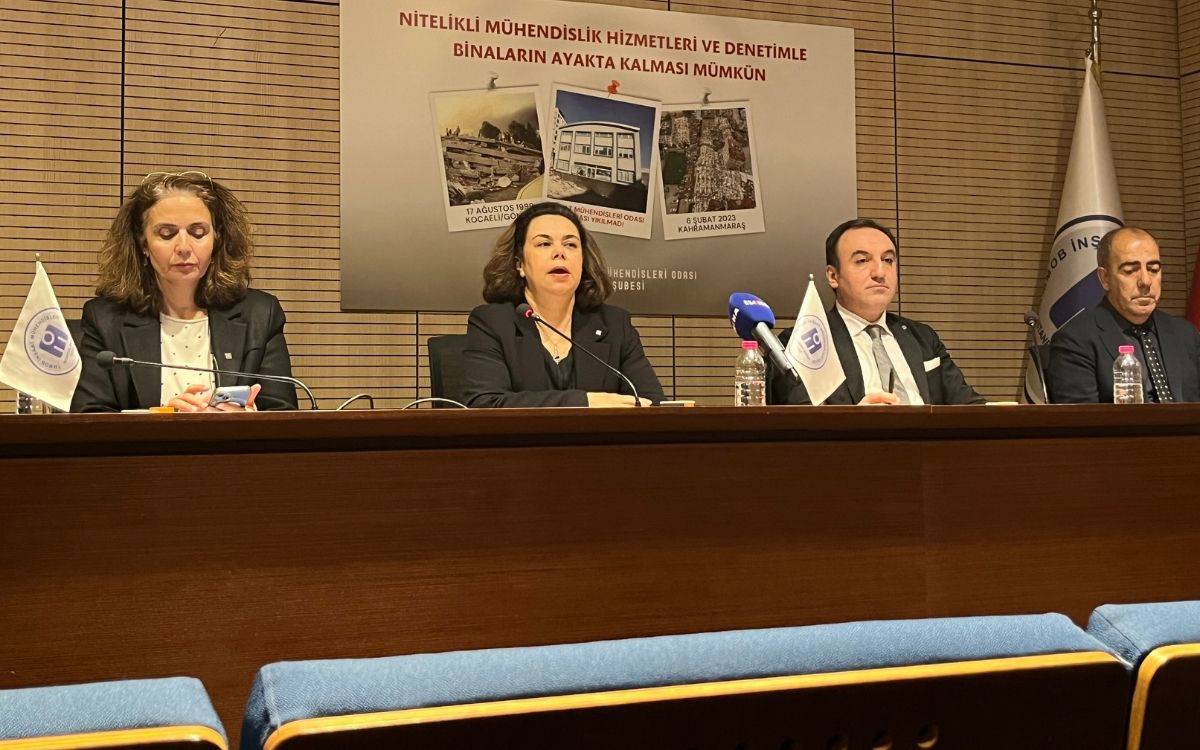



Three years after the deadly earthquakes of Feb 6, 2023, the İstanbul branch of the Union of Chambers of Turkish Engineers and Architects (TMMOB) Chamber of Civil Engineers has warned that Turkey remains dangerously unprepared for future seismic disasters.
Speaking at a press conference at the chamber's office in Karaköy, branch chair Sinem Kolgu said that despite long-standing awareness of earthquake risks, authorities have failed to take adequate measures.
Kolgu emphasized that a significant portion of the country's building stock remains vulnerable to collapse in the event of a strong earthquake.
She recalled that the twin earthquakes in 2023 killed tens of thousands of people, destroyed nearly 40,000 buildings across 11 provinces, and left more than 200,000 structures severely damaged.
She underlined that earthquakes should not be seen as unforeseeable natural disasters, but rather as predictable events whose devastating impact can be mitigated through proper planning and policy.
“The destruction wasn’t caused by the magnitude of the quake alone,” she said, “but by poor construction practices, lack of oversight, and ineffective risk mitigation policies.”
Moderate quakes still causing severe damage
Kolgu also drew attention to recent moderate earthquakes that have caused disproportionate levels of destruction.
She pointed to two earthquakes measuring 6.0 and 6.1 in Balıkesir’s Sındırgı district in 2024, which left 729 buildings and 1,036 individual units either heavily damaged or collapsed.
Another 6.2-magnitude earthquake off the coast of Silivri the same year sparked widespread concern in İstanbul and the Marmara region. Kolgu said the incident once again exposed the shortcomings in the city’s emergency response systems, including communication infrastructure, assembly areas, and emergency access routes.
Construction amnesties have increased risk
Kolgu criticized the widespread legalization of unlicensed and unsafe buildings through a series of construction amnesties issued over the past 25 years.
She noted that a large share of Turkey’s existing buildings were constructed before 2000, without modern engineering standards.
Citing findings from the parliament’s Earthquake Research Commission, she said between six and seven million homes urgently need to be rebuilt across the country.
According to the Environment, Urbanization and Climate Change Ministry, around 600,000 housing units in İstanbul alone are classified as highly risky.
Despite these alarming figures, Kolgu pointed out that Turkey still lacks a comprehensive and transparent nationwide inventory of its building stock. “Without knowing the risks and establishing priorities, an effective transformation is impossible."
Urban renewal policies
Kolgu also criticized Turkey’s urban transformation efforts, arguing they have been driven more by profit than public safety.
For over a decade, she said, renewal projects have focused on plot-based redevelopment in high-value areas rather than comprehensive, risk-reducing planning.
She stressed that real transformation requires integrated strategies that take into account ground conditions, population density, transportation networks, and designated emergency assembly areas. In lower-income neighborhoods, she added, renewal has either stalled or failed to begin at all.
Insufficient assembly areas
The chamber also flagged serious shortcomings in disaster preparedness, particularly in urban assembly areas.
Kolgu said many cities lack adequate designated spaces, and some existing areas have been repurposed for construction due to zoning changes.
“Assembly points aren’t just empty lots,” she said. “They should include temporary shelters and infrastructure for water, electricity, and basic necessities.”
Post-quake housing
Turning to the regions affected by the 2023 earthquakes, Kolgu said fundamental issues related to housing, healthcare, education, and infrastructure remain unresolved even after three years. She criticized authorities for focusing reconstruction efforts solely on building new homes, without addressing broader recovery needs.
While the government pledged to deliver 319,000 homes within the first year and 650,000 in total, Kolgu noted that only 455,000 individual units have been handed over by the third anniversary of the disaster.
“Disasters are not fate,” Kolgu concluded. “They are the result of policies that ignore science, engineering, and public responsibility. We owe it to those we lost on Feb 6 to act now, so such pain is never repeated.” (EMK/VK)