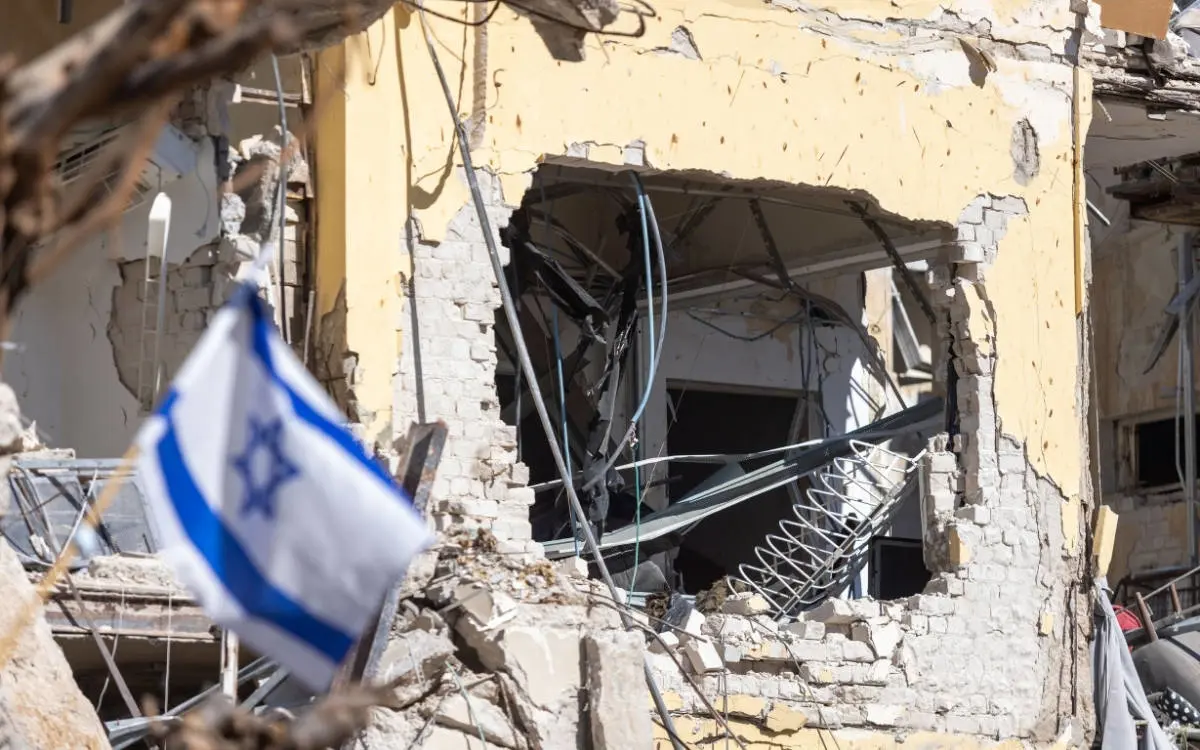






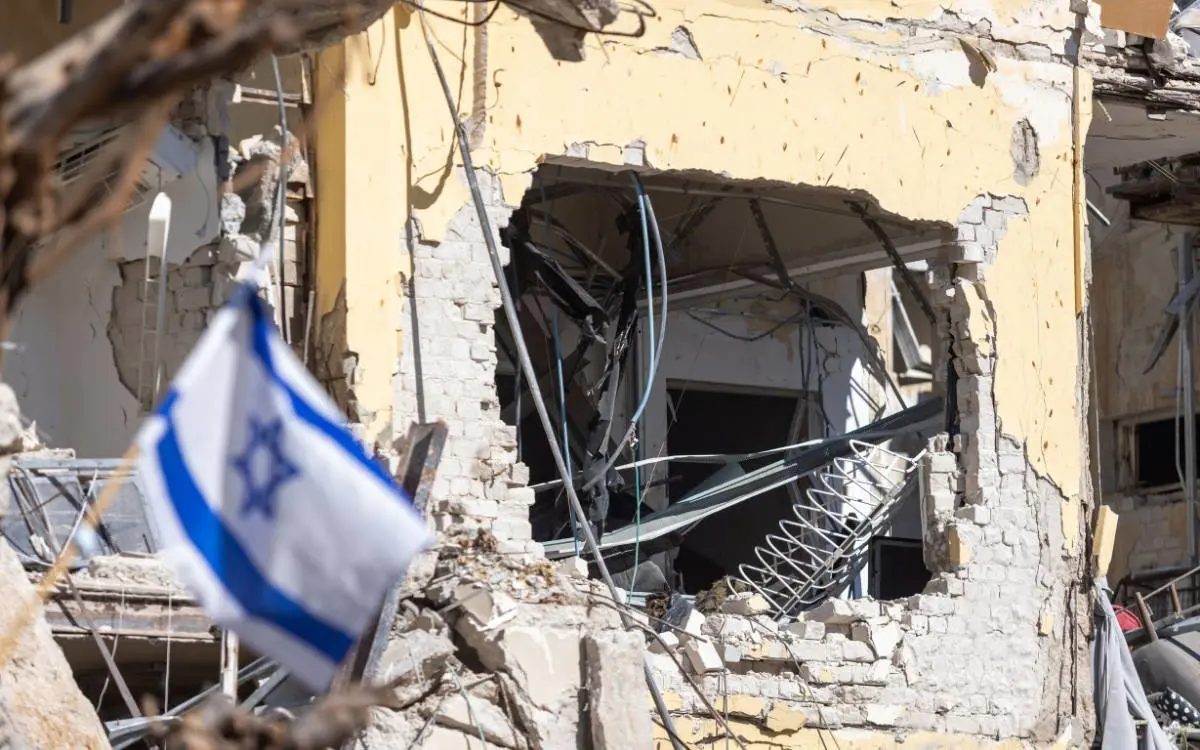



On the night of June 13, at 03:10, Israeli Defense Minister Israel Katz announced that Israel had launched a preemptive strike against Iran and declared a state of emergency in the country. The attacks targeted Iran's nuclear facilities as well as its top military commanders and nuclear scientists.
While Iran remained largely silent in the initial hours of the attack, it later retaliated with missiles, triggering reciprocal strikes that continued for 12 days. A ceasefire was declared by US President Donald Trump on Jun 25.
In our previous interview for bianet on Jun 11, 2025, Dr. Sayid R. Darati described the Middle East as a “fire zone” and connected the current political quest of the Republic of Turkey with PKK leader Abdullah Öcalan to this fire.
Before the week of the interview was over, the fire spread to Iran.
In this conversation, held on Jun 20, we continued to explore Dr. Sayid R. Darati’s prophecy and the so-called “Middle East Fire.”
“Third World War” comments
Some commentators consider the Jun 13 attack to be the beginning of the Third World War. In your opinion, is this a continuation of an ongoing chain of wars or a limited intervention? Also, how do you evaluate Israel’s attack on Iran in the context of the US’s regime change strategy pursued since the 2000s?
I believe the attack on Iran is part of a long-planned strategy and will not be the last. However, a “regime change plan” as you described, when compared to the developments of the last 25 years, would be considered limited. Although the program implemented focuses on control of energy resources, Israel’s security, and maintaining American hegemony, it seems to be a comprehensive program that not only involves regime changes but also changes in maps and regional actors. However, evaluating the matter solely from the US perspective prevents us from seeing the role of the UK, which is decisive in today’s Middle East situation. The global leadership policy led by the US today is a continuation of British imperial logic.
How would you describe this process?
Between 1916 and 1948, the UK determined the main outlines of today’s Middle East. This includes the Sykes-Picot map in 1916, the decision to establish the state of Israel with the Balfour Declaration in 1917, the drawing of Turkey’s southern borders and the permanent partition of Kurdistan through agreements in 1921 and 1924, and finally, the UK’s leading role in the establishment of Israel in 1948.
The “patronage” of this system established by the UK, after World War II, was carried out by the US, but not with the subtle political methods the UK used — rather, with a cruder power-based approach. Of course, even though world leadership passed to the US, the UK remains a decisive power in the Middle East. Israel’s security was and still is a priority for both powers. In fact, one reason for the establishment of the Arab monarchies was to prevent the formation of unions that might threaten Israel’s security.
The war’s impact on Turkey and Öcalan’s warning
But no international system goes exactly as planned or predicted, right?
Of course not. Local actors, imperial competitions, revolutions, resistances, etc., cause unexpected changes in such plans. For example, the emergence of forces like the Iranian Islamic Revolution, the PKK, and Hezbollah in Lebanon as regional powers are some of these. These are “problems to be solved” from the perspective of the international system. The attack on Iran is part of this policy. The fact that the theocratic regime in Iran is despotic or that people are suppressed by force means nothing to the US and its allies.
There are those who say, “After Iran, it’s Turkey’s turn.” Considering the likelihood of the conflict chain in the Middle East expanding after the attack on Iran, to what extent has Turkey’s role and vulnerability in this equation increased? How can Ankara’s geopolitical position and its international alliance relations be evaluated in this process?
This sequence belongs to Öcalan: In November 2002, after a long period of resistance, Saddam Hussein accepted UN Security Council Resolution 1441, which proposed solutions, and allowed the Chemical Weapons Inspection Commission to check whether there were chemical weapons on Iraqi soil. This was both a serious concession for Saddam and an important move to ease the international pressure on him. Right after this decision, the commission started working in Iraq, and the region, which was living with the fear of war, breathed a sigh of relief. Around those days, Öcalan told the lawyers visiting him: “You now think Saddam escaped by accepting the UN resolution, right? Saddam will be overthrown. Then it will be Syria’s turn, and after that, Iran’s turn. If Turkey continues with its usual mindset, Turkey will be next in line.”
This possibility, which has long been discussed both in the public sphere and certain analytical circles but apparently has not been treated as a strategic priority by Turkey, can it be said to be increasingly materializing under current conditions?
Back then, this prophecy, which was not much focused on and apparently not taken very seriously by Turkey either, has started to come true. One year later, Saddam was overthrown and Iraq transformed into a federal state. After a long civil war, Syria was effectively divided into three parts. Today, the third leg of the prophecy is unfolding. That is why even those who until recently sneered at Öcalan and his observations have begun to say, “Turkey is next.” However, these issues do not progress on such a simple and straight line. There are many factors that can affect the outcome. One of these factors is the new İmralı Process that Turkey initiated six months ago and whose outcome is still uncertain. The situation will take its final form depending on how these negotiations proceed.
Moreover, Iran is neither Iraq nor Syria. Its internal dynamics, state and societal structure, etc., are different. We should not be hasty in saying “Turkey is next.” Iran may fall quickly, may endure for months or years, or Israel might eventually admit that regime change in Iran has exceeded its scope and withdraw.
There is also the Kurds as a balancing factor. I think this is exactly what Öcalan meant when he made the Iraq-Syria-Iran-Turkey sequence. He referred to the fact that even if relatively small, in a zone where established powers clash, it is decisive with whom the Kurds align themselves — and this turned out to be true. For example, if the Kurds had sided with Saddam, would he have been overthrown so easily? Or if Assad had abandoned Arab chauvinism and made an agreement with the Kurds, would he be living in Moscow today? The same applies to Iran and Turkey. In this historical moment when the Middle East is boiling, those who confront the Kurds lose, and those who win them over prevail. Even the US, despite its immense power, encountered this reality in Syria.
Despite Israel’s advanced military technology, considering Iran’s regional depth, asymmetric capabilities, and strategic defensive reflexes, do you agree with the assessment that this intervention will have limited results?
Military or financial superiority is certainly a great advantage but does not determine everything. If it did, the US would not have been defeated in Vietnam, stuck in the mud in Iraq, forced to cooperate with the YPG in Syria, and unable to come to terms with the Taliban in Afghanistan after 20 years. If a state’s military, political, and economic goals exceed its scale, the outcome may be failure. Taking historical examples, we can consider Portugal. Portugal was the world’s first overseas colonial power and during the 16th-17th centuries had colonized almost all major seacoasts known to the world. This geographic spread extended west to all Latin America, east to Indonesia, south to all African coasts, and north to Scandinavia and Britain. However, Portugal’s total population was about 1.5 million, which was not enough even to settle the populations of their colonies. As a result, this overextension in colonial policy led to the Portuguese Kingdom withdrawing from all its colonies one by one.
Are you implying that Israel could face a similar fate?
Israel may also face a similar end. Including about 2 million Palestinian Israeli citizens, Israel’s total population is around 10 million. Its geographical size, including occupied Palestinian territories, is not even a tenth of Iran’s. Israel may have advanced military technology, but Iran is not sitting idle either. Therefore, it is unrealistic to say that “Turkey is next” immediately. Another very important factor is Turkey’s NATO membership. This is not just about the Incirlik and Kurecik bases visible from inside the country. NATO is a military-political concept, and without a serious change in this concept, it is difficult for Turkey to be next in line.
However, in our first interview, you mentioned that the Republic of Turkey, as we know it, has ended. In that case, can NATO protection still be considered valid?
Yes, it is valid. Regime changes in Turkey do not matter to NATO. Whether Demirel or Erdoğan is at the helm, whether the regime is an average republic or oligarchic, these are “technical” matters for them. From the perspective of the dominant global system, Turkey has a recognized role within NATO, and unless this hegemonic system or NATO concept changes, Turkey remains under NATO protection. The question is whether the current world system, and consequently the NATO concept, will change — for that, one needs to look at Wallerstein’s World-Systems Analysis. From that perspective, despite Turkey’s NATO membership, there is considerable reason to be concerned, because global changes and trends indicate that the NATO concept may also change soon.
The memory of the US-YPG partnership
Isn't this a contradiction? Turkey is a NATO member and thus an ally of the US; however, the same US supports the SDF (Syrian Democratic Forces), which Turkey views as a threat in Syria. So, what is the US's priority in the region? Whom does it see as friend, whom as enemy?
To answer this question, it might be helpful to turn to lessons from collective memory, since collective memory also involves collective forgetting. Looking at what is written and said in the media today, it seems as if the US came to support the Kurds in Syria against Turkey right from the start of the Syrian civil war, and that the YPG grew strong in this way. This narrative causes people to almost uncritically accept it as the sole truth and leads to collective forgetting of the past.
So, let’s go back a bit: How did the US-YPG partnership start? How should we interpret this process, and what would you like to tell us from there?
The Syrian civil war began in 2011 in Deraa and quickly spread to other regions. During this time, the Kurds established their own people’s committees in the north. When the war spread, in July 2012, the Assad regime withdrew from the north, and the People’s Defense Committees (YPG) were established there. However, this de facto Kurdish-controlled area soon came under attack by groups like Al-Nusra, Ahrar al-Sham, and other jihadist factions, and these attacks continued throughout 2013-2014.
In 2014, ISIS attacks began. Until September 2014, the YPG resisted almost alone and with only individual weapons, heavy-weapon-armed forces against ISIS. It was during this period that the YPG began to be talked about as the only force resisting ISIS, which everyone else feared. However, it was still uncertain how long they could withstand the intense ISIS pressure. This became clearer during the Siege of Kobani. YPG forces resisted ISIS despite a serious imbalance in weaponry and heavy losses, in an environment where Iraqi, Syrian, and Peshmerga forces almost retreated without resistance. This created a sense of “moral obligation” in the international public, and everyone, including the UN, started to say that help should be given to the Kurds. After all this, the US made its first direct weapons aid to the YPG on October 19, 2014, and the partnership on the ground, known to us, has continued—with many ups and downs—until today. Among these ups and downs are incidents such as the US and Russia “gifting” areas under Kurdish control like Serêkaniyê and Afrin to Turkey, and the Kurds trying to benefit from the Russia-US balance of power on the ground for a long time.
'There is no straightforward story of the US helping the Kurds'
Therefore, from today’s perspective, there is no simple story like “The US helped the Kurds.” Of course, without US aid, the Kurds probably would not have reached today’s position; but if the Kurds did not have an organized armed force, the US would not have supported them either. Remember, even after the Kobani battle, the US was still trying to create an alternative armed force to the YPG under the train-and-equip program with Turkey. Because the US-Turkey partnership is a 70-year NATO alliance, and Turkey’s sensitivities are a priority for the US On the other hand, the US is nobody’s friend. It has long-term partners like Israel and Turkey, short-term and limited partnerships like the Kurds; but ultimately, its own interests prevail.
In short, if the Kurds had no power, neither the US nor anyone else would support them. No one gives support out of mercy or friendship on the international stage. If you have power and your politics do not conflict with the politics of international powers, you may receive support. Otherwise, no one will shed a tear for you. The same applies to the current war between Iran and Israel. Neither Iran nor Israel is a friend of the Kurds. Therefore, the Kurds have no moral or political obligation to support either side. Those who engage in politics based on states’ “friendship promises” will only be disappointed.
A Middle Easternizing world
The PKK and Abdullah Öcalan sometimes state, “New developments are happening in the Middle East, and the Kurds will be at the center of these developments.” At the same time, despite speculation that the US and Israel have plans for Kurdistan, they emphasize, “We want to solve this issue with Turkey.” How do you assess this position? Is the Kurdish movement seeking a regional ally through these statements, or aiming for a strategic reconciliation with Turkey?
I prefer to approach the issue not only in light of current developments but also with historical depth. In another interview, I said today’s Turkish-Kurdish relations strongly resemble the period between 1918 and 1923. Back then, the Turks were able to replace the Ottoman Empire with the Republic of Turkey with Kurdish support. Öcalan today shows the danger approaching Turkey and says that the only way to get through the coming storm safely is through an alliance with the Kurds, and that they are ready for this. Practically, this means Turkey being “shown death and accepting dysentery,” while ideologically it aligns with Öcalan and the PKK’s stance—the Third Way. Öcalan’s message to Turkey should be understood in this context: The Kurds—one way or another—will be at the center of developments in the Middle East. How this will happen is up to your own choices, he says. Of course, this is a two-way policy. If Turkey chooses to continue its old policies, the Kurds will not make the mistakes they made in the 1920s.
As I emphasized in the other interview, from Turkey’s perspective, the Republic of Turkey as we know it ended in 2016, and in 2023 its “extensions,” the neo-Ittihadi regime, also collapsed. What is uncertain is what will be established in its place. Öcalan proposes a new state, and there seem to be pragmatic approvers of this within the state. If this process is successful, the name and the form of the new state will probably change in a few years. If it fails, the scenario of the collapse of the Great Seljuk State that I mentioned earlier will apply. Personally, I don’t think Turkey can stretch to the extent Öcalan wants it to. But if it does not know how to stretch under possible conditions, it may break. I think Öcalan and the PKK are pushing this possibility. Accordingly, Turkey will either stretch or break. In both cases, a breathing space for the Kurds will emerge. This is what is expected.
Which actors do you think will shape hegemonic restructuring in the Middle East?
This is a complex equation with many unknowns. Continuing with Wallerstein’s analysis, we are talking about a time period starting in 1991 that will determine the fate of the current world-system and likely last another 10-15 years. Therefore, it is difficult to foresee which actors will shape the hegemonic restructuring in the Middle East. The whole setup seems built around Israel; yet, this is the Middle East, and there are no guarantees. We will wait and see.
Developments in Turkey’s domestic politics and the recent political and legal status of the Kurdish issue in Turkey should be considered as linked to the major changes in the Middle East but not exactly synchronous in time. I think there will be serious changes in Turkey’s domestic politics soon—probably in the fall. As I mentioned in the first interview, although for different reasons, the current İmralı Process is an Erdoğan-post plan both for Öcalan and Bahçeli, and the changes I expect in the coming months are related to this.
Finally, the expression “Middle Easternizing” used to refer to the lawlessness and unpredictability specific to the Middle East. But in the last 20 years, the whole world has Middle Easternized, and for almost 20 years, we have been living in a global Middle East. Therefore, predicting exactly what will happen is quite difficult.
About Sayid R. Darati
Born in 1973 in Diyarbakır. After graduating from Dicle University, he completed his master’s degree at Boğaziçi University and his doctorate at Göttingen University. He continues his work on oral culture, collective memory, and history as an independent researcher.
(EJA/VK)